244 Waverly Place
West Village | built 1900
Open on the map5 entries

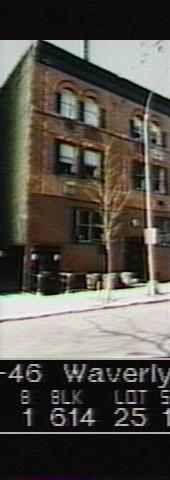
The city photographed every building for its tax records around 1940 and again in the 1980s. NYC Municipal Archives.
Written with AI from the source each entry cites, then fact-checked.
- 1886
William B. Tuthill designs the twin houses at 244 and 246 Waverly Place for Hester A. Gregory
Hester A. Gregory commissioned the architect William B. Tuthill to design 244 and 246 Waverly Place in 1886 as a pair of three-story houses behind one shared facade. Rough-hewn stone lintels, terra cotta panels between the second and third floors and radial brick arches at the top windows give the front its character. Twentieth-century alterations in 1926 and 1931 added a separate side entrance for each house, and the doorway of 244 sits slightly below grade.
“They were built for Hester A. Gregory and were designed in Romanesque Revival style by architect William B. Tuthill in 1886.”
- 1893
Steam-trap inventor Timothy Kieley buys the twin houses at 244 and 246 Waverly Place
On March 8, 1893, the estate of the late Hester Gregory sold off twenty properties, and the twin houses at 244 and 246 Waverly Place went to Timothy J. Kieley and his wife Annie. They paid $25,900, lived in 246 and rented the other. Born in County Cork, Kieley had risen from stoker to ship's engineer, then invented a return steam trap in 1878 and founded Kiely & Mueller in 1880 to make it.
Source: Daytonian in Manhattan
- 1918
Educated tenants rent 244 Waverly Place from the Kieley family
After the Kieleys bought the houses, 244 was let to well-educated tenants, many of them single women. Among them was Bertha B. Corney, who co-founded the printing and stationery firm Needleman & Sweetwood in 1909. From 1918 through 1921 the tenant was A. I. du P. Coleman, a faculty member at City College.
Source: Daytonian in Manhattan
- 1938
Congressional investigators cite letters from 244 Waverly Place about Communist Party recruiting
Through the 1930s many residents of 244 Waverly Place were Communist Party members under government scrutiny. The House Special Committee on Un-American Activities entered as evidence letters written in 1938 from the address by Kenneth Hunter, also known as Arthur Herzog Jr., in which he asked a Boston colleague to help recruit two students. Another resident, 23-year-old Vera Taft, came up in the hearings because of her 1938 trip to Russia and Finland.
Source: Daytonian in Manhattan
- 1961
The two houses are joined inside and their 1886 front is stripped of its details
In 1961 the two houses were combined internally. The work cost Tuthill's facade its Queen Anne windows, and each house lost a terra cotta panel to make room for air conditioners. Both doorways lost their original frames and hoods, and the entrance to 244 now sits below sidewalk level. Margaret Kieley had already converted 244 to apartments in 1926.
Source: Daytonian in Manhattan
Further reading
- Disfigured -- 244 and 246 Waverly PlaceDaytonian in Manhattan
- Then & Now photos: 244 Waverly PlaceVillage Preservation: Greenwich Village Then & Now
Nearby
- 18 Bank Street2 entries
- Waverly Inn16 Bank Street | 6 entries
- 20 Bank Street1 entry
- 22 Bank Street2 entries
- 24 Bank Street1 entry
- 241 Waverly Place4 entries