North Academic Center, City College
160 Convent Avenue | Manhattanville | built 1979
Open on the map13 entries

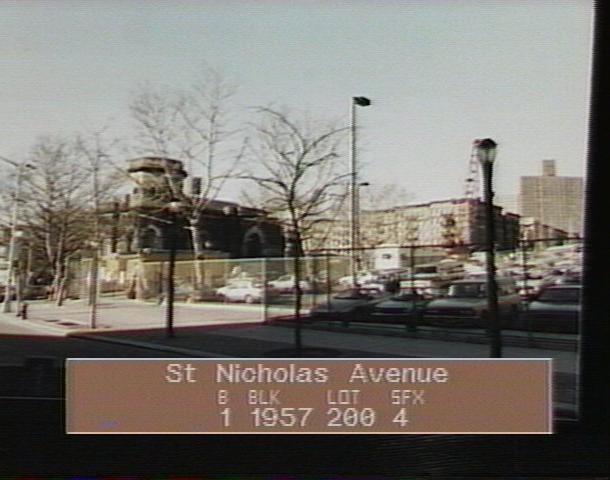
The city photographed every building for its tax records around 1940 and again in the 1980s. NYC Municipal Archives.
Written with AI from the source each entry cites, then fact-checked.
- 1915
Lewisohn Stadium opens on the site, soon home to 25-cent summer concerts
An earlier structure here, the Doric-columned Lewisohn Stadium paid for by financier Adolph Lewisohn, opened in 1915 with 8,000 seats. Summer concerts began in 1918 under Minnie Guggenheimer, with tickets as low as 25 cents, and brought Leonard Bernstein, Louis Armstrong and Ella Fitzgerald. City College football played here from 1921 to 1950. Concerts ended in 1966, and the stadium was torn down in 1973 for the $125 million North Academic Center.
Source: Wikipedia
- 1925
Marian Anderson makes her Lewisohn Stadium debut after winning a singing contest
On August 26, 1925, the Philadelphia contralto Marian Anderson made her first appearance at Lewisohn Stadium, the City College amphitheater whose site the North Academic Center now occupies. She had earned the slot by beating more than 300 rivals in a talent contest at Aeolian Hall that the stadium helped sponsor. With the New York Philharmonic behind her at the winner's concert, she sang a Donizetti aria from La favorita along with several spirituals.
Source: classical-music.com
- 1926
Stravinsky's Rite of Spring draws boos and raucous applause at the stadium
In July 1926, conductor Willem van Hoogstraten introduced Stravinsky's The Rite of Spring at Lewisohn Stadium, which stood where the North Academic Center is now. The audience answered with boos and whistles, mixed with some loud applause. The 1920s programs also brought Prokofiev's Scythian Suite and Honegger's Pacific 231, and Mahler symphonies were played to audiences of 6,000 to 7,000, decades before they became concert-hall fixtures.
Source: classical-music.com
- 1932
George Gershwin attends an all-Gershwin night that packs the stadium and turns thousands away
On August 16, 1932, with Gershwin in the audience, the Philharmonic introduced his Cuban Overture, then called Rumba, at Lewisohn Stadium, on the ground now under the North Academic Center. The piece grew out of his recent trip to Havana. The New York Herald put the turnout at 17,000, with another 4,000 turned away, the largest Lewisohn crowd to that point. From 1936 to 1964 an all-Gershwin concert was held every season.
Source: classical-music.com
- 1942
A thunderstorm wrecks the stadium's acoustic shell and the next night's concert goes on under a tent
In 1942 a violent thunderstorm destroyed the acoustic shell over the stage at Lewisohn Stadium, on the site of today's North Academic Center. The next evening Fritz Reiner, the violinist Jascha Heifetz and the Philharmonic performed an all-Brahms program in a makeshift tent. Mayor Fiorello LaGuardia used the evening to pledge that the city would supply a replacement before the next summer.
Source: classical-music.com
- 1946
Ellington, Holiday and Guthrie play a benefit for blinded veteran Isaac Woodard
On August 16, 1946, Lewisohn Stadium, which then stood on this site, held a sold-out benefit for Sergeant Isaac Woodard, a Black soldier who, just home from the Pacific war and honorably discharged, had been beaten and blinded by a white police officer in South Carolina. Organized by the New York Amsterdam News, the concert featured Nat King Cole, Cab Calloway, Duke Ellington, Carol Brice, Woody Guthrie and Billie Holiday.
Source: Wikipedia
- 1963
Martin Luther King Jr. gives the commencement address the morning he learns Medgar Evers was murdered
City College president Buell Gallagher invited Martin Luther King Jr. to give the 1963 commencement address, held at Lewisohn Stadium on the site of today's North Academic Center. The evening before, President Kennedy had announced that he would propose civil rights legislation. That morning King learned that Medgar Evers, the NAACP's field secretary in Mississippi, had been murdered. He warned the graduates that they were heading into a future of sweeping change and deep uncertainty.
Source: Untapped New York
- 1965
The Metropolitan Opera opens its stadium season before 20,000 listeners amid distant lightning
After the Philharmonic's musicians signed a 52-week contract in 1964 and moved to the new Philharmonic Hall, Mayor Robert F. Wagner announced that the Metropolitan Opera would take over the stadium's summer concerts, with $200,000 in city support. Opening night on June 21, 1965 drew about 20,000 people. With lightning and thunder in the distance, soprano Renata Tebaldi performed selections by Verdi, Rossini and Puccini. In 1967 City College announced plans to demolish the stadium.
Source: classical-music.com
- 1973
The run-down stadium plays itself in Sidney Lumet's film Serpico
In 1973 the director Sidney Lumet used the derelict Lewisohn Stadium as a backdrop in Serpico, for a scene with the actors Tony Roberts and Al Pacino. The film caught the stadium shortly before demolition, on the ground the North Academic Center now covers. The last City College commencement was held there that June.
“The derelict stadium was also used in the 1973 film Serpico, directed by Sidney Lumet, in a scene with Tony Roberts and Al Pacino. ... This practice continued through June 1973.”
Source: Wikipedia
- 1973
Lewisohn Stadium is razed to build the North Academic Center
The city demolishes the amphitheater that had hosted CCNY commencements, concerts and football since 1915, clearing the site for a planned $90 million academic complex. The New York Times marks the loss of what it calls the campus's longtime "center for culture."
Source: Wikipedia
- 1984
City College completes the North Academic Center where Lewisohn Stadium stood
City College began work on the massive North Academic Center in the 1970s, on ground that had held Lewisohn Stadium and Klapper Hall, a former orphanage that housed the School of Education. John Carl Warnecke designed the complex, which was completed in 1984. The Cohen Library, named for the philosopher and alumnus Morris Raphael Cohen, later moved into it from the South Campus.
Source: Wikipedia
- 1985
A plaza at the new academic center is named for Lewisohn Stadium
Twelve years after the stadium's demolition, the city rededicates the plaza outside the North Academic Center as Lewisohn Plaza, honoring financier Adolph Lewisohn, who had funded the original 1915 amphitheater and the summer concerts and commencements it once hosted.
Source: Wikipedia
- 2000
City College buries a time capsule on Lewisohn Plaza, to be opened in 2050
On November 17, 2000, City College buried a time capsule of items honoring campus life on the Adolph Lewisohn Plaza of Honor, the plaza in front of the North Academic Center that holds the last remnants of Lewisohn Stadium. It is one of three time capsules on the campus. Its opening date is set for 2050.
Source: Untapped New York
Further reading
- City College of New YorkWikipedia
Nearby
- A. Philip Randolph Campus High School (former High School of Music & Art)443 West 135th Street | 10 entries
- Harlem Stage Gatehouse138 Convent Avenue | 4 entries
- Shepard Hall, City College229 Convent Avenue | 3 entries
- Aaron Davis Hall129 Convent Avenue | 3 entries
- Hamilton Grange National Memorial414 West 141st Street | 13 entries
- St. Luke's Episcopal Church435 West 141st Street | 5 entries