Winter Garden Theatre
1634 Broadway | also 1638 Broadway, 762 7th Avenue, 205 West 50th Street | Times Square | built 1910
Open on the map14 entries

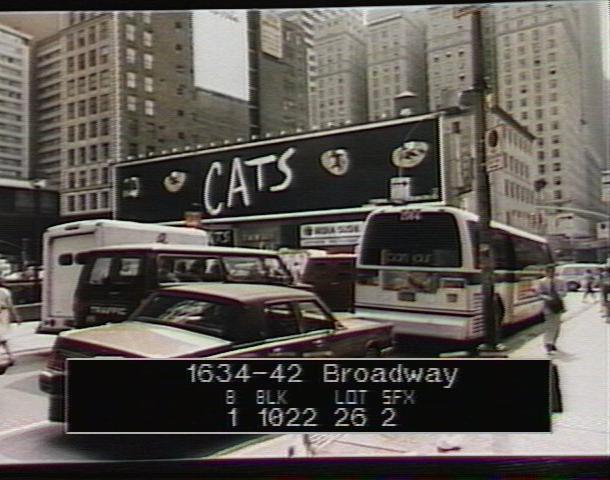
The city photographed every building for its tax records around 1940 and again in the 1980s. NYC Municipal Archives.
Written with AI from the source each entry cites, then fact-checked.
- 1896
Fire sweeps the American Horse Exchange and kills about 60 horses on the future theater site
In June 1896 fire swept through the American Horse Exchange, the building William K. Vanderbilt and fellow investors had put up in 1881 on the block where the Winter Garden now stands. About 60 of the 265 horses stabled there died, and some 6,000 onlookers gathered, at times keeping animals from getting out. Loose horses were found all over midtown. Vanderbilt rebuilt the exchange in 1897, reusing surviving walls.
Source: The New York Times
- 1896
William K. Vanderbilt builds a horse exchange on the future theater site
William K. Vanderbilt built the American Horse Exchange at Broadway and 50th Street in 1896, a marketplace for horses and carriages. The Shuberts later converted the long, shallow structure into a theater, and its unusual footprint gave the Winter Garden a wider, shallower stage than most Broadway houses.
Source: Wikipedia
- 1911
Swasey turns the horse auction ring into a theater meant to feel like an open-air garden
For the Shuberts, architect W. Albert Swasey made the Horse Exchange's auction ring into the auditorium, leaving its trusses exposed and covering the walls and ceiling with wooden latticework. A painted sky and landscaped walls seen through the lattice were meant to make the audience feel it sat outdoors under a trellis, and red Pompeian tile floors, pottery and flower boxes carried the garden theme. John Wanamaker supplied the decor for a wide, 1,800-seat house with boxes close to the stage.
“Swasey converted the auction ring of the Horse Exchange, an enormous space with a high ceiling supported by exposed trusses, into a large auditorium.”
- 1911
The Winter Garden Theatre opens with Al Jolson's Broadway debut
The Winter Garden opened on March 20, 1911, designed by architect William Albert Swasey, with the musical revue La Belle Paree. The show marked singer and actor Al Jolson's Broadway debut, and he became the theater's biggest draw through much of the 1920s.
Source: Wikipedia
- 1912
The Winter Garden adds a runway over the audience, borrowed from Max Reinhardt
The year after the theater opened, a grand runway reaching out into the audience became one of its best-known features. The device came from German director Max Reinhardt, whose company had introduced it to Broadway the previous season at the Casino Theater in a production shared with the Shuberts. At the Winter Garden it suited the intimacy of Al Jolson's style and let the producers show off eighty nearly nude showgirls.
“One of its most famous features, added the year following its opening, was the grand runway.”
- 1920
A million-dollar fire next door sends glass flying and injures J. J. Shubert on the runway
In 1920 a fire in the building between the Winter Garden and the Capitol Theatre caused about a million dollars in damage. The Winter Garden itself suffered little, but J. J. Shubert was hurt by falling glass while he nervously walked the theater's runway. The landmark report points to the blaze as proof that Swasey's worries about fire were well founded, since he gave the house large stairwells, many exits and brick and metal dividers between rooms and floors.
“…fire in the adjoining building ... caused one million dollars in damages. J.J. Shubert was injured by falling glass…”
- 1921
The Shuberts stage the Passing Show of 1921 at the Winter Garden
The Passing Show of 1921 was an edition of the annual revue series the Shuberts ran at the Winter Garden from 1912 through 1924. Jacob Shubert had rushed the first edition into production after hearing that rival producer Florenz Ziegfeld was away on vacation, and the series became the Winter Garden's answer to the Ziegfeld Follies. Its editions over the years drew performers such as Charlotte Greenwood, Ed Wynn, and Fred and Adele Astaire.
Source: Wikipedia
- 1928
Warner Brothers books the Winter Garden for talking pictures after 17 years of musical shows
After seventeen years as a home for musical shows, the Winter Garden was set to be given over to talking pictures. H. M. Warner of Warner Brothers, which controlled the Vitaphone sound process, and the theater's J. J. Shubert completed the deal in mid-August 1928. The Warners were to begin booking the house in September.
Source: The New York Times
- 1957
West Side Story premieres at the Winter Garden with Stephen Sondheim's Broadway debut as lyricist
In 1957 the Winter Garden premiered West Side Story, with music by Leonard Bernstein and lyrics by Stephen Sondheim, who was making his Broadway debut as a lyricist. Carol Lawrence starred. The musical transferred to another house in 1959 and returned to the Winter Garden briefly in 1960.
“…the Winter Garden premiered the musical West Side Story ... Stephen Sondheim, the latter of whom was making his Broadway debut as a lyricist…”
Source: Wikipedia
- 1964
Barbra Streisand opens in Funny Girl at the Winter Garden
Funny Girl, a musical built on the life of Fanny Brice, opened at the Winter Garden with Barbra Streisand in the lead. The Times critic judged her a splendid entertainer in the making, and the show liveliest when it reveled in Brice's love of show business, such as the "Cornet Man" number. It turned sticky when it dwelt on her romance with Nick Arnstein.
Source: The New York Times
- 1980
Gower Champion dies hours before 42nd Street opens at the Winter Garden
On the night of August 25, 1980, the musical 42nd Street opened at the Winter Garden. Its director and choreographer, Gower Champion, a leading figure among the theater's musical directors, had died that afternoon at Memorial Sloan-Kettering Cancer Center. The Times reported the news on its front page the next morning, naming a rare blood disease as the cause.
Source: The New York Times
- 1982
Cats opens at a Winter Garden painted black with glowing yellow eyes and $6.2 million in advance sales
In June 1982 the producers painted the Winter Garden's front black, added a pair of yellow cat's eyes and a sign announcing the show, which turned the dark theater into what the ad agency called the largest sign on Broadway all summer. Banner planes flew along the coast every weekend. By opening night on October 7, 1982, advance sales of $6.2 million may have been a Broadway record.
Source: The New York Times
- 1988
The city landmarks the Winter Garden's interior
New York City designated the Winter Garden Theatre's interior a landmark on January 5, 1988, protecting the 1,600-seat auditorium built out in a 1922-23 renovation by architect Herbert J. Krapp. The designation covers the interior rather than the exterior, which still conceals the building's origin as a horse exchange.
Source: Wikipedia
- 1997
Cats becomes the longest-running show in Broadway history at the Winter Garden
Cats opened at the Winter Garden in 1982 and became the longest-running production in Broadway history in June 1997, partway through a run that stretched nearly eighteen years. The musical finally closed at the theater in 2000.
Source: Wikipedia
Further reading
- Winter Garden TheatreWikipedia
- 1921’s hit musical review at the Winter GardenEphemeral New York
- The Booth brothers play Julius CaesarEphemeral New York
Nearby
- 750 Seventh Avenue750 7th Avenue | 13 entries
- The Michelangelo777 7th Avenue | 11 entries
- The Theater Center1627 Broadway | 6 entries
- Brill Building1619 Broadway | 14 entries
- Paramount Plaza1633 Broadway | 15 entries
- 787 Seventh Avenue (Axa Equitable Center)787 7th Avenue | 11 entries