Paramount Plaza
1633 Broadway | also 242 West 51st Street, 222 West 51st Street, 224 West 51st Street | Times Square | built 1972
Open on the map15 entries

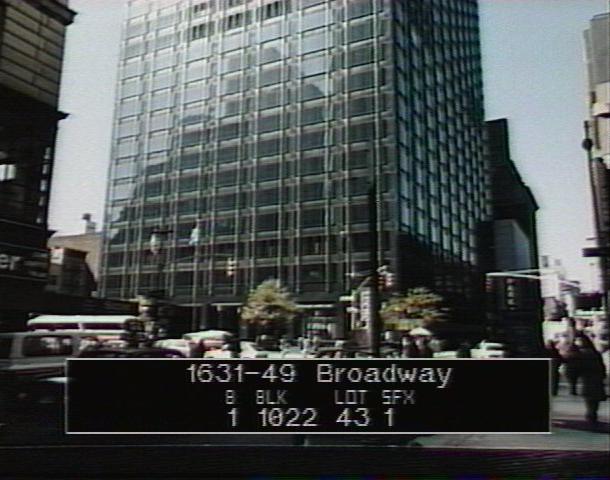
The city photographed every building for its tax records around 1940 and again in the 1980s. NYC Municipal Archives.
Written with AI from the source each entry cites, then fact-checked.
- 1967
The Uris brothers lease the Capitol Theatre site and win zoning bonuses by adding Broadway theaters
The Uris Buildings Corporation leased the site in September 1967 for 100 years and proposed an office tower with a Broadway theater. The city's Special Theater District amendment gave bonus floor area to office towers that included theaters, which let Uris add four stories beyond the normal limit. A second house, the Circle in the Square, was added in the basement at the planning commission's request.
Source: Wikipedia
- 1968
The Capitol Theatre, a 1919 movie palace, closes to make way for the Uris Building
The Capitol Theatre opened in 1919 with 5,300 seats, which later renovations cut to 1,325. By the late 1960s it was among the last major movie palaces on Broadway, since the Roxy and the Paramount had already been torn down. It closed on September 16, 1968, and the tower that is now Paramount Plaza replaced it.
Source: Wikipedia
- 1972
The Theater Hall of Fame names its first 23 members in the new Uris building
Before the Uris Theatre opened, its Theater Hall of Fame announced the first 23 people elected, among them Walter Huston, Ethel Merman, George S. Kaufman, Orson Welles and the Shubert brothers. Drama critics, editors, historians and educators voted, choosing from 166 nominees, while an advisory council had already picked 95 figures from 1860 to 1930. Producers James Nederlander and Gerard Oestreicher, who leased the theater, set aside two large side foyers for the hall.
Source: The New York Times
- 1972
Circle in the Square opens its Broadway home with Mourning Becomes Electra
Theodore Mann's nonprofit Circle in the Square opened its new Joseph E. Levine Theater, built back to back with the Uris Theater, with Eugene O'Neill's Mourning Becomes Electra. The trilogy had not been staged in New York since the Theater Guild's 1931 production, and this version was cut to a little over three and a half hours. The Times critic found the red auditorium and large playing arena lovely, though he thought the acoustics less bright than hoped.
Source: The New York Times
- 1972
The Uris Theatre opens with Via Galactica, a flop that loses a million dollars
Named for developer Percy Uris, the 1,900-seat house opened with Via Galactica, starring Raul Julia, which lasted seven performances and became the first Broadway show to lose a million dollars. Ralph Alswang designed the theater, and its lobby holds the American Theater Hall of Fame, with names inscribed in gold letters on a four-story wall. The Nederlander Organization has operated it.
Source: Wikipedia
- 1973
Sears signs a 25-year, $100 million lease for 481,000 square feet in the new tower
Sears, Roebuck signed a 25-year lease worth $100 million for 481,000 square feet at 1633 Broadway, planning to move 2,000 employees into the 48-story building early the following year. The space nearly doubled what its fashion-buying headquarters had on West 31st Street. City officials welcomed the deal as one of the biggest in years, and Mayor Lindsay said it showed Broadway and Times Square entering a new era.
Source: The New York Times
- 1974
Circle in the Square announces it will close in two weeks for lack of $191,110
In March 1974 Circle in the Square said it would shut on March 24, ending 23 years of continuous operation, because it lacked $191,110 of its $1,560,000 season budget. Artistic director Theodore Mann called it an extinction crisis. The company had made the 650-seat Circle in the Square/Joseph E. Levine Theater in the Uris Building its main stage in 1972 and was renting out its Bleecker Street house to Lanford Wilson's The Hot l Baltimore.
Source: The New York Times
- 1974
Lenders begin foreclosure on the two-year-old Uris Building
The Uris company defaulted on its construction loan, due at the end of 1973, while 30 percent of the building stood vacant in a soft office market. Irving Trust and the other lenders began foreclosure in March 1974, the first time in ten years a new New York office tower had been foreclosed on. They bought the building for nearly $69 million that May, and in 1976 sold it for $80 million to a group representing Germany's Otto family, who operated here as the Paramount Group.
Source: Wikipedia
- 1975
Frank Sinatra opens a two-week run at the Uris with Ella Fitzgerald and Count Basie
Frank Sinatra opened a two-week engagement billed simply as The Concert, sharing the stage with Ella Fitzgerald and Count Basie's orchestra. The Times reviewer found him in strong voice, working through old favorites such as Where or When and My Kind of Town. When Basie squinted at his charts through glasses, Sinatra joked that he should not hurt himself, and 20 strings joined the band for a set of love songs.
Source: The New York Times
- 1977
The King and I opens at the Uris with Yul Brynner and Constance Towers
A revival of The King and I, starring Yul Brynner and Constance Towers, opened at the Uris Theatre in May 1977 and ran for 719 performances. Earlier in the decade, after several flops, the theater had mostly been rented out for concerts and dance specials.
“The musical The King and I, with Yul Brynner and Constance Towers, opened in May 1977 and ran for 719 performances…”
Source: Wikipedia
- 1983
The Uris Theatre is renamed the Gershwin during the Tony Awards broadcast
At the 37th Tony Awards, held in the theater on June 5, the house was rededicated as the Gershwin Theatre, honoring the songwriting brothers George and Ira Gershwin. It was the first of six Tony ceremonies held there. Ira Gershwin died two months later, and the theater hosted a memorial for him.
Source: Wikipedia
- 1984
The Royal Shakespeare Company brings straight plays to the Gershwin for the first time
In October 1984 the Royal Shakespeare Company brought Much Ado about Nothing and Cyrano de Bergerac to the Gershwin, playing them in alternation for ten weeks. The 1,900-seat house had never hosted straight plays before, having held musicals, concerts and dance, so the theater was acoustically modified for the engagement.
“The theater was acoustically modified for these plays, as it was the first time the theater had hosted straight plays.”
Source: Wikipedia
- 1993
Deloitte moves its global headquarters to 1633 Broadway after the World Trade Center bombing
After the 1993 World Trade Center bombing, the accounting firm Deloitte relocated its global headquarters into the tower. It then subleased 500,000 square feet to Viacom, parent of Paramount Communications. Other 1990s tenants included Morgan Stanley, Showtime, the New York Power Authority and the American Management Association, and in 1999 Nickelodeon set up an animation studio in the building to produce Nick Jr. programs.
Source: Wikipedia
- 1998
The space-themed restaurant Mars 2112 opens in the northern sunken plaza
Mars 2112 opened in November 1998 inside the building's northern sunken plaza and ran until January 2012. Visitors entered through a UFO-like elevator, then found a Mars Bar and a Space Arcade, and a three-story Crystal Crater. After it closed, a glass retail cube designed by MdeAS Architects was installed there as the entrance to the basement retail space.
Source: Wikipedia
- 2003
Wicked opens at the Gershwin and stays on
Wicked opened at the Gershwin in October 2003, though one of its producers had hesitated over booking a theater known for short runs. The musical stayed, and the Gershwin's size suited it. In 2010 it became the first Broadway show to gross more than $2 million in a week, and in 2024 it grossed over $5 million in a nine-performance week.
Source: Wikipedia
Further reading
- Paramount PlazaWikipedia
Nearby
- Mark Hellinger Theatre (Times Square Church)237 West 51st Street | 14 entries
- The Theater Center1627 Broadway | 6 entries
- Gallagher's Steakhouse228 West 52nd Street | 8 entries
- Ambassador Theatre219 West 49th Street | 12 entries
- St. Malachy's Church, the Actors' Chapel239 West 49th Street | 9 entries
- Brill Building1619 Broadway | 14 entries