New-York Historical Society
170 Central Park West | also 2 West 77th Street, 5 West 76th Street | Upper West Side | built 1908
Open on the map11 entries

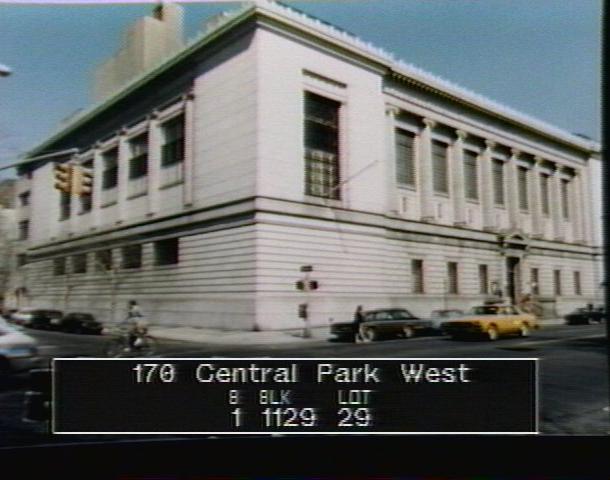
The city photographed every building for its tax records around 1940 and again in the 1980s. NYC Municipal Archives.
Written with AI from the source each entry cites, then fact-checked.
- 1890
Dry-goods merchant William T. Evans builds a house with a gallery for American art on 76th Street
In 1890 William T. Evans, an Irish-born dry-goods executive who collected American paintings, announced a four-story Romanesque Revival house with an attached art gallery at 5 West 76th Street, now covered by the Historical Society's 1930s wing. In 1892 he and his wife sold the adjoining corner lots, Nos. 1 and 3, to the New-York Historical Society for $21,000. The society bought the house itself in 1925.
Source: Daytonian in Manhattan
- 1902
Oscar Straus invites coal-strike antagonists to dinner at his house on this block
Oscar S. Straus, a former US minister to Turkey, bought the house at 5 West 76th Street in 1901; the site is now covered by the Historical Society's 1930s wing. During the 1902 coal strike he was a vice president of an arbitration committee whose formal meetings got nowhere, so he invited all parties to dinner at his home. Newspapers credited the evening, at which the strike was reportedly not discussed, with easing tensions.
Source: Daytonian in Manhattan
- 1908
The New-York Historical Society opens its Central Park West building
Founded in 1804 by John Pintard and a group of prominent citizens including Mayor DeWitt Clinton, the society was New York's first museum. In 1908 it opened this Roman Eclectic building by York & Sawyer between 76th and 77th Streets, and Walker & Gillette added pavilions in 1938. Its collections include all 435 of John James Audubon's surviving watercolors for The Birds of America.
Source: Wikipedia
- 1938
Walker & Gillette extend the Historical Society's building with matching wings
Thirty years after the original central block opened, architects Walker & Gillette added sympathetic pavilions onto both ends of the building in 1938. The extension, faced to match York and Sawyer's original granite design, is considered one of the last major Beaux-Arts additions completed in the city.
Source: Wikipedia
- 1966
The Landmarks Commission designates the building with no opposition
The Landmarks Preservation Commission designated the New York Historical Society building a landmark on July 19, 1966, after a hearing in June. One witness spoke in favor, none opposed, and the Society itself told the commission it supported designation. The report covered the 1908 central block by York & Sawyer and the 1937 wings by Walker & Gillette, noting that the additions were joined so skillfully the building looks designed at once.
“There were no speakers in opposition to designation.”
- 1988
The Historical Society's leaders warn it will be bankrupt within 18 months
After years of financial trouble, the society's leadership concluded in 1988 that the institution would go bankrupt in 18 months. Its recovery began in 1995 under Betsy Gotbaum. A $65 million renovation was finished in 2011, and in 2024 the institution renamed itself New York Historical, dropping both the hyphen and the word Society.
Source: Wikipedia
- 1990
The Jewish Museum shelters in the Historical Society building during its own expansion
While the Jewish Museum's own mansion was being expanded, the museum arranged to move into the New-York Historical Society building while the project lasted. The work on the museum began in November 1990 and lasted two and a half years, and the museum reopened on June 13, 1993.
“The Jewish Museum agreed to relocate to the New-York Historical Society building for the duration of the project…”
Source: Wikipedia
- 1995
City and state grants restore public access to the Historical Society
After financial troubles in the 1970s and 1980s, the Historical Society had limited access to its collections to professional researchers. In 1995 grants from the city and state brought the public back in, with Betsy Gotbaum leading the society. It later raised its operating budget by 160 percent to widen its public programs, and has balanced its books every year since 1998.
Source: Wikipedia
- 2005
An exhibition on slavery in New York fills the whole first floor
In 2005 the Historical Society opened Slavery and the Making of New York, covering the 1600s to 1827 and filling its entire first floor. It was the first exhibition in New York City about slavery's large but little-known part in the city's economy and history. The society also commissioned 20 new works from invited artists, some made with objects from its own collections, and followed with a second show on slavery and the Civil War in 2006.
“…mounted the first exhibition ever in New York City on the major but little-known role of slavery in the city's economy and history…”
Source: Wikipedia
- 2011
A $65 million renovation opens the Historical Society onto Central Park West
A renovation completed in November 2011 under president Louise Mirrer lengthened ground-floor windows into new doorways and added bronze sculptures of Abraham Lincoln and Frederick Douglass outside, giving the once-closed institution a street presence for the first time. The $65 million project was meant to draw in passersby rather than only ticketed visitors.
Source: Wikipedia
- 2026
The Tang Wing opens with a focus on LGBTQ history
An 80,000-square-foot addition designed by Robert A. M. Stern, known as the Tang Wing, opened on June 18, 2026, after construction that began in 2023. The new wing gives the Historical Society dedicated space for LGBTQ history for the first time.
Source: Wikipedia
Further reading
- New York HistoricalWikipedia
Nearby
- Fourth Universalist Society160 Central Park West | 6 entries
- The Kenilworth151 Central Park West | 4 entries
- Manhattan Square Apartments44 West 77th Street | 10 entries
- American Museum of Natural History200 Central Park West | 21 entries
- The San Remo145 Central Park West | 13 entries
- Richard Gilder Center for Science, Education, and Innovation415 Columbus Avenue | 5 entries