American Museum of Natural History
200 Central Park West | also 47 West 77th Street, 180 Central Park West, 7 West 77th Street | Upper West Side | built 1998
Open on the map21 entries

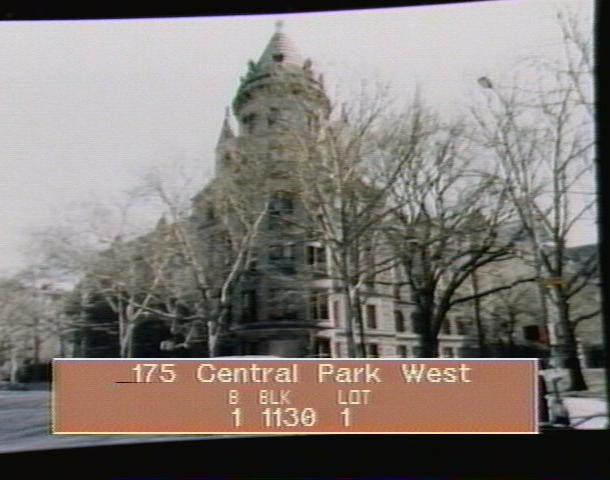
The city photographed every building for its tax records around 1940 and again in the 1980s. NYC Municipal Archives.
Written with AI from the source each entry cites, then fact-checked.
- 1869
A group including Theodore Roosevelt, J. P. Morgan and Joseph Choate incorporates the museum
The Landmarks Preservation Commission's designation report credits a group of prominent men of affairs, among them Theodore Roosevelt, the elder J. P. Morgan and Joseph H. Choate, with incorporating the American Museum of Natural History in 1869. In less than two years it opened to the public in the old Arsenal Building in Central Park, before moving to its permanent home on Manhattan Square, where today's complex stands.
- 1874
President Ulysses S. Grant attends the groundbreaking for the museum's permanent building on Manhattan Square
After the directors chose Manhattan Square, the park between Eighth and Ninth Avenues and West 77th and 81st Streets, prominent New Yorkers raised $500,000 for a building, and the park commissioners set the site aside; another $200,000 was raised afterward. President Ulysses S. Grant was among the dignitaries and officials at the groundbreaking on June 3, 1874, for a structure designed by Calvert Vaux and J. Wrey Mould.
Source: Wikipedia
- 1877
President Hayes opens the museum's first building on Manhattan Square
Chartered on April 6, 1869, after years of advocacy by naturalist Albert S. Bickmore, the museum first opened in 1871 in Central Park's Arsenal. Its first purpose-built home, a Victorian Gothic hall by Calvert Vaux and J. Wrey Mould, opened on December 22, 1877, with President Rutherford B. Hayes at the dedication. Wings added over the following decades grew into a complex of about 21 interconnected buildings.
Source: Wikipedia
- 1891
Cady, Berg & See complete the Romanesque Revival centerpiece of the West 77th Street front
The Landmarks Preservation Commission dates the central West 77th Street unit to 1891, by Cady, Berg & See, who chose the Romanesque Revival over their predecessors' Victorian Gothic. Matching east and west wings followed in 1894-1900. The five-story front of Vermont pink granite has a giant segmental arch, a seven-bay arcaded porch and rounded towers at its ends, and the commission calls it the city's most impressive Romanesque Revival example.
“It is the most impressive example of Romanesque Revival architecture in New York City.”
- 1892
The museum drops its admission fee and opens on Sundays for the first time
By February 1892 the trustees were considering Sunday opening, a change that working-class New Yorkers had long sought and that the trustees had resisted because of the expense. They stopped charging admission that July, and Sunday operations began in August 1892. Earlier, the public could visit Wednesday through Saturday, with Monday and Tuesday reserved for members.
Source: Wikipedia
- 1899
Franz Boas establishes the Jesup North Pacific Hall, now the museum's oldest hall
The hall that is now the Northwest Coast Hall was established in 1899 by the anthropologist Franz Boas as the Jesup North Pacific Hall, and it is the museum's oldest hall. Its objects came from Haida and Tlingit collections acquired in 1882, 1888 and 1894 and from the Jesup North Pacific Expedition of 1897-1902, which Boas led and museum president Morris Jesup financed. George Hunt secured the Kwakwaka'wakw house posts.
Source: Wikipedia
- 1905
The museum opens its dinosaur hall with a brontosaurus skeleton
The American Museum of Natural History opens a dedicated dinosaur hall, anchored by a mounted brontosaurus skeleton, one of the first such displays in the country. The hall builds on earlier expansions of the Central Park West building, including a 1,350-seat lecture hall and halls devoted to Native American and Mexican collections completed just a few years before.
Source: Wikipedia
- 1921
The Hall of the Age of Man opens as the only major U.S. exhibition on human evolution
The museum opened the Hall of the Age of Man in 1921, tracing the story of Homo sapiens and the path of human evolution through its displays. At the time no other major exhibition in the United States looked at human evolution in such depth. Much of its material survives in the expanded Anne and Bernard Spitzer Hall of Human Origins, which took that name on February 10, 2007.
“When it first opened in 1921, the hall was known as the “Hall of the Age of Man”…”
Source: Wikipedia
- 1922
Trowbridge & Livingston begin a gray granite wing along Central Park West
In 1922 the architects Trowbridge & Livingston started a wing running north along Central Park West, built of gray granite in a classical style rather than the Romanesque of the earlier front. The Landmarks Preservation Commission says that switch to classicism is what let John Russell Pope's competition-winning design for the Theodore Roosevelt Memorial fit the museum, and that the new wing matched the main heights of the 77th Street section.
- 1931
Governor Franklin D. Roosevelt lays the cornerstone of the Theodore Roosevelt Memorial
In 1931 Franklin Delano Roosevelt, then governor of New York, laid the cornerstone of the memorial hall on Central Park West. The building follows John Russell Pope's winning design, a Roman triumphal arch carried out by Trowbridge & Livingston in limestone. The landmark report describes bronze entrance doors, columns topped by sculpted figures, and an equestrian statue of Theodore Roosevelt by James E. Fraser standing in front.
“The cornerstone was laid in 1931 by Franklin Delano Roosevelt, then Governor of New York State.”
- 1935
The museum opens the Hayden Planetarium
Funded partly by a $150,000 gift from financier Charles Hayden, the museum opens the Hayden Planetarium, the fourth planetarium built in the United States. Designed by Trowbridge and Livingston with an Art Deco dome, it houses a Zeiss II star projector and draws nearly a million visitors in its first year, including wartime navigation classes for Army and Navy personnel.
Source: Internet Archive
- 1936
President Franklin Roosevelt dedicates the museum's Theodore Roosevelt Memorial
President Franklin D. Roosevelt dedicates the Theodore Roosevelt Memorial Hall at the museum, honoring his cousin, the former president and naturalist. The dedication follows decades of expansion at the museum, which had already added a 1,350-seat lecture hall and new galleries for Native American and Mexican collections by 1900.
Source: Wikipedia
- 1937
The old Hayden Planetarium stages an 'End of the World' show after an asteroid scare
The original Hayden Planetarium, an earlier building on this site that the Rose Center later replaced, drew nearly a million visitors in its first year. In 1937 a close pass by the asteroid Hermes led it to produce a dramatic 'End of the World' program, while 'The Mysterious Moon' offered lighter fare, an imagined lunar voyage that included a baseball game in reduced gravity.
Source: Internet Archive
- 1964
Murph the Surf and two accomplices steal the Star of India and other gems from the museum
On October 29, 1964, Jack Murphy, Alan Kuhn and Roger Clark climbed through an open window into the gem hall, where the burglar alarms were not working, and took 24 gems, among them the Star of India, the Eagle Diamond and the DeLong Star Ruby. Police, tipped off by staff at the hotel where the men threw lavish parties, arrested them two days later. The Star of India turned up in a Miami bus-station locker; the Eagle Diamond was never recovered.
“On October 29, 1964, at New York's American Museum of Natural History Murphy was involved in the notorious burglary of 24 precious gems…”
Source: Wikipedia
- 1967
The Landmarks Commission designates the museum complex, counting nearly three million visitors a year
On August 24, 1967, the Landmarks Preservation Commission designated the American Museum of Natural History, describing eighteen interconnected units by almost a score of architects. Its report counted nearly three million visitors a year and more than 2,300 habitat groups and exhibits in fifty-eight halls, plus a library of 175,000 volumes. The museum's director approved in a letter, and three witnesses spoke for designation at the June 1966 hearing.
“…more than 2,300 habitat groups, mounted specimens, showcases, dioramas, and scientific exhibits fill fifty-eight great halls and alcoves…”
- 1985
The Art Deco Society of New York campaigns to restore the old Hayden Planetarium's lobby details
The 1935 Hayden Planetarium, an earlier building on this site, was showing its age by 1985, when the Art Deco Society of New York campaigned to bring back its fading Art Deco character. The effort focused on the zodiac medallions in the lobby ceiling, done in bas-relief, and on the original light fixtures that looked like Saturn with its rings. Within a decade the museum would decide that the whole building needed replacing.
Source: Internet Archive
- 1994
The museum concludes the old planetarium is too outdated and calls for a drastic overhaul
By 1994 the museum judged that the Hayden Planetarium's dated facilities limited its ability to convey up-to-date science. It weighed renovating the existing structure but concluded that the building needed a drastic overhaul. James Stewart Polshek and Todd Schliemann, architects at Polshek Partnership, then proposed a total redesign.
Source: Internet Archive
- 2000
The glass-cubed Rose Center replaces the aging Hayden Planetarium
After curators conclude in 1994 that the 1935 planetarium can no longer convey current astronomy, architects James Polshek and Todd Schliemann complete the Rose Center for Earth and Space. Computer-aided design makes possible an 87-foot sphere that appears to float inside a 95-foot glass cube, a design earlier architects had only been able to sketch on paper.
Source: Internet Archive
- 2021
The Halls of Gems and Minerals reopen after a $32 million redesign
The Harry Frank Guggenheim Hall closed in 2017 for a $32 million redesign by Ralph Appelbaum Associates, and the space, renamed the Mignone Halls of Gems and Minerals, reopened to the public in June 2021. The new exhibits emphasize storytelling and interactivity, and they show rare pieces chosen from more than 100,000 in the collection, among them the Star of India, the Patricia Emerald and the DeLong Star Ruby.
“The halls closed in 2017 to undergo a $32 million redesign by Ralph Appelbaum Associates and reopened to the general public in June 2021.”
Source: Wikipedia
- 2022
The museum removes the equestrian Theodore Roosevelt statue from its Central Park West entrance
James Earle Fraser's statue of Theodore Roosevelt on horseback, with a Native American and an African American beside it, originally stood outside the memorial hall. Its subordinate depiction of those two figures drew controversy, and museum officials announced in 2020 that it would come down. It was taken away in January 2022 and sent on a long-term loan to a presidential library in North Dakota that honors Roosevelt.
Source: Wikipedia
- 2023
The museum opens the Richard Gilder Center for Science, Education, and Innovation
The museum's newest addition opened on May 4, 2023, and drew 1.5 million visitors in its first three months. It joined a campus that had grown from the 1877 building through the Theodore Roosevelt Memorial Hall, designed by John Russell Pope and dedicated in 1936, and the Rose Center for Earth and Space, opened in 2000. The museum holds about 32 million specimens in 45 permanent exhibition halls.
Source: Wikipedia
Further reading
- American Museum of Natural HistoryWikipedia
- Hayden PlanetariumPlace Matters
Nearby
- Richard Gilder Center for Science, Education, and Innovation415 Columbus Avenue | 5 entries
- Manhattan Square Apartments44 West 77th Street | 10 entries
- New-York Historical Society170 Central Park West | 11 entries
- Fourth Universalist Society160 Central Park West | 6 entries
- The Kenilworth151 Central Park West | 4 entries
- The Beresford211 Central Park West | 14 entries