Substation No. 2
173 Spring Street | also 88 Thompson Street | SoHo | built 1901
Open on the map4 entries

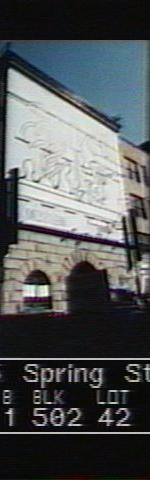
The city photographed every building for its tax records around 1940 and again in the 1980s. NYC Municipal Archives.
Written with AI from the source each entry cites, then fact-checked.
- 1898
Railroad engineer George H. Pegram, designer of the substation, becomes chief engineer of the Manhattan Elevated
Born in Council Bluffs, Iowa in 1855, George H. Pegram earned a degree in civil engineering. In 1893 he became Chief Engineer of the Union Pacific Railroad. In 1898 the Manhattan Elevated Railway Company named him its chief engineer, and he designed its massive powerhouse at 74th Street and the East River, dated 1902. He also designed this substation on Spring Street.
- 1901
Manhattan Railway files plans for a power substation to replace two old Spring Street houses
In July 1901 George Pegram filed plans for three electric substations serving the Manhattan Railway Company's Sixth and Ninth Avenue elevated lines, among them a four-story brick building at 173-175 Spring Street. The stations were meant to convert the current from the company's main powerhouse at 74th Street and the East River into power for the trains. They replaced three-story brick houses from a row that had begun going up on the block around 1818 and had long since become shops and workshops.
Source: Daytonian in Manhattan
- 1938
The Sixth Avenue El closes, leaving Substation 2 with nothing to power
The city paid $12.5 million for the Sixth Avenue El, buying it from the Manhattan Railway Company's bondholders in 1938, after the first stage of the Sixth Avenue subway had opened in 1936. The line shut down on December 4, 1938, and crews tore it down within the year. Without the El the substation had no purpose, and its heavy equipment was dismantled and carted out.
Source: Daytonian in Manhattan
- 1964
The emptied substation becomes a lumber store, and its upper floors gain a bold mural
In 1964 the building became a lumber store occupying the first floor and mezzanine, with the upper floors recorded as vacant. The Gem Lumber Company was running the store by 1979. A bold mural on the upper floors became a Spring Street landmark of its own, and the lumber store closed in 2015.
Source: Daytonian in Manhattan
Further reading
- The 1901 Substation 2 -- Nos. 173-175 Spring StreetDaytonian in Manhattan
Nearby
- 171 Spring Street2 entries
- 177 Spring Street2 entries
- 90 Thompson Street2 entries
- 167 Spring Street2 entries
- 414 West Broadway2 entries
- 420 West Broadway94 Thompson Street | 2 entries