Flatiron Building
175 5th Avenue | also 949 Broadway, 1 East 22nd Street, 171 5th Avenue | Flatiron | built 1903
Open on the map16 entries

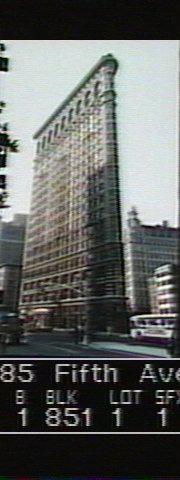
The city photographed every building for its tax records around 1940 and again in the 1980s. NYC Municipal Archives.
Written with AI from the source each entry cites, then fact-checked.
- 1857
Amos Eno buys the whole triangular block for $32,000
By 1855 a St. Germain Hotel stood at the southern end of the triangular lot where the Flatiron Building would later rise. Two years later Amos Eno bought the whole block for $32,000, and he soon put up the Fifth Avenue Hotel on a site diagonally opposite. The wedge he held came to be called names such as Eno's flatiron and the cow catcher, long before any skyscraper was planned there.
“Amos Eno purchased the entire block in 1857 for $32,000, and he shortly built the Fifth Avenue Hotel on a site diagonally across from it.”
Source: Wikipedia
- 1899
A city plan to buy Eno's flatiron collapses and William Eno wins it at auction
After Amos Eno died in 1899 his assets were liquidated and the triangular lot, where the Flatiron Building now stands, went up for sale. The New York State Assembly set aside $3 million for the city to buy it, but the plan fell apart when a newspaper reporter exposed it as a graft scheme by Tammany boss Richard Croker. William Eno, one of Amos's sons, then bought the lot at auction in April for $690,000, more than twenty times what his father had paid.
“…the lot was bought at auction by William Eno, one of Amos's sons, for $690,000 in April 1899.”
Source: Wikipedia
- 1901
A retired colonel holds out in the Cumberland apartments as the Flatiron site is cleared
The Northwestern Salvage and Wrecking Company began razing the Cumberland apartment house on the Flatiron's site in May 1901. Nearly all tenants left in exchange for compensation, but retired colonel Winfield Scott Proskey refused to move until his lease ran out. The owners tried and failed to shut off his water and gas, and he stayed while the buildings around him came down. They then learned he was bankrupt, his creditors took over the lease, and the rest of the Cumberland was razed that June.
Source: Wikipedia
- 1902
The Fuller Building, soon called the Flatiron, opens at 23rd Street
Designed by Daniel Burnham with Frederick P. Dinkelberg, the triangular tower opened on October 1, 1902, as the Fuller Building, headquarters of the George A. Fuller Company, which took the 19th floor. It stood about 285 feet and 20 stories at first. Skeptics doubted the thin wedge would stand up to the wind and nicknamed it Burnham's Folly. It became a city landmark in 1966.
Source: Wikipedia
- 1903
A film crew captures the wind whipping skirts outside the Flatiron Building
The American Mutoscope and Biography Company films pedestrians battling gusts around the triangular building on October 26, 1903, capturing how its shape funnels wind onto the sidewalk below. The downdrafts were already notorious for blowing out windows and catching the skirts of women walking the nearby Ladies' Mile shopping strip. The footage helps fix the corner's reputation as one of the city's windiest.
Source: The Bowery Boys
- 1904
Edward Steichen photographs the Flatiron at twilight
Two years after the building opened, the photographer Edward Steichen made a picture of it. During printing he gave the image a blue glow to suggest twilight, with tree branches and rain puddles in the foreground. Ephemeral New York quotes the Middlebury College Museum of Art, which says Steichen may have drawn on Japanese prints.
Source: Ephemeral New York
- 1905
A penthouse studio atop the Flatiron fills with pulp-magazine artists
By 1905 the Fuller Company needed more room for its technical drawing staff, so in March it filed plans with the Department of Buildings for a $10,000 penthouse reached by a staircase from the 20th floor. It was meant as artists' studios and was quickly taken by artists such as Louis Fancher, many of whom worked for the pulp magazines produced in the offices below.
Source: Wikipedia
- 1906
John Sloan paints a dust storm whipped up around the Flatiron
On a June day in 1906 the painter John Sloan was walking on Fifth Avenue and wrote in his diary about a windstorm that filled the air with dust and left everything in sight uneasy. He turned the scene into the painting Dust Storm, Fifth Avenue, now at the Metropolitan Museum of Art, which explains that the Flatiron stood alone as a skyscraper among low-rise buildings and produced the wind tunnel effect he painted.
Source: Ephemeral New York
- 1906
H. G. Wells admires the Flatiron's prow in the afternoon traffic
In 1906 the English writer H. G. Wells wrote that he found himself gaping at a skyscraper, the Flatiron's prow, ploughing its way through the late-afternoon traffic of Broadway and Fifth Avenue. Ephemeral New York adds that grotesque faces near the top had been staring down at pedestrians since 1902.
Source: Ephemeral New York
- 1911
Taverne Louis brings a Black dance band and a gay clientele to the Flatiron's restaurant
In 1911 Louis Bustanoby, of the Cafe des Beaux-Arts, bought the Flatiron's basement restaurant and turned it into Taverne Louis, a 400-seat French restaurant. He brought in Louis Mitchell and his Southern Symphony Quintette as the dance band, and Irving Berlin, who heard them there, suggested they try London, which they did. The taverne also welcomed gay customers, unusual for a restaurant of its kind, and closed after Prohibition.
“Irving Berlin heard the group at the Taverne and suggested that they should try to get work in London, which they did.”
Source: Wikipedia
- 1918
A cigar store in the Flatiron's narrow tip becomes an army recruiting office
During World War I, the cigar shop occupying the Flatiron Building's narrow front point is converted into a recruiting office decorated with military weaponry. The tiny triangular storefront, only a few feet wide, gives passing recruits an unmistakable spot to find. It shows the building's place in Madison Square's civic life well beyond its office tenants.
Source: The Bowery Boys
- 1921
Frank Coburn paints the Flatiron in a rainstorm
The Chicago-born painter Frank Coburn, known for moody Impressionist landscapes of Los Angeles and the Southern California desert, also painted New York. His 1921 painting shows the Flatiron Building at the meeting of Fifth Avenue and Broadway, at the edge of Madison Square Park, in the rain, with slick streets, bare branches, a lone figure under an umbrella and a yellow-glowing sky. The painting is at the Bowers Museum in Orange County, California.
Source: Ephemeral New York
- 1952
Diver Henri LaMothe starts an annual birthday leap beside the Flatiron Building
Stunt diver Henri LaMothe begins an annual birthday dive near the Flatiron Building in 1952, leaping from a platform into a shallow pool using his signature 'flying squirrel' technique. He repeats the stunt every year for two decades, eventually diving into just a foot of water by 1974. LaMothe credits yoga stretches and zen-like concentration for landing safely each time.
Source: Ephemeral New York
- 1959
St. Martin's Press moves in, beginning decades of book publishing in the Flatiron
Publishers were in the building from its early years, when Frank Munsey leased space. In 1959 St. Martin's Press moved into the Flatiron, and its parent Macmillan gradually took over more of the building; by the 2000s St. Martin's and Springer-Verlag together occupied 90 percent of it. Macmillan had moved out by June 2019.
Source: Wikipedia
- 1966
The Landmarks Commission designates the Flatiron Building with no opposition
The Landmarks Preservation Commission held its hearing on the Flatiron Building on March 8, 1966. Three witnesses spoke in favor, none opposed, and the owner wrote that he was proud to accept the designation. The commission designated the building on September 20, saying the triangular site gave the 1902 skyscraper a special character and a poetic quality, and comparing its prow to a great ship sailing up the avenue.
“Three witnesses spoke in favor of designation. There were no speakers in opposition to designation.”
- 2023
A $190 million winning bid for the Flatiron fails when the bidder misses the deposit
In March 2023 a state judge ordered the Flatiron Building auctioned because its co-owners could not settle their differences over renovation. Jacob Garlick, 31, bid $190 million on March 22 but did not pay the $19 million down payment due by March 24. A second auction on May 23 went to the majority ownership group of Gural, Newmark, Sorgente and ABS Partners, whose winning bid was $161 million.
“The building was ultimately sold for $190 million to 31-year-old Jacob Garlick…”
Source: Wikipedia
Further reading
- Flatiron BuildingWikipedia
- Flatiron BuildingPlace Matters
- An ode to construction workers on a 57th Street Art Deco towerEphemeral New York
- A painter’s stormy view of the Flatiron BuildingEphemeral New York
- The blue glow of the Flatiron Building at twilightEphemeral New York
- A 1906 dust storm beside the Flatiron BuildingEphemeral New York
- The Flatiron Building rises in the rain and fogEphemeral New York
- The Flatiron Building in all of its glittery gloryEphemeral New York
Nearby
- Sohmer Piano Building170 5th Avenue | 3 entries
- Scribner Building155 5th Avenue | 9 entries
- Shake Shack (Madison Square Park)2 Madison Avenue | 4 entries
- One Madison23 East 22nd Street | 10 entries
- Toy Building North1107 Broadway | 5 entries
- Metropolitan Life Insurance Company Tower5 Madison Avenue | 12 entries