Metropolitan Life Insurance Company Tower
5 Madison Avenue | also 2 East 24th Street | NoMad | built 1909
Open on the map12 entries

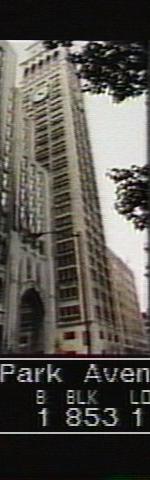
The city photographed every building for its tax records around 1940 and again in the 1980s. NYC Municipal Archives.
Written with AI from the source each entry cites, then fact-checked.
- 1890
Metropolitan Life buys the Madison Avenue corner, then so far uptown that no offices stood there
In 1890 Metropolitan Life bought the site at 1 Madison Avenue, across from Madison Square Park, in a part of town so far north that no office building had yet been put up there. The company's president, Joseph Knapp, turned again to the LeBrun architectural firm for an eleven-story block carved with Italian Renaissance ornament. The Landmarks Preservation Commission says the new building did much to establish Metropolitan Life in the public mind. That office block stood on part of the block the tower now fills, and it was the first piece of what grew to cover it.
“In 1890 Metropolitan Life purchased the site at 1 Madison Avenue, then so far uptown that no office building had yet been constructed there.”
- 1906
Metropolitan Life secures the church corner by giving Dr. Parkhurst's congregation a bigger site across the street
The last piece of the block was the corner of Madison Avenue and 24th Street, where the Madison Square Presbyterian Church stood on the lot the tower now occupies. Its minister, Dr. Charles Parkhurst, objected to selling, but on April 5, 1906 the company secured the lot after also offering the congregation a more spacious site just across East 24th Street. The old church was torn down, and construction began on the 700-foot tower, the tallest building in the world.
“Finally, on April 5, 1906, the church site was secured. Dr. Parkhurst had objected to selling, but when Metropolitan Life offered him the more spacious site just across F.ast 24th Street…”
- 1909
The Metropolitan Life tower becomes the tallest building in the world
Napoleon LeBrun & Sons designed the 700-foot tower, erected from 1905 to 1909 and modeled on St Mark's Campanile in Venice, which had collapsed in 1902 and was not rebuilt until 1912. The tower held the title of world's tallest building until 1913. Each of its four clock faces is 26.5 feet across, with minute hands 17 feet long.
Source: Wikipedia
- 1909
President John Hegeman calls the new tower a symbol of integrity, four years after his insurance investigation
In his dedication remarks in 1909, Metropolitan Life president John Rogers Hegeman described the tower as a symbol of integrity. Only four years earlier he had been through the New York State Armstrong Committee's inquiries into the insurance industry. The company was cleared, but Hegeman himself was indicted before being exonerated. The Landmarks Commission wonders whether he saw the world's tallest tower as a symbol of vindication, for both himself and the firm.
- 1913
The Woolworth Building overtakes the Met Life Tower as the world's tallest
The Metropolitan Life tower held the title of world's tallest building for only a few years. In 1913 the newly completed Woolworth Building on lower Broadway surpassed it, ending Met Life's run atop the skyline just four years after the tower's 1909 completion.
Source: Wikipedia
- 1937
New Yorkers write in to ask why the Met Life tower's clock hands have been taken apart
When workers took the hands of the tower's four clock faces apart for cleaning in 1937, the public noticed. A newspaper columnist reported that letters poured in asking what was going on. One anonymous reviewer found the clock's chimes a comforting sound arriving on a dependable schedule. The company's advertising had long leaned on the tower, using the slogan about its light that never fails.
“…when the clock faces' hands were taken apart for cleaning in 1937, "letters poured in, asking what went on…”
Source: Wikipedia
- 1964
A renovation replaces the tower's marble facade with limestone
Metropolitan Life spent the 1950s and early 1960s rebuilding its Madison Square complex, demolishing the original 1890s home office and adding new wings. A renovation of the tower itself, completed in 1964, replaced its marble facade with limestone to match the new construction surrounding it.
Source: Wikipedia
- 1978
The tower becomes a National Historic Landmark for Met Life's role in commerce, not for its architecture
The tower went onto the National Register of Historic Places in 1972 and designated a National Historic Landmark in 1978. The national honor recognized Metropolitan Life's part in American commerce, not the building's design or engineering. New York City made the tower a city landmark in 1989. The adjacent east wing, built in the mid-twentieth century, was left out of every designation because it was still fairly new.
“National Historic Landmark status was granted because of Metropolitan Life's role in American commerce, not for the building's architectural or engineering significance.”
Source: Wikipedia
- 1985
Metropolitan Life vacates its landmark tower
By 1985 Metropolitan Life Insurance had moved its operations out of the tower it had built as its headquarters in 1909. The building remained mostly in company hands for years afterward before a series of sales beginning in 2005 brought in outside owners and, eventually, a hotel.
Source: Wikipedia
- 2011
Designer Tommy Hilfiger is reported to be buying the clock tower for $170 million to build a hotel
In May 2011 Commercial Observer reported that Tommy Hilfiger and another investor were paying $170 million for the 700-foot tower, which he planned to turn into his own hotel after considering the old Times building and the Hotel Chelsea. The seller, Africa Israel, was getting out for $30 million less than it paid in 2007, when it had planned to spend another $110 million converting the building to condos. SL Green had paid $150 million for it in 2005, also planning condos.
Source: commercialobserver.com
- 2015
The New York EDITION hotel opens inside the old insurance tower
In the 1960s a renovation replaced the tower's decaying marble with limestone and removed most of LeBrun's ornament, though the clock tower kept its proportions. The city designated the tower a landmark in 1989. In May 2015 the New York EDITION, a 273-room luxury hotel, opened inside the former office tower.
Source: Wikipedia
- 2020
Construction begins on a glass addition atop the tower's 1950s east wing
Work on One Madison Avenue began in November 2020 after SL Green secured a $1.25 billion construction loan. Architects Kohn Pedersen Fox cut the 14-story east wing down to nine floors and built eighteen more above, and the sky bridge to the North Building was demolished. Crews also rebuilt a section of the landmark tower's facade that was exposed when part of an annex came down. IBM became the anchor tenant in March 2022, and the building topped out that December.
“Construction on the renovation started in November 2020, after SL Green received a $1.25 billion construction loan.”
Source: Wikipedia
Further reading
Nearby
- Metropolitan Life Insurance Company Tower1 Madison Avenue | 8 entries
- Shake Shack (Madison Square Park)2 Madison Avenue | 4 entries
- Metropolitan Life North Building11 Madison Avenue | 14 entries
- One Madison23 East 22nd Street | 10 entries
- Appellate Division Courthouse27 Madison Avenue | 14 entries
- Madison Square Park Tower45 East 22nd Street | 9 entries