Williamsburgh Savings Bank (The Weylin)
175 Broadway | also 173 Broadway, 834 Driggs Avenue | Williamsburg | built 1875
Open on the map9 entries

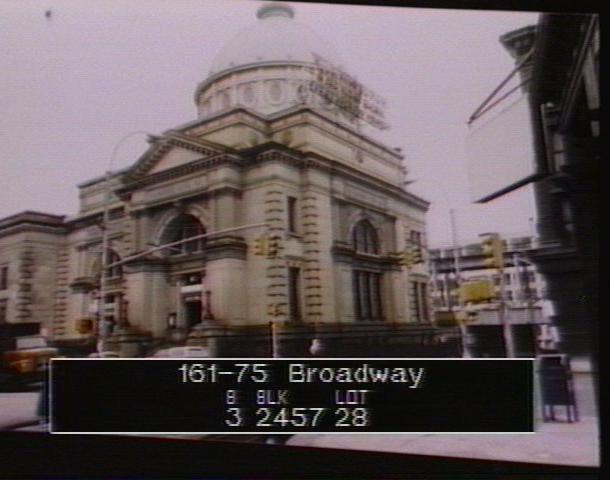
The city photographed every building for its tax records around 1940 and again in the 1980s. NYC Municipal Archives.
Written with AI from the source each entry cites, then fact-checked.
- 1869
The Williamsburgh Savings Bank picks George B. Post after a design competition
After paying $110,000 for a corner plot at Broadway and Driggs Avenue, the bank's trustees invited four architects to compete. Post's Classical Revival plan drew the most votes, ahead of Peter B. Wight's French Second Empire design, though some trustees worried about passing over Wight. Post was chosen that August and offered Wight $5,000 to decorate the interior.
Source: Wikipedia
- 1875
The Williamsburgh Savings Bank opens its $700,000 headquarters
The bank opened the building on June 1, 1875, after delays from design changes, the Panic of 1873 and contractors. It ended up costing $700,000. A year later it held $14 million in deposits from 25,000 accounts, and it sold its old building in 1876. Karl Muller made the sculptural group on the exterior.
“The Williamsburgh Savings Bank opened its new building on June 1, 1875. The year after the building opened, the bank had $14 million in deposits from 25,000 accounts.”
Source: Wikipedia
- 1875
George B. Post's steel dome becomes the bank's emblem
The four-story Classical Revival building is clad mostly in Westerly stone, with a steel-plated dome on a drum of 20 oval windows. The dome became the bank's symbol; its officials later asked for one atop the Hanson Place headquarters of 1929, over its architects' objections. Peter B. Wight designed the interior, including a 75-by-75-foot banking room under the dome.
“The dome became a symbol of the bank, leading bank officials to request the inclusion of a dome atop its second headquarters at One Hanson Place…”
Source: Wikipedia
- 1893
A crowd of depositors makes passersby think the bank is facing a run
In 1893 so many account holders gathered outside the Williamsburgh Savings Bank to deposit money that people walking by assumed it was a bank run with mass withdrawals. The bank had grown quickly since opening the building, reaching $25 million in deposits from 51,000 accounts by 1885.
“…when a large number of account holders gathered outside the building to deposit money in 1893, passersby thought there was a bank run with mass withdrawals…”
Source: Wikipedia
- 1906
A west annex opens with separate banking rooms for men and for women
Helmle, Huberty & Hudswell designed a $300,000 annex, which opened in 1906 after strikes by workers and marble cutters slowed construction. The original banking room reopened that December after $300,000 in renovations, by which time the bank counted 95,000 depositors. After that, men banked in the new room while women stayed under the old dome.
“Afterward, men used the new room while women continued to transact under the old dome.”
Source: Wikipedia
- 1929
The bank opens a new headquarters at One Hanson Place and keeps Broadway as a branch
Since savings banks were allowed branches from 1923, the Williamsburgh decided in 1926 to build a headquarters near Downtown Brooklyn's transit hub. The permanent Hanson Place headquarters opened on April 1, 1929. The Broadway building stayed in use as a branch and was extended west again in 1941-42.
“…the permanent Hanson Place headquarters opened two years later on April 1, 1929.”
Source: Wikipedia
- 1966
The Landmarks Preservation Commission designates the Williamsburgh Savings Bank a landmark
The commission designated the building at 175 Broadway and its tax lot as a city landmark on May 17, 1966, after a hearing at which two witnesses spoke in favor and none opposed. It called the bank an excellent example of Classic Revival architecture from before the 1893 Chicago Fair and noted it had served the community for over ninety years.
- 2010
Juan Figueroa buys the bank building and the property beside it from HSBC for $4.5 million
HSBC had wanted to sell the bank building, but its design suited few modern uses. In 2010 Juan Figueroa bought it and the adjacent property for $4.5 million, and the next year he announced plans for a banquet hall. He said he was mainly drawn by the development potential of the neighboring site. Only a quarter of the original marble floor survived, and Wight's mural was so dirty it looked black.
“In 2010, Juan Figueroa bought the building and adjacent property from HSBC for $4.5 million.”
Source: Wikipedia
- 2014
The old bank reopens as the Weylin, named for a fictional character
After a $24 million restoration from 2011 to 2014 by Figueroa and his cousin Carlos Perez San Martin, the building opened in February 2014 as the Weylin, an event venue. The name came from an invented 19th-century figure, Weylin B. Seymour, whose initials supposedly matched the bank building's monogram. The restoration won the National Trust's Tony Goldman Preservation Award that year.
“The banquet hall was named the Weylin after a fictional 19th-century character, Weylin B. Seymour, whose initials allegedly corresponded to the bank building's monogram.”
Source: Wikipedia
Further reading
Nearby
- Forman Building195 Broadway | 7 entries
- Peter Luger Steak House848 Driggs Avenue | 5 entries
- Meadowsweet149 Broadway | 3 entries
- Long Island Business College143 South 8th Street | 11 entries
- Kings County Savings Bank135 Broadway | 7 entries
- Williamsburgh Trust Company Building (Holy Trinity Cathedral)177 South 5th Street | 6 entries