Forman Building
195 Broadway | also 185 Broadway, 189 Broadway | Williamsburg | built 1883
Open on the map7 entries

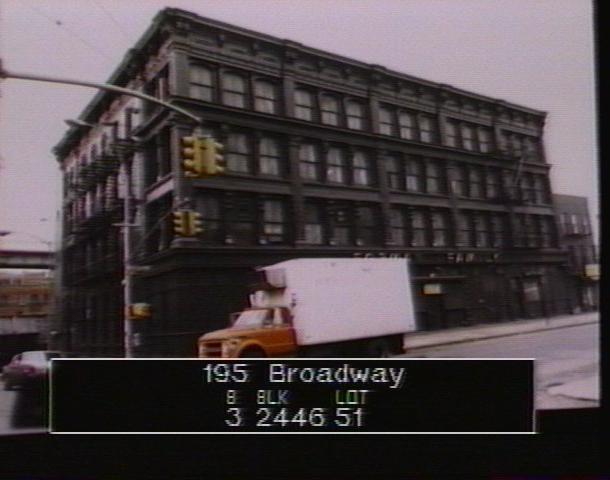
The city photographed every building for its tax records around 1940 and again in the 1980s. NYC Municipal Archives.
Written with AI from the source each entry cites, then fact-checked.
- 1882
James R. Sparrow and his son buy the corner of Broadway and Driggs Avenue and file plans for five buildings
In May 1882 James R. Sparrow and his son James R. Sparrow Jr. acquired a lot at the northeast corner of Broadway and Driggs Avenue, buying it from the Brooklyn Library Building Fund Association. That September architect William B. Ditmars filed plans for five four-story iron and brick business buildings. By March 1883 the work was almost complete, with stores planned for the ground floor and offices above.
- 1883
Herman Schwarzmann's cast-iron front, made by Atlantic Iron Works, decorates the new building with calla lilies
The Broadway facade was cast by the Atlantic Iron Works and designed by Herman J. Schwarzmann, a German immigrant who had been chief architect of Philadelphia's 1876 Centennial Exposition. The Landmarks Commission calls its Neo-Grec design inventive, with unusual calla lily ornament that reflects the Aesthetic Movement. Few cast-iron buildings were put up in Brooklyn, and this is one of them.
- 1886
James R. Sparrow, builder of 183-195 Broadway, dies as a well-known Brooklyn developer
James R. Sparrow, born in Delaware in 1810, worked as a carter, in the whaling trade and in the boot, shoe and iron trades, and later became a real estate developer in Brooklyn. His Brooklyn Eagle obituary described him as the earliest man in Greenpoint to build on a big scale. He died in 1886, only a few years after putting up the Broadway building with his son.
- 1904
Part of the building serves as a police station house for the 184th Precinct
The police department rented part of 183-195 Broadway beginning in 1904 and was still there in 1909, using it as a station house for the 184th Precinct. The completion of the Williamsburg Bridge in 1903 had transformed the neighborhood, and the building's use shifted from commercial toward mostly manufacturing around the same time.
“From 1904 until at least 1909, the police department leased part of the building for use as a station house for the 184th Precinct.”
- 1911
The Sparrow family leases the building to a superintendent of Berlin Knitting Mills, a sweater maker
Frederick Wohl, superintendent of Berlin Knitting Mills, took a lease on the building from the family of James R. Sparrow Jr. in December 1911. The firm made clothing, and the 1912 state industrial directory listed it with 10 men and 20 women making sweaters. Later occupants included many manufacturers, especially textile firms; among them were Brite Yarn Corporation, Fredericks Spinning Company and Mohair Sweater Mills.
- 1937
Benjamin and Sol Forman buy the building and run a metalware factory in it for about fifty years
The Williamsburg Savings Bank foreclosed on the building in 1934, and in March 1937 Benjamin and Sol Forman, children of Russian immigrants, bought it. Their company made stamped-metal giftware such as trays, pitchers and coffeepots, and rented out other space in the building. Sol Forman closed the metalware business in the early 1980s because of foreign competition.
- 1970
The Forman building houses the executive offices of Peter Luger Steakhouse
Sol Forman liked to entertain clients at Peter Luger Steakhouse, across the street at 178 Broadway, and bought the restaurant after it closed in 1950. Address directories of the 1970s and 1980s give 183-195 Broadway as the steakhouse's executive and administrative office.
Nearby
- Williamsburgh Savings Bank (The Weylin)175 Broadway | 9 entries
- Peter Luger Steak House848 Driggs Avenue | 5 entries
- Williamsburgh Trust Company Building (Holy Trinity Cathedral)177 South 5th Street | 6 entries
- Meadowsweet149 Broadway | 3 entries
- Long Island Business College143 South 8th Street | 11 entries
- Kings County Savings Bank135 Broadway | 7 entries