Wiehl & Widmann Building
18 Beaver Street | Financial District | built 1920
Open on the map7 entries

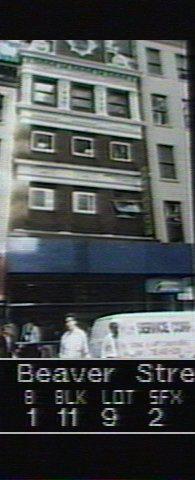
The city photographed every building for its tax records around 1940 and again in the 1980s. NYC Municipal Archives.
Written with AI from the source each entry cites, then fact-checked.
- 1883
Restaurateurs Alfred Wiehl and Eugene Widmann commission a new restaurant building crowned by a statue of Hebe
In 1883 the restaurateurs Alfred Wiehl and Eugene Widmann, both German-born, planned to replace the old building at 18 Beaver Street, used for years by firms such as the fruit importers Barnstorf & Co. They hired H. J. Schwarzmann & Co. to design a store and restaurant, estimated at $20,000. Schwarzmann, who had designed Memorial Hall and Horticultural Hall for Philadelphia's 1876 Centennial Exhibition, set carved brownstone courses against red brick, added floral pilasters on the fourth floor, and capped the gable with a statue of Hebe, the wine-pouring cupbearer of the gods.
Source: Daytonian in Manhattan
- 1888
Produce broker Hugo Mueller, who lost heavily on wheat that day, dies after a visit to the saloon
On May 9, 1888, produce broker Hugo Mueller, a regular at Wiehl & Widmann's, lost heavily on wheat at the Produce Exchange and afterward went with friends to the saloon at 18 Beaver Street. A Brooklyn Daily Eagle account said he was thought to have swallowed a drug mixed into his champagne there. A friend took him home in a coupe, where he died in bed that evening. Alfred Wiehl, testifying before the coroner on May 18, said Mueller had mixed a powder into his wine and then grown flushed and drowsy.
Source: Daytonian in Manhattan
- 1895
Alfred Wiehl mourns Captain Kurt von Goessel, a favorite patron, after the steamer Elbe sinks
German sea captain Kurt von Goessel was a favorite of the restaurant and a close friend of Alfred Wiehl, whose family had hosted the captain's wife for a month in 1893. On the night of January 30, 1895, his steamer Elbe sank in about 20 minutes after colliding with the British steamer Crathie, with more than 330 lives lost. The next morning The Evening World found gloom at 18 Beaver Street, with the captain feared lost, and Wiehl showed the paper a photo of the captain's wife with their daughter, who was 19.
Source: Daytonian in Manhattan
- 1897
Alfred Wiehl asks the White House for a vial of faucet water to baptize a friend's baby named for McKinley
The Draz family, friends of Alfred Wiehl, had a baby on the night William McKinley won the presidency and named him for the president. As the baptism neared in March 1897, Wiehl wrote to the White House and enclosed a vial, asking that it be filled from a White House faucet so the water could be used to christen 'Franze McKinley Draz' in New York the following night. The Evening Star called it a funny request, and Secretary Porter had a bottle of White House water sent to New York in time.
Source: Daytonian in Manhattan
- 1912
A former Russian secret policeman tells a Times reporter about police graft at the Slavic-American League's rooms
The Slavic-American League kept its headquarters in the upper rooms of 18 Beaver Street in 1912. There in August, Leonid Menstchikoff, who had served in the Russian Imperial Secret Police, described police corruption to a New York Times reporter. He said that in Russia everybody had to pay graft because the rules on even legitimate business were so strict that payoffs were needed for tolerable conditions, whereas in America only lawbreakers were made to pay it.
Source: Daytonian in Manhattan
- 1923
The Secret Service staff fills the upstairs dining room for a dinner honoring Joseph A. Palma
On July 2, 1923, the United States Secret Service staff took over the upstairs dining room of Fusco Bros. for a dinner honoring Joseph A. Palma. About 200 people attended the tribute to a man the New York Times said had built his reputation catching counterfeiters and mail robbers. The Fusco brothers, Guido, Lucien and Albert, had started a downtown restaurant business in 1907 and moved it into the building in 1915.
Source: Daytonian in Manhattan
- 1926
Prohibition agents raid Fusco Bros., a restaurant said to be popular with downtown brokers
Fusco Bros. carried on through Prohibition while many restaurants closed, with the building's owner apparently a partner. On April 14, 1926, a 'flying squad' of Prohibition agents raided the restaurant, and the New York Times, covering the padlock proceedings, said it was patronized by many brokers from the Financial District. The family kept the place going long afterward: Guido Fusco's sons Mario and Guido Jr. were still running it in 1974.
Source: Daytonian in Manhattan
Further reading
- The 1883 Wiehl & Widmann Bldg. No. 18 Beaver StreetDaytonian in Manhattan
Nearby
- 2 Broadway9 entries
- American Bank Note Company Building70 Broad Street | 4 entries
- Standard Oil Building26 Broadway | 11 entries
- International Telephone and Telegraph Building75 Broad Street | 4 entries
- 6 Stone Street5 entries
- 25 Bridge Street6 entries