25 Bridge Street
Financial District | built 1910
Open on the map6 entries

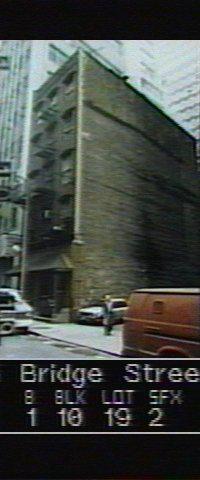
The city photographed every building for its tax records around 1940 and again in the 1980s. NYC Municipal Archives.
Written with AI from the source each entry cites, then fact-checked.
- 1852
Lodger James Martindale returns to the rooming house here to find his rooms rifled and $104 gone
Before the present warehouse, a three-story house stood at 25 Bridge Street and took in lodgers, as many of the area's remaining houses did. In June 1852 James Martindale, who lived on the top floor, returned home to discover that his rooms had been rifled and $104 taken; the thief, John David, was taken into custody on June 16 on burglary and larceny charges. Martindale, later a janitor at the Mechanics' Bank on Wall Street, lost a purse holding $160 in gold while working there in October 1859.
Source: Daytonian in Manhattan
- 1869
A five-story Italianate brick warehouse replaces the old house, and Amelia Whitlock buys it for $15,000
By 1869 the house at 25 Bridge Street had been replaced by a five-story brick warehouse and store building in the Italianate style, with elliptical-arched cast-iron lintels. Its owner, Elizabeth Whitlock, sold it that year to Amelia Whitlock for $15,000, when she bought a building opposite at No. 26. The warehouse was faced in brick with minimal decoration.
Source: Daytonian in Manhattan
- 1884
A fire in a stock of cotton pickings smolders for two hours and showers cotton onto neighboring ledges
A fire started on the fourth floor at about 8 p.m. on January 4, 1884, among the tightly packed cotton pickings of dealer John Collins. The New York Times reported that the blaze smoldered through the stock for two hours while firemen used hooks and brooms along with water, and that cotton thrown from the windows lay on neighboring window copings like snow. Collins lost about $600, bag dealer John H. Haskell and Loewenthal Brothers about $200 each, and the building took about $200 in damage.
Source: Daytonian in Manhattan
- 1891
Engine Company 10, whose firehouse stands just behind, goes home without finding a fire in the building
Shortly after 9:30 p.m. on October 4, 1891, fire again started on the fourth floor, by then home to Percy Kent's bag factory. A boy ran around the block to alert Engine Company No. 10, whose firehouse stood directly behind the building, but the firefighters could not find the blaze and went home. Flames then showed at the rear, and Engine Company No. 4 from Liberty Street, answering a second alarm from Broad Street, put the fire out before No. 10 realized it was real. The Times blamed the unit's stupidity and said its men had grown rusty.
Source: Daytonian in Manhattan
- 1922
The city, which owns the warehouse, draws no bids at two auctions in 1922 and keeps it until 1930
The City bought 25 Bridge Street in 1904 for $35,000. In 1922 the City Controller announced the sale of 202 parcels no longer needed by city departments, including this one, with an upset price of $65,000. No one bid at the auction on August 9 or at a second on August 28, and the building was not sold until 1930, to George W. Butler. Daytonian in Manhattan, calling it in 2017 the only 19th-century building left in its immediate neighborhood, suggests city ownership while the neighboring warehouses were being replaced is most likely why it survived.
Source: Daytonian in Manhattan
- 1962
A 1962 restaurant conversion hides the ground floor behind a country-store facade, later home to the White House Tavern
In 1962 the ground floor became a restaurant, and the cast-iron storefront was covered with a facade like those on a Cracker Barrel, complete with porch and shingled roof; the Italianate cornice was lost at some point. By 1994 the space housed the White House Tavern, a local bar favored by Financial District workers, and the brick was later painted red and fitted with decorative shutters that do not fit the windows. Even so, the loft above is still the 1869 warehouse.
Source: Daytonian in Manhattan
Further reading
- The Surprising Survivor at 25 Bridge StreetDaytonian in Manhattan
Nearby
- 6 Stone Street5 entries
- 2 Broadway9 entries
- Fraunces Tavern54 Pearl Street | 16 entries
- Anglers' Club of New York101 Broad Street | 4 entries
- 105 Broad Street3 entries
- 85 Broad Street (Goldman Sachs headquarters)85 Broad Street | 3 entries