Harlem YMCA
180 West 135th Street | Harlem | built 1932
Open on the map10 entries

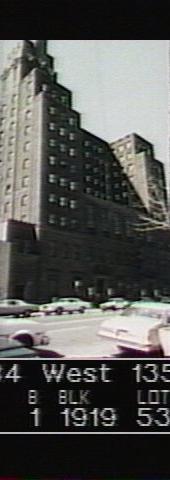
The city photographed every building for its tax records around 1940 and again in the 1980s. NYC Municipal Archives.
Written with AI from the source each entry cites, then fact-checked.
- 1930
The YMCA buys a row of dwellings on West 135th Street as the site for its new branch
After the New York City YMCA decided in March 1930 to build a new home for its West 135th Street branch, it searched central Harlem for a site, but the state's 1929 Multiple Dwellings Law limited much of the area to lower-scale housing. In July it acquired a group of dwellings at 174-184 West 135th Street, opposite the existing branch, as the building site.
“In July, the YMCA acquired a group of dwellings on the south side of West 135th Street (Nos. 174-184), opposite the existing branch, for a building site.”
- 1932
The Harlem YMCA builds its new home at 180 West 135th Street
Built in 1931 and 1932 across the street from the branch's 1919 building, the red-brown brick, neo-Georgian YMCA was designed with James C. Mackenzie Jr. as architect in charge and was among the best-equipped Ys in the country, with residential rooms on its upper floors. Inside hangs Aaron Douglas's mural "Evolution of Negro Dance." The city designated it a landmark on February 10, 1998.
Source: Wikipedia
- 1932
A parade and cornerstone ceremony mark the rise of Harlem's new YMCA
Ground was broken in November 1931 before several hundred people. The cornerstone followed in May 1932 at a larger ceremony preceded by a parade, where speakers thanked the Phelps-Stokes foundation, the late Julius Rosenwald and John D. Rockefeller Jr. for the gifts that made the building possible. The Times described it as the biggest building anywhere for Black young men and boys, though a building-trades strike held up work for nearly six weeks.
- 1933
The new YMCA opens on New Year's Day with an eight-day festival
Finished in December 1932, the building was dedicated and opened on January 1, 1933, starting an eight-day festival. About 15,000 visitors came through, 2,000 people joined as members, and 70 percent of the dormitory rooms were filled. Planned for 4,000 men and 1,000 boys, it held a cafeteria, swimming pool, two gymnasiums, a basement theater and 254 dormitory rooms.
- 1934
A YMCA publication calls the Harlem branch the borough's busiest community center
A 1934 YMCA publication boasted that, as a community center, the branch held more activities inside its building than any other New York YMCA or any other organization in Manhattan. The building hosted groups including the Negro Technical Association's New York chapter and, in the 1940s, the National Coordinating Committee on Civil Rights, and the Little Theater performed in its basement theater.
“…as a community center it surpasses in the number of community activities carried on within the Association building any of the New York Y.M.C.A.'s…”
- 1935
Aaron Douglas paints the WPA mural Evolution of Negro Dance
The Harlem Renaissance painter completes a black-and-white silhouette mural inside the Harlem YMCA, tracing Black history from slavery through the Harlem Renaissance in dance. The Works Progress Administration's Federal Art Project pays for the work; Douglas paints four more Harlem murals around this period, at the nearby 135th Street library. Evolution of Negro Dance still hangs in the building today.
Source: livingnewdeal.org
- 1936
The 135th Street Branch is renamed the Harlem Branch YMCA
On January 1, 1936, the branch's name was officially changed to the Harlem Branch. An observer that year wrote that Harlem saw the Y as one of its leading cultural centers. The building cost $156,000 a year to maintain, with a staff of sixty and more than 250 volunteers, and served an estimated 2,500 visitors daily.
“The name of the 135th Street Branch was officially changed to the "Harlem Branch" on January 1, 1936.”
- 1941
Poet Claude McKay moves into the Harlem YMCA
Writer Claude McKay, a major voice of the Harlem Renaissance, lived at the YMCA from 1941 to 1946. His residence here is why the building was named a National Historic Landmark on December 8, 1976. A young Malcolm Little, later Malcolm X, also stayed at the Y for its closeness to his favorite nightclubs.
Source: Wikipedia
- 1955
The Harlem YMCA opens its programs to girls and women
After the American YMCA officially desegregated following 1946, the Harlem Branch kept serving the largest African-American membership in the country. In 1955 its programs were opened to girls and women, and after 1964 women could also use its accommodations. The branch became known for its "Salute to the Stars" fundraisers and Black Achievers in Industry awards dinners.
- 1976
The federal government names the Harlem YMCA a National Historic Landmark
The U.S. Department of the Interior designates the 1932 building a National Historic Landmark for its association with writer Claude McKay, who lived there for several years. New York City would not designate the building a landmark of its own until 1998, more than two decades later.
Source: Wikipedia
Further reading
- Harlem YMCAWikipedia
Nearby
- New York Amsterdam News Building2293 Adam Clayton Powell Jr Boulevard | 2 entries
- James Weldon Johnson Residence187 West 135th Street | 2 entries
- Small's Paradise200 West 135th Street | 4 entries
- Countee Cullen Library104 West 136th Street | 3 entries
- Mother A.M.E. Zion Church140 West 137th Street | 3 entries
- Schomburg Center for Research in Black Culture515 Lenox Avenue | 12 entries