Schomburg Center for Research in Black Culture
515 Lenox Avenue | also 503 Lenox Avenue | Harlem | built 1910
Open on the map12 entries

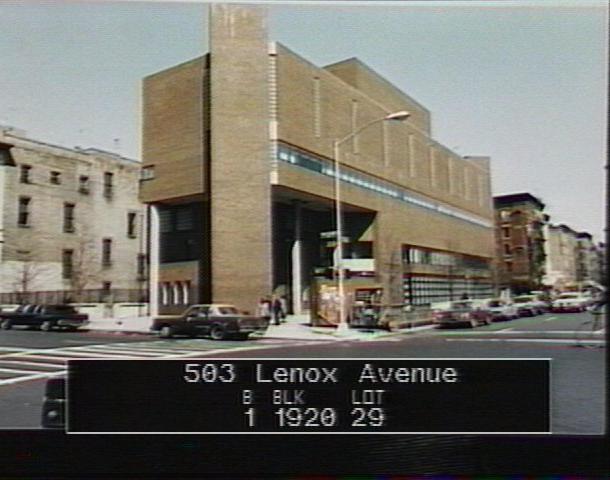
The city photographed every building for its tax records around 1940 and again in the 1980s. NYC Municipal Archives.
Written with AI from the source each entry cites, then fact-checked.
- 1905
The 135th Street branch library opens in a McKim, Mead & White palazzo
The New York Public Library opened its 135th Street branch at 103 West 135th Street on July 14, 1905, with about 10,000 books. Charles Follen McKim of McKim, Mead & White designed it in an Italian Renaissance palazzo style. In May 1925 the branch began operating a Division of Negro Literature, History and Prints, the seed of today's Schomburg Center, which added a new building on Lenox Avenue in 1980.
Source: Wikipedia
- 1921
The library hosts Harlem's first exhibition of African American art
Under librarian Ernestine Rose, the 135th Street branch mounts what becomes an annual showcase of Black artists' work, part of a wider push to build the library's holdings on African American history and culture. Four years later the library formally creates a Division of Negro Literature, History and Prints to house them.
Source: Wikipedia
- 1926
The library acquires Arturo Schomburg's collection with a Carnegie grant
Collector Arturo Schomburg spent more than 20 years gathering books, manuscripts and prints documenting the Black experience. In May 1926 Carnegie Corporation of New York approved $10,000 for the New York Public Library to buy the collection, which went to the Division of Negro Literature, History and Prints at the 135th Street branch. Schomburg later served as its curator from 1932 until his death in 1938.
Source: carnegie.org
- 1938
Arturo Schomburg, the collection's namesake, dies after six years as curator
Schomburg, who sold his roughly 5,000-item personal collection to the library in 1926, had served as its first curator since 1932. His death leaves the division he built as the core of what becomes, by 1940, the Schomburg Collection of Negro History and Literature.
Source: Wikipedia
- 1980
Bond Ryder Associates completes the new brick Schomburg Center building
The Schomburg Center's new building in Harlem was completed in 1980 and is credited to Bond Ryder Associates, the firm of the architect Max Bond. Harvard Magazine counts it among the firm's commemorations of the Black freedom struggle, alongside the King Center in Atlanta, completed two years later. Like many of Bond's designs, it is built of brick, blends modernism with the architectural history of the African diaspora, and keeps to a human scale.
Source: harvardmagazine.com
- 1981
The city designates the 135th Street library a landmark
The Landmarks Preservation Commission designates Charles McKim's 1905 Italian Renaissance library, built with funding from Andrew Carnegie, a New York City landmark. The building, by then the heart of the Schomburg Center for Research in Black Culture, later receives National Historic Landmark status in 2016.
Source: Wikipedia
- 1991
Houston Conwill's Rivers cosmogram is set into the lobby floor above Langston Hughes's ashes
Sculptor Houston Conwill's 1991 terrazzo installation Rivers fills the floor of the Langston Hughes Lobby, and the poet's ashes are interred beneath it. Lines from Hughes's poem The Negro Speaks of Rivers run across a copper-colored cosmogram, ringed by a blue band naming the Mississippi, Congo, Nile and Euphrates. Hyperallergic describes the work as honoring both Hughes and Arturo Schomburg, the center's namesake.
Source: hyperallergic.com
- 1991
Amiri Baraka and Maya Angelou dance on the new Hughes cosmogram at an evening celebration
At an evening celebration of Langston Hughes in 1991, held in the newly expanded Schomburg Center, the poets Amiri Baraka and Maya Angelou danced on the cosmogram, which features one of Hughes's poems. The NYC LGBT Historic Sites Project preserves the moment in a photograph by Chester Higgins Jr. The picture was taken for The New York Times.
Source: NYC LGBT Historic Sites Project
- 2000
Lest We Forget: The Triumph Over Slavery opens and later tours the world for UNESCO
In 2000 the Schomburg Center mounted an exhibition called Lest We Forget: The Triumph Over Slavery. It afterward traveled internationally for more than ten years under the sponsorship of UNESCO's Slave Route Project. A later Schomburg show, in 2005, drew on letters and photographs related to Malcolm X.
Source: Wikipedia
- 2017
A $22.3 million renovation adds gallery and research space and a two-story annex
Finished in 2017, a $22.3 million project gave the Schomburg Center new gallery and research areas, a two-story annex, and upgrades to the Langston Hughes Auditorium and the second-floor Rare Books Reading Room. It came during Kevin Young's four years as director, when yearly attendance rose by 40 percent to about 300,000 visitors and the center landed major archives, among them the papers of James Baldwin.
Source: Wikipedia
- 2017
The Schomburg Center is named a National Historic Landmark
In January 2017 the center received National Historic Landmark status. The NYC LGBT Historic Sites Project notes that its holdings include records of Lorraine Hansberry, James Baldwin and the Alvin Ailey American Dance Theatre. Within the Manuscripts, Archives and Rare Books Division, the In the Life Archive, once called the Black Gay and Lesbian Archive, gathers works by Black LGBT people.
Source: NYC LGBT Historic Sites Project
- 2020
The Schomburg acquires Harry Belafonte's personal archive
In March 2020 the Schomburg Center acquired the archive of Harry Belafonte, whose recordings, letters, manuscripts and photographs document a career of more than seventy years. Funders including the Mellon, Open Society and Ford foundations backed the purchase. NBC News noted that Belafonte's career began with the American Negro Theatre, located in the basement of the Schomburg Center, and director Kevin Young called it a great honor to welcome Belafonte back.
Source: nbcnews.com
Further reading
Nearby
- Countee Cullen Library104 West 136th Street | 3 entries
- Harlem Hospital Mural Pavilion512 Lenox Avenue | 3 entries
- Harlem Hospital Center506 Lenox Avenue | 4 entries
- Mother A.M.E. Zion Church140 West 137th Street | 3 entries
- Harlem YMCA180 West 135th Street | 10 entries
- James Weldon Johnson Residence187 West 135th Street | 2 entries