Gracie Mansion
181 East End Avenue | also 97 East End Avenue | Yorkville | built 1801
Open on the map20 entries

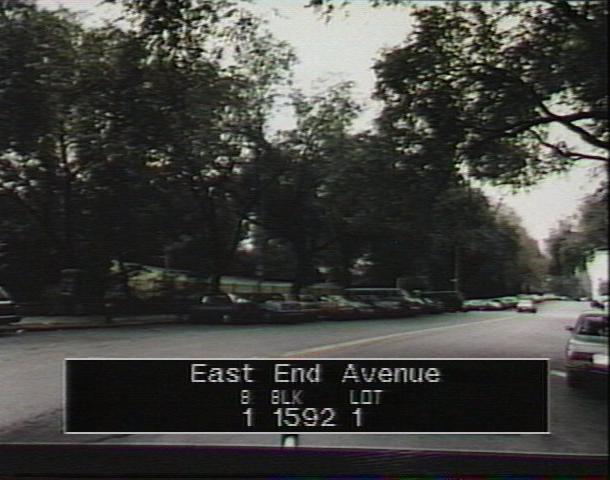
The city photographed every building for its tax records around 1940 and again in the 1980s. NYC Municipal Archives.
Written with AI from the source each entry cites, then fact-checked.
- 1770
Merchant Jacob Walton builds an earlier mansion on the same bluff
Walton's house, known as Belview, stands on the site nearly three decades before Archibald Gracie's mansion goes up. The Continental Army fortifies the site in 1776, and British cannon fire heavily damages the house that September; British forces then hold the site until 1783.
Source: Wikipedia
- 1799
Merchant Archibald Gracie builds a country house above the East River
Archibald Gracie, a wealthy merchant, bought this riverside land in December 1798 and January 1799 and built his house here in 1799. The site had earlier held Jacob Walton's 1770 house, Belview, which became a Continental Army fort in 1776 and was hit by British cannon fire that September.
Source: Wikipedia
- 1801
Gracie hosts Hamilton and fellow Federalists on his porch, and a newspaper follows
In 1801 Archibald Gracie, a friend and business partner of Alexander Hamilton, hosted a meeting of Federalists on his porch, led by Hamilton. The gathering led to the founding of the New-York Evening Post, known today as the New York Post. The newspaper later built a headquarters at 20 Vesey Street in 1907.
Source: Untapped New York
- 1813
Washington Irving praises Gracie's riverside retreat in a letter
In 1813 the writer Washington Irving, one of many notable guests of Archibald Gracie, wrote that he could hardly express how sweet and delightful he found the retreat, with its pure air, pleasing scenery and deep quiet. Gracie's visitors also included Alexander Hamilton, John Jacob Astor, John Quincy Adams and the future French king Louis Philippe. Irving possibly wrote some of his novel Astoria at the house.
“I cannot tell you how sweet and delightful I found this retreat, pure air, agreeable scenery and profound quiet…”
Source: Wikipedia
- 1823
War of 1812 losses force Archibald Gracie to give up his mansion
Gracie's firm loses more than a million dollars during the War of 1812, and the war's aftermath drains his finances. By 1823 the mansion has passed to Rufus King, whose sons had married two of Gracie's daughters; King puts the property up for sale that April, and Archibald Gracie & Son dissolves the following month.
Source: Wikipedia
- 1896
The city acquires the mansion for its new park and turns it into a park outbuilding
In 1896 New York City took the house through condemnation proceedings connected with a park it was building nearby, today's Carl Schurz Park. The decorative trellis railings were removed, and the mansion became a shabby outbuilding that served for a time as public restrooms and an ice-cream parlor. Those ordinary park uses lasted until the 1920s, when the Museum of the City of New York moved in.
Source: americanheritage.com
- 1924
The Museum of the City of New York opens inside the mansion
The city took over the land for Carl Schurz Park in 1891 and acquired the house itself in 1896. In November 1924 the Museum of the City of New York opened in the mansion, formally opening its exhibits to the public in March 1927. The museum moved out completely in August 1932.
Source: Wikipedia
- 1928
Blasting in Hell Gate brings down part of the mansion's ceiling
In June 1928 part of a ceiling in the mansion collapsed after the U.S. War Department set off explosives in the Hell Gate channel to deepen it. The house was shut for repairs, but the ceiling could not be fixed while the blasting continued. The war secretary denied the building was structurally damaged.
Source: Wikipedia
- 1934
Robert Moses has the vacant mansion restored with a new roof, porch and clapboards
By 1934 the house had stood vacant for two years after the Museum of the City of New York left. Parks Commissioner Robert Moses, who was then upgrading Carl Schurz Park, pressed for a proper restoration, and the house received a new roof, a new porch, new clapboards and badly needed interior repairs. Moses later proposed the rescued house as the mayor's official residence.
Source: americanheritage.com
- 1942
Fiorello La Guardia moves in, making Gracie Mansion the mayor's residence
On May 27, 1942, Mayor Fiorello La Guardia and his family moved into the mansion, the first mayor to live here, and it has served as the official mayoral residence since. A new wing named for Susan Wagner, wife of Mayor Robert F. Wagner Jr., was dedicated on September 27, 1966, a week after the city made the house a landmark.
Source: Wikipedia
- 1946
Mayor O'Dwyer moves in and the city installs an elevator for his ailing wife Kitty
William O'Dwyer moved into the mansion at the end of January 1946, having decided it offered his family more privacy than their Brooklyn home. An elevator was installed for his wife Kitty, who had Parkinson's disease, though she stayed mostly on the upper floors with her nurses and housekeeper instead of using it. Kitty O'Dwyer died within a year of the move.
“An elevator was installed for O'Dwyer's wife Kitty, who had Parkinson's disease…”
Source: Wikipedia
- 1957
Susan Wagner hosts so many events that she sometimes changes clothes in a closet
By 1957 Susan Wagner, wife of Mayor Robert F. Wagner Jr., estimated that she was holding at least 125 events a year at the mansion. Almost every room was open to visitors, and charities held teas there. Official city meetings sometimes pushed into the family's living space, forcing her to go into a closet to change clothes.
“…forcing Susan to go inside a closet to change clothes…”
Source: Wikipedia
- 1966
The Landmarks Preservation Commission designates Gracie Mansion a city landmark
On September 20, 1966, the Landmarks Preservation Commission designated Gracie Mansion a landmark, following a March hearing where two witnesses, including Parks Commissioner Thomas Hoving, spoke in favor and no one opposed. The commission found it the only one of Manhattan's original country seats still lived in as a home, and also pointed to its role as the residence of the mayors of New York.
- 1966
A fireplace from the house where Hamilton died is installed in the new ballroom
When the Susan B. Wagner wing was built in 1966, its ballroom received a fireplace from the Bayard family house on Jane Street in the West Village. After his 1804 duel with Aaron Burr, Alexander Hamilton was brought to that house and, by tradition, spent his last moments before the hearth, dying on July 12.
Source: Untapped New York
- 1966
The mansion gains a wing named for Susan B. Wagner
Workers complete an addition named for the wife of former mayor Robert F. Wagner, adding space for official entertaining separate from the family's private quarters. The Susan B. Wagner Wing lets the mansion host larger public events without disrupting the residence next door.
Source: Wikipedia
- 1970
A spark from WPIX's Yule Log reshoot burns a rug and ends filming at the mansion
WPIX shot its original Yule Log, a fireplace film aired on Christmas, in the mansion's Peach Room between 1966 and 1970. In 1970 the station reshot it on 35-millimeter film because the first 16-millimeter reel had worn out, and the crew removed the fireplace screen for a fuller fire. A stray spark damaged an antique rug, Mayor John Lindsay refused a return visit, and later versions were filmed in an identical fireplace in California.
Source: Untapped New York
- 1981
Mayor Ed Koch establishes the Gracie Mansion Conservancy
Koch sets up the nonprofit Conservancy as a public-private partnership to fund restoration and upkeep of the aging mansion. The organization leads a $5.5 million renovation completed during his administration and continues to oversee the historic house's preservation decades later.
Source: Wikipedia
- 2001
A judge bars Rudy Giuliani's girlfriend from Gracie Mansion at his wife's request
On May 21, 2001, State Supreme Court Justice Judith Gische barred Judith Nathan, Mayor Rudy Giuliani's girlfriend, from entering the mansion or its grounds while the mayor's children lived there. Donna Hanover, his estranged wife, had sought the order and called the mansion a private home. Giuliani countered that parts of the 200-year-old house were public and that Nathan should be able to attend functions there.
Source: cbsnews.com
- 2002
Mayor Bloomberg declines to live in Gracie Mansion and raises money to renovate it
Michael Bloomberg became the only mayor since 1942 not to live in Gracie Mansion, staying instead in his own Beaux-Arts townhouse on East 79th Street. He said it would be wrong to take one of the city's great houses away from the public, and he led a campaign to raise money to renovate the house. After a $7 million renovation overseen by decorator Jamie Drake in 2002, tours and events held by city agencies and nonprofit groups increased.
Source: Untapped New York
- 2025
A man scales the fence on New Year's morning and is found in a second-floor bedroom
Shortly before 4:30 a.m. on January 1, 2025, a 20-year-old from the neighborhood climbed the mansion's perimeter fence and reached a second-floor bedroom, where Mayor Eric Adams's security detail found him. Police said he had filmed himself taking a Christmas ornament from a drawer. Adams was not home and was not in danger. The man was charged with burglary and illegal entry, and bail was set at $5,000.
Source: abc7ny.com
Further reading
- Gracie MansionWikipedia
Nearby
- Henderson Place549 East 86th Street | 6 entries
- Henderson Place6 Henderson Place | 5 entries
- Asphalt Green (Municipal Asphalt Plant)555 East 90th Street | 10 entries
- The Chapin School100 East End Avenue | 9 entries
- 10 Gracie Square6 entries
- Church of St. Joseph (Yorkville)428 East 87th Street | 5 entries