Asphalt Green (Municipal Asphalt Plant)
555 East 90th Street | also 1712 York Avenue | Yorkville | built 1942
Open on the map10 entries

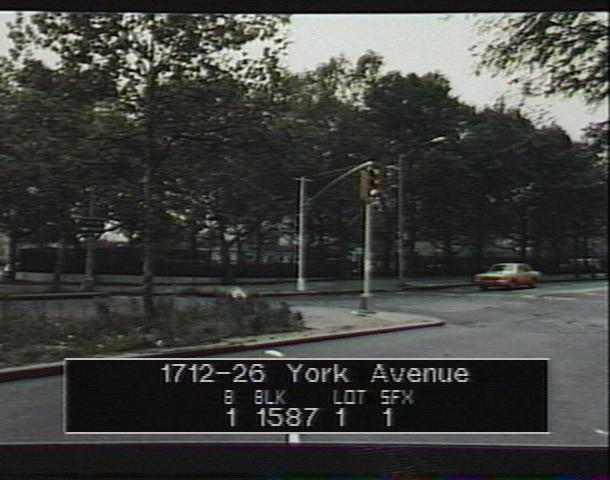
The city photographed every building for its tax records around 1940 and again in the 1980s. NYC Municipal Archives.
Written with AI from the source each entry cites, then fact-checked.
- 1914
An earlier asphalt plant opens on the East River at 91st Street to pave Manhattan
An earlier asphalt plant opened on this East River site in 1914 to produce asphalt for Manhattan's streets. The waterfront spot near the borough's geographical center was chosen so raw materials could arrive by water with little trucking through the streets. By the late 1930s that plant was outmoded and the area had shifted from semi-commercial to residential, but the site was still judged the right place for a replacement.
“This plant replaced another asphalt plant on the site which had opened in 1914 to produce asphalt for the streets of Manhattan.”
- 1943
Robert Moses derides the new asphalt plant as a Cathedral of Asphalt
Parks commissioner Robert Moses disliked the plant, dubbing it the Cathedral of Asphalt and calling it a freakish experiment. In a 1943 op-ed in the New York Times he named it as one example of the modernistic buildings going up around the city. Walker Binger, the public works commissioner who supervised the project, answered in the Times with a defense of the design.
Source: Wikipedia
- 1944
The city completes a parabolic concrete asphalt plant on the East River
Designed by Ely Jacques Kahn and Robert Allan Jacobs and built from 1941 to 1944, the Municipal Asphalt Plant mixed paving material for city streets. It is described as the first parabolic-arched building in the United States made of reinforced concrete, and the Museum of Modern Art included it in its 1944 exhibition "Art in Progress" as an example of good design.
Source: Wikipedia
- 1944
The Museum of Modern Art shows the asphalt plant in its Built in the U.S.A. exhibition
Despite the criticism during construction, the arched plant won praise from the Museum of Modern Art, which featured it in the spring 1944 exhibition Built in the U.S.A. 1932-1944. The March 1944 issue of Architectural Forum also published the building and applauded its functionalism.
“…acclaimed by the Museum of Modern Art when it was exhibited in the show "Built in the U.S.A. 1932-1944" in the spring of 1944…”
- 1944
The city approves $97,000 in dust-removal equipment as plant dust drifts toward Gracie Mansion
In May 1944, just before the plant opened, the Planning Commission approved dust-elimination equipment costing $97,000. Equipment already in place caught 85 percent of the dust, but the rest often blew over the East River toward Gracie Mansion, the mayor's residence nearby.
“…the remaining dust often drifted over the East River and into the nearby Gracie Mansion, the New York City mayor's residence…”
Source: Wikipedia
- 1968
The city shuts down its East River asphalt plant
The parabolic-arched mixing plant that had supplied asphalt for Manhattan's streets since 1944 closed in 1968 as the city consolidated its asphalt production at a single plant in Queens. The building sat empty on the East River for years afterward, its future uncertain.
Source: Wikipedia
- 1972
A neighborhood group starts raising private money to turn the closed plant site into Asphalt Green
In 1972 a grass-roots community organization began raising money to turn the shuttered plant site into a youth sports and recreation center, which became known as Asphalt Green. The Landmarks Commission later reported that its grass field for football, soccer and softball was the only one of its kind in that part of the East Side. Private funds raised door to door and from foundations, notably the Vincent Astor and Heckscher foundations, paid for the facilities, and school and youth groups used them heavily in 1974-75.
“…began raising funds to convert the site into a much needed youth sports and recreational center…”
- 1974
Neighborhood opposition led by Dr. George Murphy kills a housing plan for the shuttered plant
City officials had proposed converting the closed asphalt plant into housing through the Educational Construction Fund, but physician George Murphy organized sustained neighborhood resistance to the plan. The fund canceled the housing project in August 1974, clearing the way for a recreation center instead. The building's eventual gym would later be named for Murphy and his wife Annette.
Source: Wikipedia
- 1976
The city designates the closed asphalt plant a landmark
The plant stopped operating in 1968. Its storage buildings and conveyor were torn down, but the concrete mixing building survived three weeks of demolition attempts. Neighbors led by local doctor George Murphy fought plans to redevelop the site, and the Landmarks Preservation Commission designated the building in January 1976; it joined the National Register in 1980.
Source: Wikipedia
- 1984
The old mixing plant reopens as the George and Annette Murphy Center
Asphalt Green began in 1973 as a temporary field and courts on the site. After a $3 million renovation, the mixing plant reopened in October 1984 as a sports and arts center named for George and Annette Murphy. An indoor AquaCenter followed, with its main pool completed in June 1993 at a cost of $24 million.
Source: Wikipedia
Further reading
- Municipal Asphalt PlantWikipedia
Nearby
- Gracie Mansion181 East End Avenue | 20 entries
- Henderson Place549 East 86th Street | 6 entries
- Henderson Place6 Henderson Place | 5 entries
- Glaser's Bake Shop1670 1st Avenue | 3 entries
- Church of St. Joseph (Yorkville)428 East 87th Street | 5 entries
- St. Joseph Church (Yorkville)404 East 87th Street | 6 entries