Whittemore House
181 West 10th Street | West Village | built 1839
Open on the map5 entries

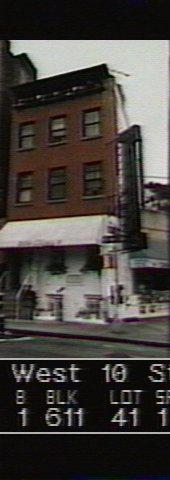
The city photographed every building for its tax records around 1940 and again in the 1980s. NYC Municipal Archives.
Written with AI from the source each entry cites, then fact-checked.
- 1830
Samuel Whittemore's textile-machinery factory stands where 181 West 10th Street later rises
The lot where 181 West 10th Street now stands was once part of the factory of Samuel Whittemore, who built machinery for the textile industry and sat in the State Assembly in 1816. The works covered ground bounded by Amos, Asylum, Factory and Charles streets, which became West 10th, West 4th and Waverly Place. After Whittemore became president of the new Greenwich Bank in 1830 and moved to Grove Street, the factory was soon demolished.
Source: Daytonian in Manhattan
- 1833
William T. Whittemore builds nine Greek Revival houses on his father's factory site
In 1833 William T. Whittemore, son of the factory owner, began a speculative row of nine houses, with five fronting West 10th Street and four fronting West 4th. No. 181 was faced in red brick with brownstone trim, with iron stoop railings ending in basket-like newels on stone bases. Whittemore never lived in any of them.
Source: Daytonian in Manhattan
- 1873
Theater manager James E. Hayes dies at home at 181 West 10th Street a month after announcing the Olympic's rebuild
James E. Hayes bought the house in the late 1860s. A scenic artist who began at the Olympic Theatre in 1863, he later took over its lease and management from his father-in-law, manager John Duff. On April 5, 1873 he announced the renovated Olympic as nearly a new house, then died in the house on May 7, aged 47, of what the Herald called brain fever, before it reopened.
Source: Daytonian in Manhattan
- 1913
The Seventh Avenue extension slices the corner off 181 West 10th Street
Real estate agent Charles C. Hickok lobbied for years to push Seventh Avenue south of 11th Street to Varick Street, and in 1913 the work began alongside the Seventh Avenue subway. It wiped out most of the Whittemore row on West 10th Street. No. 181 survived with a trimmed corner, and owner William V. Burke hired architect Roland I. Markwith in June 1914 to patch the masonry, leaving the building's odd chamfered corner.
Source: Daytonian in Manhattan
- 1939
A restaurant partner sues over the name Julius, and the other Julius wins
Julius Lombardi ran a bar and grill in the ground floor of 181 West 10th Street with partner John Reneganeschi, who ended the partnership on March 1, 1939. Lombardi renamed the place Julius and hung an illuminated sign, while Reneganeschi opened his own Julius a block away on West 10th. He sued for deceptive use of the name, and the State Supreme Court ruled against Lombardi. Reneganeschi's bar is today's Julius.
Source: Daytonian in Manhattan
Further reading
- The 1839 Wm. T. Whittemore House - 181 West 10th StreetDaytonian in Manhattan
- Then & Now photos: 181 West 10th StreetVillage Preservation: Greenwich Village Then & Now
Nearby
- 54 Charles Street5 entries
- 56 Charles Street1 entry
- 58 Charles Street1 entry
- 52 Charles Street1 entry
- 48 Charles Street5 entries
- 50 Charles Street1 entry