Vander Ende-Onderdonk House
1820 Flushing Avenue | also 140 Onderdonk Avenue | Ridgewood | built 1775
Open on the map9 entries

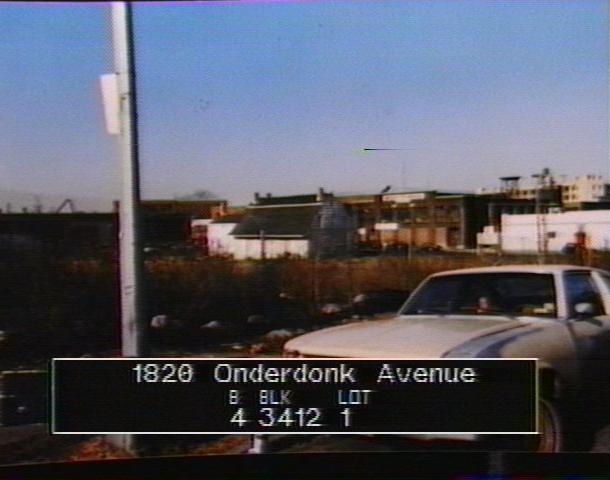
The city photographed every building for its tax records around 1940 and again in the 1980s. NYC Municipal Archives.
Written with AI from the source each entry cites, then fact-checked.
- 1709
Paulus van Ende buys the 100-acre farm tract on the disputed Bushwick-Newtown line
In 1709 Paulus van Ende and his wife, probably the daughter of Hendrick Ryker, bought one hundred acres here, in land long contested between Dutch Bushwick and English Newtown. Van Ende, born around 1679 in Utrecht, was living in Flatbush at the time. His son Hendrick inherited the farm in 1737, and Hendrick's widow, Antie Calyer van Ende, took it over in 1750. The stone house itself is thought to date from later in the century.
“The land changed hands several times prior to 1709, when one hundred acres were purchased by Paulus van Ende and his wife…”
- 1738
A 1738 census records the Vander Ende family holding three enslaved people
A census taken in 1738 lists the Vander Ende family, owners of this farm, as holding three enslaved people. Atlas Obscura counts the house among the few surviving sites in New York City tied to slaveholding, and notes that around the start of the 1700s about 42 percent of New York households owned slaves, a share exceeded among the colonial cities only by Charleston, South Carolina.
Source: atlasobscura.com
- 1779
Owner Moses Beadel dies a prisoner during the Revolutionary War
A January 1769 survey fixing the line between Kings and Queens counties used a corner of this house as a marker, describing it as once Frederick Van Nanda's and then held by Moses Beadel, husband of Hendrick van Ende's daughter Jane. Beadel died in 1779, a prisoner in the Revolution. His son, also Moses, and daughter-in-law Jane Remsen took over the farm and sold nearly half of it in 1786.
“After Moses Beadel's death in 1779 as a prisoner during the Revolutionary War, the Onderdonk House property passed to his son…”
- 1821
Adrian Onderdonk buys the farm two years after marrying Ann Wyckoff
Adrian Onderdonk, born in 1795 in Cow Neck (Manhasset), bought the property in 1821, two years after marrying Ann Wyckoff, whose Brooklyn family owned several farms nearby on Flushing Avenue. The couple probably added the frame wing and new fireplaces. Adrian died young in 1831; Ann stayed on with their daughters, possibly until her death in 1863. Daughter Gertrude Onderdonk Schoonmaker inherited the house, the last of the family connected with it.
- 1912
Gertrude Schoonmaker sells the house, and a scrap glassworks opens on the old farm
Gertrude Onderdonk Schoonmaker sold the house and a small parcel around it in 1912, after earlier selling other parts of the farm for development. As factories filled the neighborhood, Louise Gmelin ran a scrap glassworks on the property until about 1924, and by the early 1920s dormers had been added to the roof.
“Louise Gmelin started a scrap glassworks here which continued until about 1924.”
- 1937
A state boundary adjustment moves the Onderdonk House into Queens
In 1937 New York State adjusted the county line and placed the house in Queens. By then it had drawn notice as one of a group of 18th-century farmhouses still standing among the factories along Flushing Avenue. The Historic American Buildings Survey had recorded it in photographs and drawings in 1936, and it appeared in the Federal Writers' Project's 1939 New York City Guide.
- 1944
A greenhouse manufacturer hides the farmhouse behind a brick front addition
The American Moninger Greenhouse Manufacturing Corp. used the house for offices and a caretaker's apartment, and in 1944 built a brick neo-Federal addition across its front, designed by engineer Saul Goldsmith, while tearing down the old frame wing. A factory, storage sheds and a lumber yard took up the rest of the lot. Industry stayed until 1973, including work making spacecraft parts for the Suisse-O-Matic Co.
“…the American Moninger Greenhouse Manufacturing Corp., which in 1944 constructed a brick neo-Federal style addition (designed by engineer Saul Goldsmith) covering the front of the house…”
- 1975
Fire badly damages the house soon after neighbors save it from demolition
The factory buildings on the lot came down in 1974, and local residents mounted a campaign that kept the house from being demolished. In January 1975 a fire left it severely damaged. The National Register of Historic Places added it in January 1977, and that December the Greater Ridgewood Historical Society took ownership.
“Local residents mounted a successful effort to prevent the demolition of the house, but it was severely damaged by fire in January of 1975.”
- 1980
Giorgio Cavaglieri's firm rebuilds the burned farmhouse from 1936 survey records
From 1980 to 1982 the firm of Giorgio Cavaglieri reconstructed the house, relying mostly on the 1936 Historic American Buildings Survey drawings and what survived the fire, paid for by city, state and federal funds and local fundraising. Little 18th-century fabric remains beyond much of the rough stonework of the foundation and first story; the gambrel roof with spring eaves, double Dutch doors and frame wing are re-creations.
“The only surviving eighteenth-century material is much of the rough random ashlar stonework of the foundation and first story…”
Further reading
- Vander Ende–Onderdonk HouseWikipedia
Nearby
- House of Yes2 Wyckoff Avenue | 3 entries
- 1861 Stockholm Street2 entries
- 1863 Stockholm Street1 entry
- 1867 Stockholm Street1 entry
- 1869 Stockholm Street2 entries
- 1871 Stockholm Street2 entries