The Warwick
184 West 10th Street | also 188 West 10th Street, 230 West 4th Street | West Village | built 1881
Open on the map5 entries

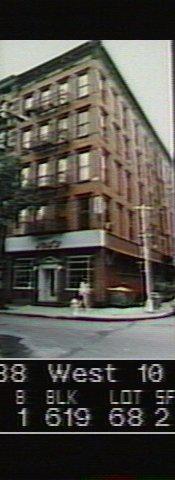
The city photographed every building for its tax records around 1940 and again in the 1980s. NYC Municipal Archives.
Written with AI from the source each entry cites, then fact-checked.
- 1881
Dugro & Raegener finish the Warwick apartments with stores at West 4th and West 10th
Attorney and future congressman Philip Henry Dugro and his partner Herman Raegener hired architect F. W. Klemt in 1880 to design a five-story building with apartments and stores on the southwest corner where West 4th meets West 10th Street. It cost $18,000 and opened in 1881 in neo-Grec style, red brick with brownstone trim. A stone plaque above the West 10th Street entrance reads Warwick.
Source: Daytonian in Manhattan
- 1895
A tenant is named in a court fight between two women who each claim to be Thomas Watson's wife
Lizzie Barton, who lived in the Warwick in 1895, became entangled with a man named Thomas Watson who turned out to have more than one wife. Antoinette Watson went to court on May 3, 1895 to make Ella May Watson prove her marriage, and Ella May countersued for $30,000 and filed for divorce, naming both Antoinette and Barton. Barton does not appear to have been called to testify.
Source: Daytonian in Manhattan
- 1904
Black Hand extortionists demand $10,000 from the saloon keeper on the ground floor
Herman Romer ran the saloon in the building's West 4th Street storefront. On September 1, 1904 he received a letter decorated with a black hand, a stiletto, a revolver and a skull and crossbones, demanding $10,000 left in Tompkins Square Park by September 14 or he would be killed. He took it to the Detective Bureau, which offered a $1,000 reward for the sender.
Source: Daytonian in Manhattan
- 1923
A funeral parlor at 230 West 4th Street is exposed as a speakeasy when a hearse arrives with beer kegs
Saloon owner Fred Kern was arrested in a Prohibition raid in August 1922, then converted his corner saloon into a funeral parlor. Notices of funeral services ran in the newspapers, but visitors were partying in a back-room speakeasy. The scheme lasted until September 9, 1923, when two Prohibition agents inspected a hearse at the curb and found it loaded with about six kegs of beer.
Source: Daytonian in Manhattan
- 2011
Alex Stupak opens Empellon in the corner storefront after a run of short-lived restaurants
The corner space cycled through restaurants for decades. Joe's gave way to Formerly Joe's and then Joe's Again, and by 1999 Chow Bar and Grill had replaced it, which a Times critic noted in 2000 had been shortened to Chow Bar. Comida Mercado Fresca opened in 2010, and in 2011 chef Alex Stupak's Mexican restaurant Empellon took the space.
Source: Daytonian in Manhattan
Further reading
- The 1881 Warwick Apartments -- 184 West 10th StreetDaytonian in Manhattan
- Then & Now photos: 184-188 West 10th Street (aka 230 West 4th Street)Village Preservation: Greenwich Village Then & Now
Nearby
- 228 West 4th Street6 entries
- 224 West 4th Street5 entries
- 77 Christopher Street1 entry
- St. John's Lutheran Church Parsonage79 Christopher Street | 2 entries
- St. John's Lutheran Church81 Christopher Street | 6 entries
- St. John's Evangelical Lutheran Church Parish House83 Christopher Street | 2 entries