228 West 4th Street
West Village | built 1899
Open on the map6 entries

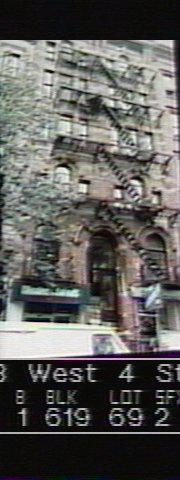
The city photographed every building for its tax records around 1940 and again in the 1980s. NYC Municipal Archives.
Written with AI from the source each entry cites, then fact-checked.
- 1896
Distiller Ephraim Howe dies at 85 in the old house that stood at 228 West 4th Street
An earlier building on this site was the home of Ephraim Howe, a descendant of a Mayflower passenger who made a fortune in the distillery business and belonged to the Produce Exchange. He stayed on in the house as the neighborhood filled with tenements and died there on April 8, 1896, aged 85. His estate included a $40,000 gift to Tufts College toward a new building.
Source: Daytonian in Manhattan
- 1899
Builder Peter J. Herter replaces Ephraim Howe's old house with a tenement covered in bearded faces
The Sun reported on September 16, 1899 that Howe's estate had sold the old building to a builder from the Herter family. Peter J. Herter of P. Herter & Son designed a Romanesque Revival tenement with a steep stoop, a tall entrance, classical relief panels, and carved bearded faces as keystones and supports. Balconies were propped on spread-winged eagles. The flashy ornament was meant to attract blue-collar tenants.
Source: Daytonian in Manhattan
- 1910
Muralist and stained-glass artist Genevieve Cowles lives at 228 West 4th Street
Genevieve Almeda Cowles, born in 1871, lived here in 1910. She specialized in mural decoration and stained glass but was best known for work with her twin sister Maude. The two illustrated books, among them an 1899 edition of Hawthorne's The House of the Seven Gables, and designed windows for Grace Church's Honor Room on Broadway.
Source: Daytonian in Manhattan
- 1912
Resident George Vredenberg is arrested for walking into a burned building with a lit cigar
A fire adjuster's clerk living here, George S. Vredenberg, was arrested on February 4, 1912 at 636 Broadway, where a millinery factory building had burned and then caught fire a second time a few hours later. Chief Kenlon suspected a careless smoker had caused the rekindling, and he ordered the arrest when Vredenberg came in with a lighted cigar. The charge was bringing it into a building full of people and flammable goods.
Source: Daytonian in Manhattan
- 1922
Prohibition agents raid the tearoom of resident Herbert Lyson on New Year's Eve
Herbert Lyson, who lived here, owned a Greenwich Village tearoom at 163 West 4th Street. Candle-lit tearooms like his drew artists and uptown visitors, but on New Year's Eve 1922 Lyson was serving alcohol. Prohibition agents raided the place that night and arrested four patrons and Lyson, who were held on $500 bail.
Source: Daytonian in Manhattan
- 1969
The Amron Gallery serves whale meat and muktuk at an Eskimo art preview in the ground-floor shop
Through the 1960s and early 1970s the street-level space held the Amron Gallery, which sold American Indian and Eskimo crafts. The New York Times reported on March 10, 1969 that nearly 300 people crowded in around a 55-gallon goldfish tank for a preview of Eskimo sculpture, prints and toys. Guests nibbled on whale meat in a Spanish sauce, along with Arctic char and muktuk marinated in mustard sauce.
Source: Daytonian in Manhattan
Further reading
- The Over-the-Top No. 228 West 4th StreetDaytonian in Manhattan
- Then & Now photos: 228 West 4th StreetVillage Preservation: Greenwich Village Then & Now
Nearby
- The Warwick184 West 10th Street | 5 entries
- 224 West 4th Street5 entries
- 77 Christopher Street1 entry
- St. John's Lutheran Church Parsonage79 Christopher Street | 2 entries
- St. John's Lutheran Church81 Christopher Street | 6 entries
- St. John's Evangelical Lutheran Church Parish House83 Christopher Street | 2 entries