Julius'
186 Waverly Place | also 159 West 10th Street | West Village | built 1826
Open on the map15 entries

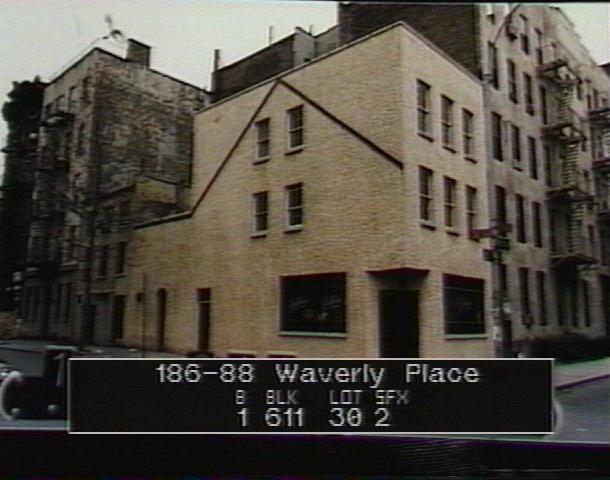
The city photographed every building for its tax records around 1940 and again in the 1980s. NYC Municipal Archives.
Written with AI from the source each entry cites, then fact-checked.
- 1826
A Federal-style house and store rises at Waverly Place and West 10th Street
Builders raised a small house and store at the corner of West 10th Street and Waverly Place in 1826, roughly two and a half stories tall with a peaked roof and probably one or two dormers. That same building still holds the bar known today as Julius'.
Source: Daytonian in Manhattan
- 1864
The ground-floor store is converted into a tavern
The building's ground-floor store was turned into a tavern in 1864, a year before the Civil War ended, starting the corner's long run as a drinking establishment. Later called the Seven Doors, the tavern would eventually become Julius'.
Source: Daytonian in Manhattan
- 1919
Prohibition forces the tavern, then called the Seven Doors, to add a peephole
When the Volstead Act took effect in 1919, the bar then known as the Seven Doors had to operate illegally, installing a peephole in the door to screen visitors during Prohibition. Jazz musicians reportedly played in the back room through the 1930s and 1940s.
Source: Daytonian in Manhattan
- 1932
Al Hirschfeld's speakeasy guide calls Julius' a 'madhouse without keepers'
By 1932 Julius' was a popular speakeasy and a hangout for the literary and artistic crowd. Al Hirschfeld's guide Manhattan Oases compared it to the Café Dôme of Paris and said anyone you hoped to see would turn up if you stayed long enough. The guide noted that the authorities had shut the place down four times.
“…highlighted in Al Hirschfeld's 1932 guide to illicit watering holes, Manhattan Oases, as a “madhouse without keepers” that had been shuttered by authorities four times…”
- 1932
The building is raised to three full stories and covered in stucco
An added story brought the building to its present three-story height in 1932, and the exterior was finished in stucco, giving it the form the bar occupies today. The bar later added the brass basset-hound footrest along its floor that patrons still rest their feet on.
Source: Daytonian in Manhattan
- 1946
Weegee photographs the Julius' bartender for his book Weegee's People
The news photographer Arthur Fellig, known as Weegee, was a regular at Julius'. His 1946 photo book Weegee's People includes a picture of the bartender and calls the bar a rendezvous of artists and writers. Weegee wrote that he came by practically every night to see whether any messages were waiting for him there.
“Weegee included a picture of Julius' bartender, noted its prominence as a “rendezvous of artists and writers,” and visited there practically every night…”
- 1955
The Village Voice is founded at Julius'
Weegee had described the bar as a hangout for newspaper people, and the label proved apt when the Village Voice was founded there in 1955. Around the same time the columnist Walter Winchell wrote that the bar poured only the best drinks and that many well-known people had rested a foot on its rail.
“…borne out with the founding there of the Village Voice in 1955…”
- 1964
A 1964 guidebook hints in code that Julius' draws attractive men and theater people
By the late 1950s Julius' was drawing gay patrons, Rudolf Nureyev, Truman Capote and Edward Albee among them. The 1964 Inside Guide to Greenwich Village signaled this in coded wording gay readers could decipher, saying the bar now attracted an amazing quantity of attractive men and theater notables.
- 1966
Mattachine Society activists are refused a drink in the Julius' "Sip-In"
Mattachine Society members Dick Leitsch, Craig Rodwell and John Timmons, with activist Randy Wicker as a witness, announced they were gay and asked to be served at Julius'. The bartender refused and covered the glasses with his hands, a moment photographed by Fred W. McDarrah and published in the Village Voice. The activists' goal was to publicize discriminatory State Liquor Authority rules.
Source: NYC LGBT Historic Sites Project
- 1966
Julius' ejects Craig Rodwell over a button and posts a face-forward sign
Before the April 1966 Sip-In, a recent raid and entrapment arrests had left the management of Julius' uneasy about its gay customers. The bar had expelled the activist Craig Rodwell because of the 'Equality for Homosexuals' button he wore, and hung a sign above the bar telling patrons to face forward, meant to stop pickups. Rodwell was among the activists who staged the Sip-In there on April 21.
“…it had recently ejected Craig Rodwell for wearing an “Equality for Homosexuals” button and installed a sign over the bar instructing patrons to face forward…”
- 1967
A state appeals court rules the liquor authority wrongly suspended Julius' license
In March 1967 a state appeals court held that the State Liquor Authority had been wrong to suspend Julius' liquor license over a single solicitation arrest of a gay patron by an undercover officer. The arrest had come months before the Sip-In. The authority responded that nothing in its rules barred serving any orderly person, without addressing whether identity alone made someone disorderly.
“…state appeals court ruled that the SLA was wrong to suspend Julius’ liquor license based on a single solicitation arrest there of a gay patron…”
- 1970
Scenes of the film The Boys in the Band are shot at Julius'
Julius' served as a location for scenes in the 1970 film The Boys in the Band. A scene in the 1976 film Next Stop, Greenwich Village, featuring Lenny Baker and Christopher Walken, was shot there as well.
“Scenes from the film The Boys in the Band (1970) were shot at the bar.”
Source: Wikipedia
- 2008
A monthly dance party called Mattachine begins at Julius'
From 2008 until 2024 the bar hosted a monthly dance party called Mattachine, the name of the gay-rights society whose members staged the 1966 Sip-In there. Angela DiCarlo, John Cameron Mitchell, Amber Martin, P.J. Deboy and Paul Dawson co-founded the party and DJ'd it.
Source: Wikipedia
- 2016
Julius' is added to the National Register of Historic Places
The National Register of Historic Places listed Julius' on April 20, 2016, a year after it had joined the New York State Register, recognizing the bar's role in the 1966 Sip-In. A plaque commemorating the Sip-In was later dedicated at the site in April 2022.
Source: Wikipedia
- 2022
Julius' becomes a New York City landmark
The building at 159 West 10th Street dates to 1826, and a bar has occupied the corner since the mid-19th century; the Julius' name dates from about 1930. It was listed on the National Register of Historic Places in April 2016 and designated a New York City landmark in December 2022, following research and advocacy by the NYC LGBTQ Historic Sites Project.
Source: NYC LGBT Historic Sites Project
Further reading
- Julius (restaurant)Wikipedia
- Julius Bar -- No. 159 West 10th StreetDaytonian in Manhattan
Nearby
- 184 Waverly Place2 entries
- 156 West 10th Street1 entry
- 158 West 10th Street1 entry
- 133 7th Avenue South1 entry
- 137 7th Avenue South1 entry
- Mead-Metraux House193 Waverly Place | 4 entries