Village East by Angelika
187 2nd Avenue | also 189 2nd Avenue, 181 2nd Avenue | East Village | built 1926
Open on the map13 entries

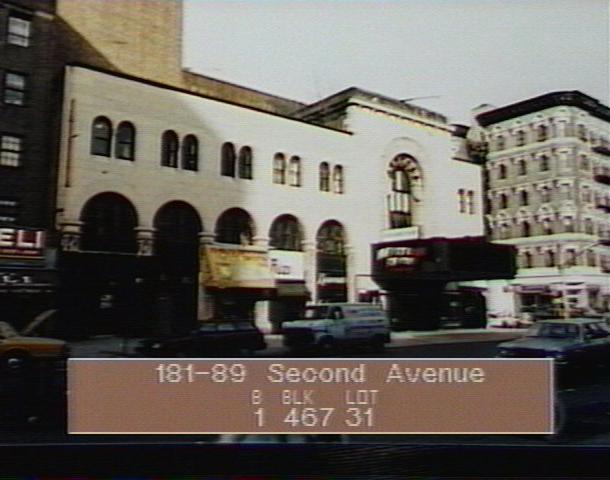
The city photographed every building for its tax records around 1940 and again in the 1980s. NYC Municipal Archives.
Written with AI from the source each entry cites, then fact-checked.
- 1870
Philanthropist John H. Keyser founds his Strangers' Hospital while living in a row house on the lot
Before the theater, several row houses stood on this lot. In one of them lived John H. Keyser, a philanthropist who financed the Strangers' Hospital entirely himself around 1870. A New York Times article cited by Village Preservation calls 183 Second Avenue a lovely Italianate home. The row houses were torn down in 1925 to clear the way for the Yiddish Art Theater.
- 1926
The Louis N. Jaffe Art Theatre opens as the home of the Yiddish Art Theatre
Developer Louis N. Jaffe built this Moorish Revival theater, designed by Harrison G. Wiseman, for Maurice Schwartz's Yiddish Art Theatre at a cost of about $1 million. It opened on November 17, 1926, and was the only house in the Second Avenue Yiddish Theatre District built for a specific Yiddish company. The Phoenix Theatre used it from 1953 to 1961, and it later hosted Oh! Calcutta! and Grease.
Source: Wikipedia
- 1932
Maurice Schwartz returns with Yoshe Kalb, a Yiddish hit that runs about 300 performances
After years of drifting between houses, Maurice Schwartz and his Yiddish Art Theater came back to their Second Avenue home for the 1932-34 seasons. Their first production, I. J. Singer's Yoshe Kalb, became one of the biggest successes in Yiddish theater history, playing some 300 performances over two seasons before an English-language version reached Broadway. Critic Brooks Atkinson likened a Saturday night with the company to a house-warming.
- 1936
The former Yiddish Art Theatre reopens as the movie house Century Theatre
After the Yiddish Art Theatre closed, the building reopened in 1936 as the Century Theatre, a movie house, beginning decades of name changes as the venue passed between film and stage. It was renamed the Stuyvesant Theatre in 1946 while still showing movies.
Source: Wikipedia
- 1948
A gay supper club tied to the Genovese family runs in the theater's basement as Club 181
By the late 1940s a night club occupied the basement, where Stephen Franse opened Club 181. Daytonian in Manhattan says Franse was connected to the Genovese crime family and ran the gay supper club as a front. A former waiter recalled lavish costumes and talented female impersonators in 1948, with straight couples coming to see the show. The club left in 1953 for East 4th Street and became Club 82.
Source: Daytonian in Manhattan
- 1953
The Phoenix Theater opens its off-Broadway home here with Jessica Tandy and Hume Cronyn
In fall 1953 Norris Houghton and T. Edward Hambleton leased the vacant Stuyvesant Theater for the Phoenix, an off-Broadway company meant to free artists from Broadway's hit-or-flop pressure. Its backers included Richard Rodgers and Elia Kazan. Tickets cost $1.20 to $3.00 and performers' pay was capped at $100 a week. The first play, Sidney Howard's Madam, Will You Walk, opened in December 1953 with Tandy and Cronyn.
“The theater opened in December, 1953, with Sidney Howard's Madam, Will You Walk, starring Jessica Tandy and Hume Cronyn.”
- 1959
Once Upon a Mattress becomes the Phoenix's biggest hit and launches Carol Burnett
The Phoenix had its least successful season in 1958-59 and then scored its biggest hit with the musical comedy Once Upon a Mattress, which the landmarks report says launched the career of Carol Burnett. The company was later praised for Henry IV and Hamlet. After years of deficits it decided the big house was a burden and moved to a smaller theater on East 74th Street in the fall of 1961.
- 1965
The theater becomes Manhattan's only burlesque house as the Gayety
Operating as the Gayety Theater from 1965 to 1969, the venue was the only burlesque house left in Manhattan. It had briefly been called the Casino East Theater beginning in 1961, part of the building's continual turnover of names and uses through the mid-20th century.
Source: Wikipedia
- 1969
Oh! Calcutta! runs for two years at the renamed Eden Theater
Renamed the Eden Theater in 1969, the venue hosted the nude revue Oh! Calcutta! for 704 performances through 1971. It also gave an early home to Grease in 1972, shortly before that musical moved to Broadway and became a long-running hit.
Source: Wikipedia
- 1972
Grease opens at the Eden Theater on its way to Broadway
On February 14, 1972, the musical Grease opened at what was then the Eden Theater, three years after Oh! Calcutta! had begun its run in the house. Village Preservation's East Village Building Blocks entry notes that Grease went on to Broadway and great success. The Eden was one of many names the building carried, among them the Gayety, the Stuyvesant and the Phoenix.
- 1973
Photographer Peter Hujar takes the apartment of Warhol star Jackie Curtis in the theater's front wing
At some point the front portion of the theater building was turned into apartments. One housed Jackie Curtis, a performer in Andy Warhol's films, and then photographer Peter Hujar, who lived there from 1973 to 1987. His friend, the artist David Wojnarowicz, took over the apartment and stayed until his death in 1992. Curtis's grandmother, known as Slugger Ann, was the building's super.
- 1991
The former Yiddish theater is carved into a seven-screen multiplex
An $8 million renovation converted the auditorium into a seven-screen multiplex, preserving the ornate balcony as one screen while splitting the orchestra level and former backstage area into six more. The reconfigured Village East Cinema reopened on February 22, 1991, initially running just five of its seven screens.
Source: Wikipedia
- 1993
The city designates the theater's exterior and interior as landmarks
After decades as an off-Broadway house and then the Entermedia Theatre, the building was converted into a multiplex, the Village East Cinema, in 1991. The city landmarked both its exterior and its ornate interior in 1993. After closing during the COVID-19 pandemic, it reopened on March 5, 2021, as Village East by Angelika.
Source: Wikipedia
Further reading
- Village East by AngelikaWikipedia
- The 1926 Yiddish Art Theatre -- 181 2nd AvenueDaytonian in Manhattan
- 181-189 Second Avenue; 183-189 Second AvenueVillage Preservation: East Village Building Blocks
Nearby
- 175 2nd Avenue2 entries
- 237 East 12th Street3 entries
- Rectory of St. Mark's Church / Neighborhood Preservation Center232 East 11th Street | 4 entries
- Ukrainian Congress Committee of America203 2nd Avenue | 6 entries
- St. Mark's Church in-the-Bowery131 East 10th Street | 12 entries
- John's of 12th Street302 East 12th Street | 3 entries