Ukrainian Congress Committee of America
203 2nd Avenue | East Village | built 1920
Open on the map6 entries

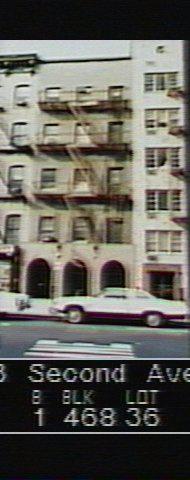
The city photographed every building for its tax records around 1940 and again in the 1980s. NYC Municipal Archives.
Written with AI from the source each entry cites, then fact-checked.
- 1862
Hamilton Fish develops the five-story brick house as a private home, one of a row
Like its neighbors on Second Avenue, 203 was built around 1862 as a five-story brick private house, developed by Hamilton Fish. Its life diverged from the rest of the row in the twentieth century. Little of the original facade survives: the brick has been stuccoed and painted, the stone lintels and sills shaved off, the metal cornice removed, and a brick-arched extension added at street level.
- 1909
Moses Greenbaum buys the house and turns it into the People's Hospital
Greenbaum bought the building in 1909 and converted it into The People's Hospital, removing the rear wall and the raised stoop entrance. A 1911 Times article said the hospital opened to ease the strain on overcrowded East Side hospitals and appealed in particular to Austrians and Hungarians. A laboratory was later added at the back and a morgue installed in the basement.
- 1913
Dr. Friedrich Friedmann tests his tuberculosis serum at the People's Hospital, and it proves not to cure the disease
In 1913 Dr. Friedrich Friedmann tested his tuberculosis serum at the People's Hospital. Many hoped the serum would be a cure for the disease; however, subsequent trials by the Surgeon General found that it was not.
- 1949
The building becomes the William I. Sirovich House, a day center for older New Yorkers
In 1949 the former hospital became a home and day care center for the elderly, named for one of the hospital's trustees. The William I. Sirovich House offered space for socializing and recreation and had social workers on staff. Unlike many homes for the aged it never housed residents, which made it an early example of adult day care. It operated until 1976.
- 1976
The Ukrainian Museum is founded by the Ukrainian National Women's League of America and settles into 203 Second Avenue
When the day center closed in 1976, the building became home to the Ukrainian Museum, which the Ukrainian National Women's League of America had founded that year. The league and the Ukrainian Congress Committee of America bought the building together and shared it, with the museum on the top two floors.
Source: Village Preservation
- 2005
The Ukrainian Museum leaves Second Avenue for a new building on East 6th Street designed by George Sawicki
The Ukrainian Museum, founded in 1976, moved into a new building on East 6th Street that opened in 2005, by George Sawicki, a Ukrainian-American architect, of the firm Sawicki Tarella Architecture + Design. Before that it had occupied the top two floors of 203 Second Avenue. By 2013 its collection had grown past 40,000 objects.
Source: Village Preservation
Further reading
- Ukrainian Congress Committee of AmericaWikipedia
- 203 Second AvenueVillage Preservation: East Village Building Blocks
Nearby
- 237 East 12th Street3 entries
- Dr. Cornelius Walke House213 2nd Avenue | 3 entries
- Charles M. Mather House249 East 13th Street | 4 entries
- Henry Knebel House217 2nd Avenue | 3 entries
- Village East by Angelika187 2nd Avenue | 13 entries
- Labor Temple223 2nd Avenue | 4 entries