Scheffel Hall
190 3rd Avenue | Gramercy | built 1895
Open on the map4 entries

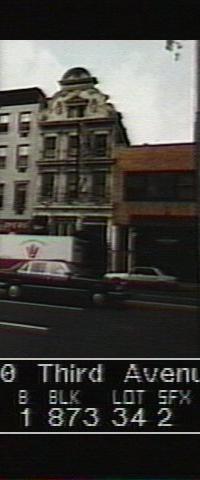
The city photographed every building for its tax records around 1940 and again in the 1980s. NYC Municipal Archives.
Written with AI from the source each entry cites, then fact-checked.
- 1895
A German beer hall modeled on part of Heidelberg Castle opens on Third Avenue
Architects Henry Adams Weber and Hubert Drosser designed this beer hall and restaurant in 1894–95, modeling its facade on the early 17th-century Friedrichsbau at Heidelberg Castle and naming it for the German poet Joseph Viktor von Scheffel. O. Henry set his story The Halberdier of the Little Rheinschloss here. The city designated the building a landmark in 1997.
Source: Wikipedia
- 1909
O. Henry sets a short story inside Scheffel Hall
Author O. Henry uses Scheffel Hall as the setting for his short story "The Halberdier of the Little Rheinschloss," published in 1909. The tale draws on the rathskeller's smoky rafters, rows of imported steins, and a portrait of the German poet Goethe on the wall. Verses from student songs, honoring the hall's namesake Joseph Victor von Scheffel, decorate the walls.
Source: Daytonian in Manhattan
- 1939
The German-American Rathskeller begins decades of bars and music at No. 190
After housing the German-American Athletic Club in the 1920s, the hall reopened in 1939 as the German-American Rathskeller, later known as Joe King's Rathskeller. From the 1970s it was home to Fat Tuesday's, a jazz club, and the restaurant Tuesday's, which ran until the early 2000s.
Source: Wikipedia
- 1997
The city designates Scheffel Hall a landmark
The Landmarks Preservation Commission designates 190 Third Avenue a New York City landmark in 1997. The commission cites the building's rare German Renaissance-style facade, modeled on Heidelberg Castle's Friedrichsbau, and its long history as a gathering place for the neighborhood's German immigrant community. The terra-cotta detailing and scrolled gable that architects Henry Adams Weber and Hubert Drosser designed in 1894-95 remain intact.
Source: Wikipedia
Further reading
- Scheffel HallWikipedia
- Scheffel Hall - 190 Third AvenueDaytonian in Manhattan
- SCHEFFEL HALL, Gramercy ParkForgotten New York
- A Gramercy beer garden inspired by a castleEphemeral New York
Nearby
- 129 East 17th Street4 entries
- Washington Irving Campus40 Irving Place | 6 entries
- St. George's Episcopal Church209 East 16th Street | 4 entries
- Pete's Tavern66 Irving Place | 5 entries
- Hotel 17225 East 17th Street | 3 entries
- St. George's Episcopal Church211 East 16th Street | 8 entries