St. George's Episcopal Church
211 East 16th Street | also 7 Rutherford Place | Gramercy | built 1856
Open on the map8 entries

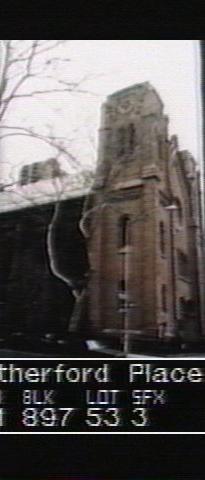
The city photographed every building for its tax records around 1940 and again in the 1980s. NYC Municipal Archives.
Written with AI from the source each entry cites, then fact-checked.
- 1848
St. George's opens for services in its new church two years after the cornerstone
St. George's laid its cornerstone in 1846 and held its first services in the new building in 1848, eight years before the church was finished in 1856. The Landmarks Preservation Commission's report quotes a diarist of 1848 who called the surrounding area a "howling wilderness" at the time the church was built.
- 1856
St. George's completes its Romanesque Revival church on Stuyvesant Square
The congregation, which began as a Trinity Church chapel in 1752 and became independent in 1811, built this church between 1846 and 1856 to designs by Charles Otto Blesch, with interiors by Leopold Eidlitz. A fire gutted it in 1865, and it was rebuilt within two years. J. P. Morgan was its senior warden and a major benefactor.
Source: Wikipedia
- 1865
Fire guts St. George's Episcopal Church
A fire destroys the interior of the nine-year-old Stuyvesant Square church. Architect Leopold Eidlitz, who had designed the original interior, again oversees a two-year rebuilding, this time shaped by Rector Stephen Tyng's low-church evangelical views, which called for a plain communion table rather than an ornate altar.
Source: Wikipedia
- 1889
St. George's removes the spires from its twin towers
The congregation takes down the spires that had topped St. George's two front towers since the 1860s. The towers remain flat-topped afterward, giving the Stuyvesant Square landmark the squared-off silhouette it still shows today.
Source: Wikipedia
- 1894
Harry T. Burleigh is hired as soloist, with J. P. Morgan casting the deciding vote
In 1894 the all-white parish hired the Black singer and composer Harry T. Burleigh as its soloist over objections from some members; J. P. Morgan cast the deciding vote. Burleigh, who had studied with Antonín Dvořák at the National Conservatory, sang at St. George's for 52 years until retiring in 1946.
Source: Wikipedia
- 1949
More than 2,000 mourners attend Harry Burleigh's funeral at St. George's
Harry T. Burleigh, who had sung as a soloist at St. George's for 52 years until his 1946 retirement, died on September 12, 1949. A crowd of more than 2,000 came to his funeral at the church, and Hall Johnson, Noble Sissle, Eubie Blake, W. C. Handy and Cameron White served as pallbearers. His remains were returned to Erie, Pennsylvania, for burial.
“More than 2,000 people attended his funeral at St. George's Church. Pallbearers included Hall Johnson, Noble Sissle, Eubie Blake, William C. Handy, and Cameron White.”
Source: Wikipedia
- 1967
The Landmarks Commission designates St. George's Church after a hearing with no opposition
On June 20, 1967, the Landmarks Preservation Commission designated St. George's Church and its tax lot as a landmark. Four witnesses spoke in favor at the April 1966 hearing, none spoke against, and the church's vestry wrote to approve. The report calls the church one of the great examples of Romanesque Revival architecture in New York, linked to the sturdy Romanesque of southern Germany, and notes that parts of the exterior and all interior surfaces had been restored in 1964.
“Four witnesses spoke in favor of designation. There were no speakers in opposition to designation.”
- 1976
St. George's merges to form Calvary-St. George's Parish
The same year St. George's is named a National Historic Landmark, the Stuyvesant Square congregation merges with Calvary Church and the Church of the Holy Communion to form Calvary-St. George's Parish, combining three historic Episcopal congregations into one parish.
Source: Wikipedia
Further reading
Nearby
- St. George's Episcopal Church209 East 16th Street | 4 entries
- Friends Seminary and Meeting House222 East 16th Street | 15 entries
- Hotel 17225 East 17th Street | 3 entries
- Scheffel Hall190 3rd Avenue | 4 entries
- Washington Irving Campus40 Irving Place | 6 entries
- 129 East 17th Street4 entries