Germania Bank Building
190 Bowery | also 1 Spring Street | Nolita | built 1899
Open on the map14 entries

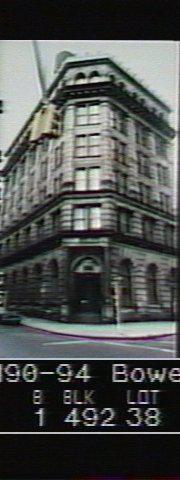
The city photographed every building for its tax records around 1940 and again in the 1980s. NYC Municipal Archives.
Written with AI from the source each entry cites, then fact-checked.
- 1896
Germania Bank buys three lots at the Bowery and Spring Street corner
In December 1896 Germania Bank bought three adjoining lots from Max Daniger and William Hyams, on the northwest corner where the Bowery meets Spring Street. About thirteen months afterward, on January 3, 1898, the architect Robert Maynicke filed plans at the Department of Buildings for a freestanding, fireproof six-story building on the site.
- 1898
Robert Maynicke gives the bank a granite base and a copper crown meant to be seen from the Bowery El
Architect Robert Maynicke, born in Germany, a Cooper Union student who had worked for George B. Post, designed the bank in a plain Beaux-Arts style. The Landmarks Commission says the rusticated granite base conveyed strength, and the entrance portico sits at the chamfered corner so passersby look straight at it. The ornate copper cheneau at the roofline was conspicuous from the elevated trains that once ran above the Bowery.
- 1899
Germania Bank opens its new Bowery headquarters for business a year to the day after filing plans
The Germania Bank opened its new six-story building at the Bowery and Spring Street for business on January 3, 1899, exactly a year after architect Robert Maynicke filed the plans. The public had been invited to inspect it on December 28, 1898. The fireproof building cost about $200,000. Its first floor was a public banking hall, the basement held safe deposit vaults, and offices filled the upper floors. A 1900 pamphlet stressed the security of the vaults.
“…the bank was opened for public inspection on December 28, 1898 and for regular business on January 3, 1899, exactly one year after Maynicke filed the plans…”
- 1900
Germania Bank publishes a pamphlet selling the security of its new vaults
In 1900 Germania Bank issued a promotional pamphlet, Germania Bank and Safe Deposit Vaults, with a rendering of its new building on the cover. Photographs and text stressed how secure its vaults were, urging customers to keep insurance policies, wills, securities and valuables in them. The vaults were in the basement.
“In 1900, the bank produced a promotional pamphlet ... Entitled Germania Bank and Safe Deposit Vaults, it stressed the security of its vaults.”
- 1918
Germania Bank becomes the Commonwealth Bank amid anti-German feeling in World War I
In late 1917 the bank's directors, led by president Edward C. Schaefer, petitioned the court to rename the institution the Commonwealth Bank, which the Landmarks Commission sees as most likely a response to anti-German sentiment during World War I. Permission came on January 28, 1918, and the new name quietly took effect. Commonwealth opened a Lexington Avenue branch in 1923 and had branches in the Bronx and Brooklyn before Manufacturers Trust acquired it in 1927.
“Permission was granted on January 28, 1918, and the bank's new identity quietly took effect.”
- 1927
Commonwealth Bank, the former Germania, is bought by Manufacturers Trust
In 1927 Manufacturers Trust Company acquired the Commonwealth Bank, as Germania Bank had been called since 1918. Commonwealth had expanded after opening its first branch, on Lexington Avenue near 57th Street, in 1923, and by 1927 it had three Manhattan branches besides its Bowery headquarters, plus one each in the Bronx and Brooklyn. Manufacturers Trust had absorbed twenty-two other banks by 1930.
“In 1927, the Commonwealth Bank was acquired by the Manufacturers Trust Company, which had embarked on an expansion spree in 1912; by 1930, it had absorbed twenty-two other banks.”
- 1962
Manufacturers uses the upper floors for records storage and adds a rooftop water tank
By 1962 the bank, by then part of Manufacturers Hanover Trust, was using the upper stories of 190 Bowery to store records. It added more fireproofing, which required installing a water tank on the roof. The building continued as a branch bank until the mid-1960s.
- 1966
Jay Maisel rents floors to the artists Adolph Gottlieb and Roy Lichtenstein
After buying the old bank in 1966, photographer Jay Maisel kept his home, studio and gallery there. Between 1966 and 1968 he rented the second floor to the artist Adolph Gottlieb and the fourth floor to the artist Roy Lichtenstein. Locals knew the building as The Bank, and it was widely thought to be abandoned.
“…between 1966 and 1968 rented the second and fourth floors to artists Adolph Gottlieb and Roy Lichtenstein, respectively.”
Source: Wikipedia
- 1966
Photographer Jay Maisel buys the abandoned bank for $102,000 and moves in
In 1966 the young photographer Jay Maisel, whose landlord had just raised the $125-a-month rent on his Second Avenue studio by $50, was shown the abandoned Germania Bank by broker Jack Klein. He bought it for $102,000 and moved in, finding the main floor knee-deep in garbage and soot. His parents cried, he told New York magazine, and the Bowery was where people ended up rather than where they aspired to live.
Source: nymag.com
- 2005
The Landmarks Commission designates the former Germania Bank Building despite owner opposition
The Landmarks Preservation Commission designated the former Germania Bank Building a city landmark on March 29, 2005. At the public hearing on October 19, 2004, four people spoke in favor, among them people speaking for Assemblyman Sheldon Silver, the Historic Districts Council, Place Matters and the Municipal Arts Society. The owners and their representative, three speakers in all, opposed designation.
“March 29, 2005, Designation List 360. Four people spoke in support of designation ... Three people, the owners and their representative, spoke in opposition.”
- 2008
Jay Maisel still lives in the 72-room bank, where Keith Haring once chalked babies on the exterior
By 2008 Maisel and his family still lived in the six-story, 72-room building, using the first three floors as galleries for his photographs and keeping his work in the original basement vault. He told New York magazine that Roy Lichtenstein had once rented the fourth floor, and that Keith Haring used to cover the exterior with chalk babies, which he liked because they washed off easily. The landmarked facade remained a magnet for graffiti artists.
Source: nymag.com
- 2015
Maisel sells the Bowery building to developer Aby Rosen for $55 million
Public records filed with the city on February 5, 2015, showed that Maisel had sold the building for $55 million to developer Aby Rosen, decades after paying $102,000 for it. The Daily News called him one of the last holdouts on the once-seedy Bowery. He had lived on the upper floors with his wife and daughter and used the lower floors as a studio. The deal had been struck the previous year.
Source: nydailynews.com
- 2019
Stephen Wilkes's documentary Jay Myself shows the bank as Maisel empties it
Jay Myself, directed by Stephen Wilkes, a former associate of Jay Maisel, played at Film Forum in 2019. Few people had been allowed inside 190 Bowery, and Wilkes persuaded Maisel to let him film the interiors just as Maisel was moving out. Maisel had filled the rooms with items he might use in his photographs, carefully arranged, among them bottles, dye transfer prints and porcelain hands from a rubber glove factory.
Source: The Bowery Boys
- 2019
Supreme opens a store in the old bank after Maisel's 49 years there
In 2019, after Jay Maisel had moved out following 49 years, the clothing brand Supreme opened a store inside 190 Bowery. Stephen Wilkes's documentary Jay Myself, released the same year, follows Maisel's departure. By 2022 the building also housed EmpireDAO, a shared workspace for cryptocurrency and blockchain companies.
“…clothing brand Supreme opened a store within 190 Bowery…”
Source: Wikipedia
Further reading
Nearby
- 5 Spring Street5 entries
- 2 Spring Street188 Bowery | 3 entries
- 206 Bowery5 entries
- P. A. Fogarty Stable11 Spring Street | 4 entries
- Empire Wagon Works Building194 Elizabeth Street | 4 entries
- Hammacher Schlemmer's Bowery store209 Bowery | 3 entries