206 Bowery
Nolita | built 1920
Open on the map5 entries

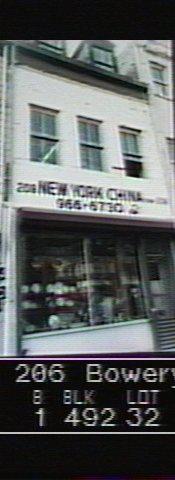
The city photographed every building for its tax records around 1940 and again in the 1980s. NYC Municipal Archives.
Written with AI from the source each entry cites, then fact-checked.
- 1810
Butcher John Brown and his wife Lydia live here beside his porterhouse tavern for the Fly Market butchers
Number 206 was built around 1810 as part of a group with 202, 204 and 208 Bowery, which shared party walls. According to the Bowery Historic District nomination, many butchers from the Fly Market moved to this stretch of the Bowery after fires in lower Manhattan. John Brown ran a tavern for them next door at 208, while he and his wife Lydia lived at 206.
“John Brown's Porterhouse, a tavern serving area butchers, was located at 208, with Brown and his wife, Lydia living in the attached residence at 206.”
Source: National Register nomination
- 1810
An intact early Federal house keeps its gambrel roof and Flemish-bond brick
The Bowery nomination calls 206 an intact early Federal building: a two-and-a-half-story, three-bay rowhouse with a gambrel roof, a pair of gable dormers, a stone foundation and walls a foot thick laid in Flemish bond. Its neighbors in the original group were all changed. Number 202 was replaced in 2005, 204 became a commercial box around 1965, and 208 was raised to a third story.
“No. 206 remains an intact example of an early Federal-era building…”
Source: National Register nomination
- 1826
Walter Keeler opens a shoe store, the first of many shopkeepers in the house
Ephemeral New York, drawing on a Landmarks Preservation Commission report, describes the house as a speculative investment tied to the heirs of leather merchant James Meinell. It was only 16 feet 8 inches wide and always had a commercial ground floor with the tenant's family above. Walter Keeler's shoe store opened in 1826, and James Cooper's fancy goods store followed from 1839 to 1853. Later tenants included an engraver, an umbrella maker, a cigar shop, a milliner and a jeweler.
Source: Ephemeral New York
- 1940
The Tri-City Barber School trains students in the little house
According to the city landmarks report that Ephemeral New York cites, 206 Bowery housed the Tri-City Barber School during the 1930s and 1940s. The post includes a 1940 photo showing the school. It adds that Berenice Abbott's 1935 photograph of a barber school on the Bowery shows a different one, at 264 Bowery.
Source: Ephemeral New York
- 1995
Newsday reports a suspected prostitution ring holding women captive at 206-208 Bowery
By the 1990s the signage outside 206 Bowery suggests the space served the Bowery's restaurant-supply trade. Newsday reported in January 1995 on a suspected prostitution ring said to be keeping women captive at a brothel in Chinatown, at 206-208 Bowery. Ephemeral New York found the allegation in newspaper archives while researching the house.
Source: Ephemeral New York
Further reading
- 206 BoweryPlace Matters
- The 200-year-old brick holdout house hiding behind a restaurant supply sign on the BoweryEphemeral New York
Nearby
- Empire Wagon Works Building194 Elizabeth Street | 4 entries
- 5 Spring Street5 entries
- Germania Bank Building190 Bowery | 14 entries
- The Bowery House218 Bowery | 5 entries
- P. A. Fogarty Stable11 Spring Street | 4 entries
- Young Men's Institute Building ("The Bunker")222 Bowery | 6 entries