Lundy's Restaurant
1901 Emmons Avenue | also 2803 East 19th Street, 3156 Ocean Avenue | Manhattan Beach | built 1934
Open on the map9 entries

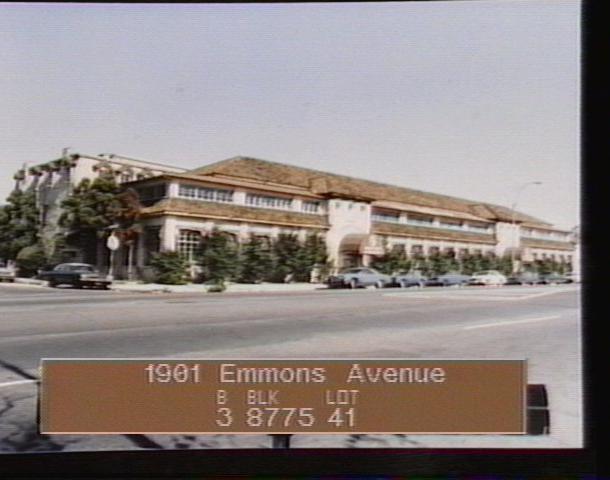
The city photographed every building for its tax records around 1940 and again in the 1980s. NYC Municipal Archives.
Written with AI from the source each entry cites, then fact-checked.
- 1862
Ellen McMahon's Bayside Hotel and Casino stands on the corner that Lundy's later takes over
Before the restaurant, the Emmons Avenue site between Ocean Avenue and East 19th Street held the Bayside Hotel and Casino. The Landmarks Preservation Commission says Ellen McMahon had the hotel put up in 1862 and expanded it in 1882. Irving Lundy acquired the property and worked the old hotel into the plans for his new restaurant.
“This hotel building, erected for Ellen McMahon in 1862 and enlarged in 1882, was incorporated into the plans for the new restaurant.”
- 1934
Irving Lundy times the opening of his new restaurant to the closing of the old one
The city condemned the Emmons Avenue waterfront buildings in 1931 but did not tear them down until the summer of 1934. Irving Lundy had his original pier restaurant's demolition put off until the last minute so he would lose little business. The new building, designed by Bloch & Hesse, was finished in time for the last clam to be shucked in the old place just as the first was unveiled in the new.
- 1934
Bloch & Hesse design Lundy's as a Spanish Colonial Revival seafood palace
Bloch & Hesse, a firm that specialized in restaurant design, gave Lundy's sand-colored stucco walls, low red Mission tile roofs, arched entrances, ironwork and leaded glass windows. The style was relatively rare around New York, and the commission thought this was the only prewar restaurant building in New York to survive in it. Since the building came before central air-conditioning, large operable windows were placed to catch water views and ocean breezes.
- 1935
Federal agents raid Lundy's over unpaid liquor taxes, and a judge blocks the dismantling of the bar
Soon after the new restaurant opened, the federal government threatened to seize it because Irving Lundy had not paid taxes on the liquor stored there. Federal agents raided the restaurant and it briefly closed in June 1935. A judge sympathetic to Lundy then blocked the plan to dismantle the bar, and in October Lundy agreed to pay the back taxes.
“After a federal raid and a brief closure in June 1935, a judge sympathetic to Lundy ordered an injunction against the federal government's proposal to dismantle the bar at Lundy's.”
Source: Wikipedia
- 1957
Waiters strike at Lundy's, and Irving Lundy announces the restaurant will never reopen
In July 1957 seventy-five employees walked out in a wage dispute, and about two hundred more followed. The restaurant was then serving 2,000 people on an average weekday and 10,000 on Sundays. A few days into the strike Irving Lundy announced that Lundy's would never reopen. Most of it stayed closed, apart from the clam bar, until a labor agreement was reached that December.
“A larger strike started in July 1957, when 75 employees walked out during a dispute over wages; another 200 employees walked out soon afterward.”
Source: Wikipedia
- 1977
Irving Lundy, the reclusive owner nicknamed the Howard Hughes of Brooklyn, dies
Irving Lundy never married and grew reclusive in later life, which earned him the nickname the Howard Hughes of Brooklyn. He had built up ownership of the waterfront properties along Emmons Avenue from East 19th to East 29th Streets. After his death in September 1977, his $25 million estate went to a niece and three nephews, and the restaurant began losing money under new management.
Source: Wikipedia
- 1992
The city designates the shuttered Lundy's a landmark, and murals later cover its graffiti
Lundy's had closed in 1979 and fallen into disrepair, and Peter Romeo, co-director of the Sheepshead Bay Beautification Group, lobbied for its restoration. The Landmarks Preservation Commission designated the building a city landmark on March 3, 1992, with the owner's support. In 1993, with the owner's permission, Romeo painted more than three dozen murals over the graffiti on the facade.
Source: Wikipedia
- 1995
A scaled-down Lundy's reopens in the landmark and sparks a wave of building on Emmons Avenue
Tam Restaurant Group, run by Frank and Jeanne Cretella, reopened Lundy's on December 6, 1995, in about half the space of the original. By March 1996 property owners said real estate prices had doubled along Emmons Avenue, and new restaurants and shopping plazas were opening. Weekend reservations were booked up to a month ahead, and diners came from as far as eastern Long Island.
“Tam reopened the second Lundy's on December 6, 1995.”
Source: Wikipedia
- 2009
A Russian-themed market in the Lundy's building draws 46 stop-work orders during its renovation
Neighbors objected when David Isaev, who ran the Cherry Hill Gourmet Market, removed lettering from the Lundy's sign over the entrance. The city said the market broke zoning rules for the district, and it issued 46 stop-work orders in all. The renovation cost $7 million and the market opened in May 2009, and the Landmarks Preservation Commission waived the violations in 2011 after Isaev agreed to restore the sign.
Source: Wikipedia
Further reading
- Lundy's RestaurantWikipedia
Nearby
- Lundy Brothers Restaurant2795 East 19th Street | 6 entries
- Roll-A-Palace1728 Sheepshead Bay Road | 5 entries
- Manhattan Beach Jewish Center60 West End Avenue | 4 entries
- Sheepshead Bay High School3000 Avenue X | 3 entries
- Jewish Center of Brighton Beach2915 Ocean Parkway | 3 entries