Lundy Brothers Restaurant
2795 East 19th Street | also 1901 Emmons Avenue | Manhattan Beach | built 1934
Open on the map6 entries

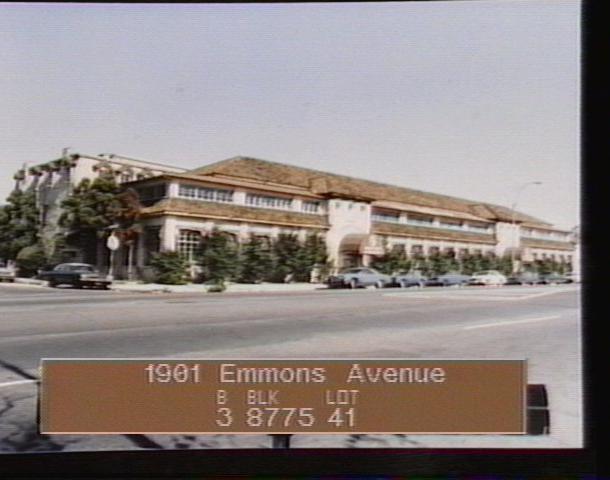
The city photographed every building for its tax records around 1940 and again in the 1980s. NYC Municipal Archives.
Written with AI from the source each entry cites, then fact-checked.
- 1934
The new Lundy's opens in time for the last clam of the old place to be shucked as the first is unveiled in the new
Because the city was razing the old waterfront in 1934, Lundy had the demolition of his pier restaurant put off until the last minute. Work on the new building began right away, with the architects bringing drawings and details to the site each morning under Walter Hesse, Piero Ghiani and Lundy himself. It was thought to be one of the country's largest restaurants, seating 850 diners on the first floor and about as many on the second.
“…accommodating 850 patrons on the ground floor and a similar number on the second floor…”
- 1945
The Theresa Brewer Room is added, named for the singer who married Irving Lundy's nephew
A one-story frame addition at the rear, put up in 1945 while building materials were rationed, was later called the Theresa Brewer Room after a well-known singer who wed Lundy's nephew. It is faced in logs and stucco. A mosaic war memorial with aquatic motifs decorates its Ocean Avenue wall.
“…later known as the Theresa Brewer Room after the popular singer who married Irving Lundy's nephew…”
- 1955
At its mid-1950s peak Lundy's employs 385 people and serves up to 15,000 diners on Mother's Day
In its heyday in the mid-1950s the restaurant employed 385 waiters, bartenders, cooks and office workers. A typical weekday brought about 2,000 diners and a Sunday about 10,000, while Mother's Day could reach nearly 15,000. Playwright Wendy Wasserstein recalled tossing hot biscuits with her brother on Mother's Days there, and columnist James Brady remembered Sunday clams at the bar with his father.
“…employed a staff of 385 waiters , bartenders, cooks, and office workers…”
- 1977
Irving Lundy, a reclusive landlord who lived above the restaurant with fourteen Irish setters, dies
Lundy invested his restaurant profits in real estate, eventually owning over seventy properties in Sheepshead Bay, among them every lot along the north side of Emmons Avenue from East 19th Street to East 29th Street. Press accounts described him as eccentric and increasingly reclusive. He lived alone with fourteen Irish setters in a top-floor apartment of the annex, seen only by his nephew and valet. After he died in 1977 the family kept the restaurant going for about two years.
“He lived alone, save for fourteen Irish setters, in an apartment on the top floor of the restaurant annex…”
- 1981
The closed restaurant and about fourteen acres of nearby property sell for eleven million dollars
In 1981 the restaurant building was sold together with roughly fourteen acres of real estate nearby. The price was eleven million dollars. In the years after Lundy's closed, the building suffered weathering and vandalism, though the landmarks commission judged these changes largely reversible and the essential fabric largely intact.
“In 1981 the restaurant, together with about fourteen acres of nearby real estate, were sold for eleven million dollars…”
- 1992
The Landmarks Preservation Commission designates Lundy's as the last of Sheepshead Bay's great seafood palaces
After hearings in February and May 1989, at which fourteen witnesses spoke in favor, the commission designated the building a landmark on March 3, 1992. Its report described Lundy's as the last of the great seafood palaces that once flourished in Sheepshead Bay, remembered fondly by tens of thousands of New Yorkers, and said it had served as many as a million meals a year.
Nearby
- Lundy's Restaurant1901 Emmons Avenue | 9 entries
- Roll-A-Palace1728 Sheepshead Bay Road | 5 entries
- Manhattan Beach Jewish Center60 West End Avenue | 4 entries
- Sheepshead Bay High School3000 Avenue X | 3 entries
- Jewish Center of Brighton Beach2915 Ocean Parkway | 3 entries