AT&T Building
195 Broadway | Financial District | built 1916
Open on the map10 entries

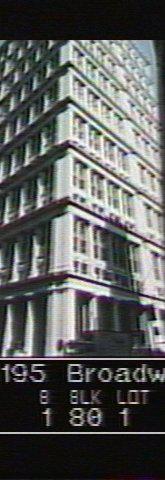
The city photographed every building for its tax records around 1940 and again in the 1980s. NYC Municipal Archives.
Written with AI from the source each entry cites, then fact-checked.
- 1911
AT&T plans to replace George B. Post's Western Union Building on this lot
AT&T had taken a controlling interest in Western Union in 1909, and its president, Theodore Vail, headed both companies by 1910. In 1911 the two firms planned to replace the Western Union Building at Broadway and Dey Street, designed by George B. Post in 1872-75, with a new headquarters by William Welles Bosworth to be shared. They also decided at the same time to build a joint operations building at Walker and Lispenard Streets.
“…plans were made to replace the Western Union Building (George B. Post, 1872-75) at Broadway and Dey Street with a new headquarters building…”
- 1913
Vail agrees to give up Western Union under antitrust pressure, but the shared tower goes ahead
By 1912 AT&T faced growing criticism for operating in violation of antitrust law. With the Interstate Commerce Commission investigating, and its attorney warning that the company was breaking the Sherman Antitrust Act, Vail settled with the government in December 1913, promising to divest AT&T's stake in Western Union. Both companies still pressed on with their shared buildings, and the Western Union Building passed to a new holding company, the 195 Broadway Corporation.
- 1916
Benedict Brothers jewelers hold out and win a lobby shop in the new tower
In July 1916, six days before the new zoning resolution took effect, the 195 Broadway Corporation had Bosworth file permits for three 27-story additions covering the rest of the block. Holdouts stalled the plan. The jeweler Benedict Brothers, long the leaseholder of the Fulton and Broadway corner store, had to be promised a shop in the new lobby, and the Astor Estate refused terms. Wartime shortages followed, and the permits lapsed in July 1918.
- 1916
William Welles Bosworth completes AT&T's Broadway headquarters
Architect William Welles Bosworth designs a neoclassical tower at 195 Broadway as headquarters for AT&T, which had acquired Western Union in 1909. Construction runs from 1912 to 1916, with a final corner section finished in 1922, giving president Theodore Vail's company a building meant to embody "the ideal the Telephone Company stands for."
Source: Wikipedia
- 1920
The Board of Appeals lets Bosworth finish the Broadway and Fulton corner
Bosworth filed plans in December 1919 for a smaller addition filling the corner of Broadway and Fulton Street. The Superintendent of Buildings rejected it because it would exceed the zoning code's height limits. The Board of Appeals granted a variance in January 1920, reasoning in part that the building was a monumental, quasi-public structure on the city's most important thoroughfare and deserved special consideration.
- 1922
Paul Manship's bronze reliefs adorn the finished AT&T Building
As the last wing of 195 Broadway is completed in 1922, sculptor Paul Manship installs four bronze relief panels known as "The Four Elements," representing fire, water, air and earth with partly nude classical figures, daring imagery for the period. The panels, which now frame a Lower Broadway storefront entrance, have since been replaced by copies of Manship's originals.
Source: Ephemeral New York
- 1927
The building is the New York end of the first transatlantic telephone call, to London
In 1927 195 Broadway served as the New York end of the first transatlantic telephone call, placed to London, and of the first intercity Picturephone call. The tower was then AT&T's headquarters, and the company's radio station, WEAF, broadcast from the Fulton Street tower, a practice that continued after RCA bought the station in 1925.
“…the New York end of the first intercity Picturephone call in 1927 and of the first transatlantic telephone call, made to London, England…”
Source: Wikipedia
- 1980
Evelyn Longman's gilded Genius of Electricity comes down from the tower
A gilded bronze figure by sculptor Evelyn Beatrice Longman, the Genius of Electricity, stood atop the Fulton Street tower from 1916 to 1980. It came down as AT&T relocated its headquarters to midtown during the 1980s, though the golden ball it once stood on still caps the tower.
“…gilded bronze figure of Electricity by Evelyn Beatrice Longman that stood atop the tower from 1916 to 1980…”
- 1983
AT&T sells 195 Broadway and its block to Peter Kalikow for $70 million
As part of the Bell System breakup, AT&T sold 195 Broadway and the rest of its block to businessman Peter Kalikow in May 1983 for $70 million. Kalikow had the facade steam-cleaned and replaced Paul Manship's original bronze relief panels, which AT&T had removed, with replicas. After buying air rights from neighboring St. Paul's Chapel, he developed the western part of the block as a hotel, the Millennium Hilton, which opened in 1992.
“195 Broadway, and the rest of the block where it was located, was sold for $70 million to businessman Peter Kalikow in May 1983…”
Source: Wikipedia
- 2006
The city landmarks the AT&T Building's exterior and lobby
New York City designates 195 Broadway a landmark in July 2006, protecting both its exterior and its ground-floor interior. AT&T had already left the building in 1984 for a new postmodern headquarters at 550 Madison Avenue designed by Philip Johnson, taking its rooftop "Golden Boy" statue with it.
Source: Wikipedia
Further reading
- 195 BroadwayWikipedia
- What the bronze reliefs on 195 Broadway meanEphemeral New York
Nearby
- Millenium Hilton55 Church Street | 7 entries
- St. Paul's Chapel209 Broadway | 14 entries
- Fulton Center200 Broadway | 9 entries
- Corbin Building192 Broadway | 13 entries
- New York County Lawyers' Association Building14 Vesey Street | 4 entries
- Cushman Building174 Broadway | 6 entries