2 Park Avenue
also 40 East 33rd Street | Midtown South | built 1928
Open on the map8 entries

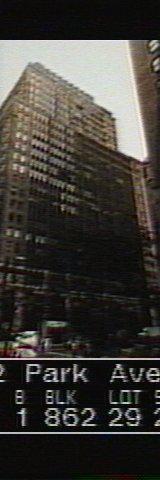
The city photographed every building for its tax records around 1940 and again in the 1980s. NYC Municipal Archives.
Written with AI from the source each entry cites, then fact-checked.
- 1878
A. T. Stewart's Women's Hotel opens here with a reception for nearly 20,000 visitors
Dry-goods magnate Alexander T. Stewart commissioned architect John Kellum in 1869 to design a hotel for working women on the Park Avenue block where 2 Park Avenue now stands, but neither man lived to see it finished. Stewart's widow opened the Women's Hotel on April 2, 1878, sending 13,000 invitations, and the New York Times estimated nearly 20,000 people toured it that night. It held 502 sleeping rooms, a 2,500-volume library and a garden court with a goldfish fountain.
Source: Daytonian in Manhattan
- 1878
Women's Hotel fails within 54 days and reopens as the Park Avenue Hotel despite a Cooper Union protest
Within 54 days of the opening, Mrs. Stewart called the hotel a failure, and Judge Hilton, who handled the matter, argued that women would not accept help that kept them apart from men. On June 4 a crowd packed Cooper Union to protest the closing. After $50,000 of alterations, the hotel, on the site of today's 2 Park Avenue, reopened on June 8 as the Park Avenue Hotel, charging $3 a night.
Source: Daytonian in Manhattan
- 1902
Fire kills 21 at the Park Avenue Hotel after guests find the fire stairs padlocked
In February 1902 a fire at the 71st Regiment Armory sent a spark into the Park Avenue Hotel, which stood on the site of today's 2 Park Avenue and had been touted as fireproof but had no sprinklers. Guests panicked in smoky corridors and found the exit stairs padlocked, although investigators said the iron stairs and brick shafts would otherwise have been a safe route to the street. Twenty-one people burned to death.
Source: Daytonian in Manhattan
- 1919
Park Avenue Hotel staff walk out for a night to throw their own ball
On November 12, 1919, the employees of the Park Avenue Hotel, which then stood where 2 Park Avenue is today, walked out, not in a general strike but to hold a ball of their own. A notice told guests to make any requests for ice water, newspapers, stationery or stamps by 7 p.m., since the bellboys, doormen and waiters were giving a party at the Manhattan Casino. Guests were invited at 50 cents and asked to wear evening dress.
Source: Daytonian in Manhattan
- 1928
Kahn's colored terra-cotta tower replaces the hotel and earns Lewis Mumford's praise
Ely Jacques Kahn of Buchman & Kahn designed the tower as a speculative building that could serve offices, showrooms or light manufacturing, filling its three street fronts around a rear light court. Its colored terra-cotta panels were a high point of his ornamental style, and Lewis Mumford singled the building out in 1928 as a model of modern design, praising its sunny bands of terra cotta accented in red, green and sky blue.
- 1928
Boy Scouts of America, Tammany Hall and the architects themselves take offices in the new tower
When the building was completed, the national headquarters of the Boy Scouts of America occupied the 17th floor, and the Building Trades Employers' Association took the whole 25th floor. The top two floors held the offices of the architects, Buchman & Kahn. Tammany Hall rented space for a time as well, until its permanent home at 44 Union Square was ready.
“On the 17th floor were the national headquarters of the Boy Scouts of America.”
Source: Wikipedia
- 1936
Hunter College moves into three and a half floors after fire destroys its building
In February 1936, after a fire destroyed its existing building, Hunter College leased three and a half floors of 2 Park Avenue and fitted them out as classrooms and study halls within three weeks. The college went on renting space in the tower for several years.
Source: Wikipedia
- 1986
Receiver's $7.7 million fee in the sale of 2 Park Avenue draws court scrutiny
After a court forced owner Sheldon Breitbart to resign as general partner and named John Bower receiver, the building was auctioned in December 1986 for $151 million to a group led by Bernard Mendik and EF Hutton. Bower was paid $7.7 million, about $4,000 an hour and roughly 70 times the next-largest receiver payment in New York State. An appeals court cut it to $5 million in 1988, still 40 times the next highest.
“Despite not providing documentation for his work, Bower was paid $7.7 million for his role in the receivership proceedings, or about $4,000 an hour.”
Source: Wikipedia
Further reading
- 2 Park AvenueWikipedia
Nearby
- Grolier Club Building29 East 32nd Street | 4 entries
- Vanderbilt Hotel66 East 34th Street | 8 entries
- 3 Park Avenue9 entries
- The Roger Hotel129 Madison Avenue | 3 entries
- B. Altman & Company Department Store188 Madison Avenue | 9 entries
- American Academy of Dramatic Arts120 Madison Avenue | 15 entries