Educational Building
2 West 13th Street | also 70 5th Avenue | Greenwich Village | built 1913
Open on the map11 entries

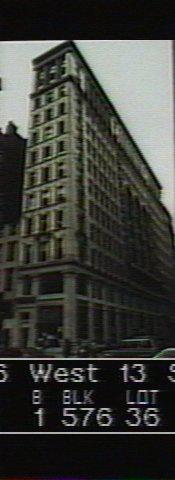
The city photographed every building for its tax records around 1940 and again in the 1980s. NYC Municipal Archives.
Written with AI from the source each entry cites, then fact-checked.
- 1913
Charles A. Rich designs a 12-story Beaux-Arts office building for the publisher George Plimpton
George A. Plimpton, a textbook publisher and college trustee, hired Charles Alonzo Rich to design the Educational Building at Fifth Avenue and West 13th Street, built in 1912-14. The white-brick tower rises twelve stories over a limestone base and carries a terra-cotta cornice. Rich nodded to his client's trade: door surrounds show cartouches with open books, and the top-floor metal grilles hold gilded book reliefs.
“…the door surrounds display cartouches with open books and the uppermost floors have metal grilles with gilded book reliefs.”
- 1914
The NAACP moves its national office into the new Educational Building
In 1914 the National Association for the Advancement of Colored People took four offices on the fifth floor, where a staff of fourteen worked. The extra space was needed for a full-time attorney to help its Legal Committee. The rent was higher and bills sometimes went unpaid, but co-founder W. E. B. Du Bois saw value in a prominent location, arguing that Black people had hidden too long in the back alleys of the earth. The association stayed until 1923.
- 1915
The NAACP asks its neighbor, a film censorship board, to stop The Birth of a Nation
In February 1915 the NAACP appealed to the National Board of Review of Motion Pictures, a tenant in the same building, hoping it would block the New York premiere of The Birth of a Nation, a silent feature glorifying the Ku Klux Klan. Du Bois called the picture vicious propaganda. Cuts were made to some of the worst scenes, but the Board approved it, and it opened at the Liberty Theater on West 42nd Street. The fight led the Board to rethink its role and recognize a film's quality instead of censoring it.
“In February 1915, the NAACP reached out to the Board, hoping a sympathetic neighbor could halt the New York City premiere of The Birth of a Nation…”
- 1917
Tenants petition to oust the pacifists, and someone vandalizes a peace committee's door
After the United States entered World War I in April 1917, about 30 tenants, among them two peace groups, asked Plimpton to evict six peace societies, including the Church Peace Union and the Woman's Peace Party. Critics called the groups unpatriotic and complained that visitors clogged the elevators and halls. Vandals also altered the door of the Neutral Conference Committee, which was planning a conference to end the war, so that it read "Con Committee."
“…the door of the Neutral Conference Committee, which hoped to organize a conference to end the war, was altered to read “Con Committee.”…”
- 1917
Crystal Eastman's Woman's Peace Party newsletter is barred from the mails
From January to October 1917 the New York branch of the Woman's Peace Party, led by lawyer and suffragist Crystal Eastman and Fanny Garrison Villard, published a biweekly paper called Four Lights from its eighth-floor office. It opposed conscription and compulsory service so sharply that the Postmaster General judged both June issues treasonous and refused to deliver them. Justice Department agents then visited the office to ask which of the editors were German citizens.
“Both June 1917 issues were deemed treasonous by the Postmaster General, which barred delivery, and the Department of Justice visited the group’s office…”
- 1917
Plimpton evicts the People's Council, warning he will not answer for treason upstairs
The People's Council of America, a socialist anti-war group formed in June 1917 and modeled on workers' councils in Russia, briefly made the Educational Building its national headquarters. Accused of pro-German sympathies, it was ordered out in September 1917 by Plimpton, acting at the Police Department's request. He wrote that as landlord he would be held responsible if tenants committed treason, and the group moved to 138 West 13th Street.
“…at the request of the Police Department Plimpton evicted the People’s Council in September 1917.”
- 1918
Federal agents raid the National Civil Liberties Bureau, forerunner of the ACLU
Set up in 1917 by the American Union Against Militarism, the National Civil Liberties Bureau used about 40 lawyers in 36 cities to give free legal help and is counted among the origins of the American Civil Liberties Union. On August 30, 1918, Justice Department and Military Intelligence agents raided it along with the New York Bureau of Legal Advice. Neither group was prosecuted under the Espionage Act, but director Roger Baldwin resigned and both bureaus were evicted by the end of September.
“…both the New York Bureau of Legal Advice and the National Civil Liberties Bureau were raided by agents of the Department of Justice and Military Intelligence.”
- 1920
Du Bois launches The Brownies' Book, a monthly magazine for Black children
A companion to The Crisis, The Brownies' Book began in January 1920 under W. E. B. Du Bois, Jessie Redmon Fauset and Augustus Granville Dill, as the first monthly magazine for young African American readers. Du Bois hoped it would inspire pride, teach history and encourage children to take part in the NAACP. Langston Hughes made his debut in its pages in 1921, but circulation disappointed and the last issue appeared in December 1921.
“A related publication, The Brownies’ Book, was launched in January 1920.”
- 1922
Baseball Magazine's publisher issues the first Baseball Cyclopedia from its offices here
The Baseball Magazine Company rented space in the building from 1914 to 1940, a stay of 26 years. Its Baseball Magazine was the sport's first national monthly, and in 1922 the company added The Baseball Cyclopedia, the first reference book on the game's history, the major-league clubs and player statistics.
“The Baseball Magazine Company had offices in the building for 26 years, from 1914 to 1940.”
- 1923
The NAACP and The Crisis leave for 69 Fifth Avenue, and Du Bois blames Southern customers
In July 1923 the NAACP and its magazine The Crisis relocated to 69 Fifth Avenue, at East 14th Street, where they took over a full floor. In his 1940 autobiography Du Bois wrote that the move was not their decision and that Southern customers of Ginn and Company forced them out. He asserted that Plimpton probably asked the group to leave, giving in to pressure from racist clients.
“…it was probably Plimpton who asked the NAACP to leave, bowing to pressure from racist clients.”
- 1972
The New School buys the building, and Parsons moves in
The New School for Social Research, a private school founded in 1919 with long ties to Greenwich Village, acquired 70 Fifth Avenue in May 1972. Parsons School of Design, which had joined the university in 1970, moved into the building that same year. A renovation by Rice+Lipka Architects in 2006-08 made it part of the Sheila C. Johnson Design Center and won awards from the American Institute of Architects and the Municipal Art Society.
“The New School acquired 70 Fifth Avenue in May 1972.”
Further reading
- The 1913 Educational Building - 70 Fifth AvenueDaytonian in Manhattan
Nearby
- William W. Tompkins House68 5th Avenue | 6 entries
- Macmillan-Forbes House11 West 12th Street | 3 entries
- Appleton & Co. Building72 5th Avenue | 6 entries
- Ardsley House29 West 12th Street | 3 entries
- The Ardea31 West 12th Street | 3 entries
- Mellin Macnab Building12 West 12th Street | 7 entries