MetLife Building (Pan Am Building)
200 Park Avenue | East Midtown
Open on the map19 entries

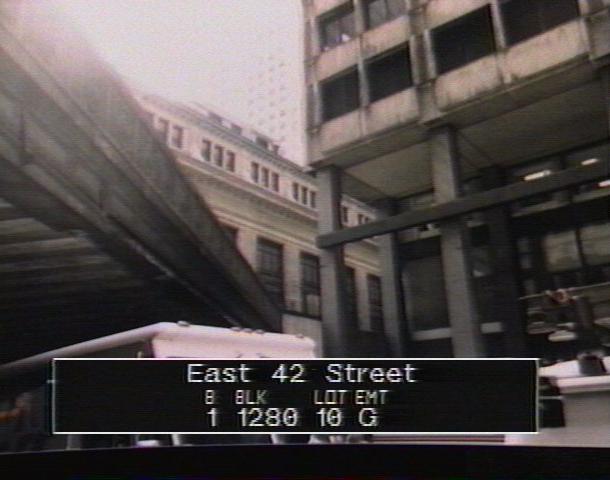
The city photographed every building for its tax records around 1940 and again in the 1980s. NYC Municipal Archives.
Written with AI from the source each entry cites, then fact-checked.
- 1954
Railroads propose an 80-story tower above Grand Central, then a plan to demolish the terminal
In 1954, as traffic on the lines serving Grand Central declined, the railroads proposed an 80-story tower designed by I. M. Pei above the station. Later that year Fellheimer & Wagner drew up a 50-story building as part of a scheme that required tearing down the terminal. Neither went ahead, and in 1958 developer Erwin Wolfson proposed a 3-million-square-foot tower on the site of an older building behind the terminal, the start of what became the Pan Am Building.
Source: The New York Times
- 1958
Wolfson hires Walter Gropius and Pietro Belluschi to improve the design
Developer Erwin Wolfson judged Emery Roth and Sons' modest 1958 plan too modest for so prominent a site, and in July 1958 he announced Bauhaus founder Walter Gropius and Pietro Belluschi as co-designers. Within a week Gropius suggested turning the slab east to west, as at Lever House, and the tower was moved north to 45th Street. By February 1959 the plans showed a 55-story octagon with 2.4 million square feet of space.
Source: Wikipedia
- 1960
Pan Am signs a 25-year lease before its tower is even built
Pan American World Airways founder Juan Trippe signs a lease for 613,000 square feet across 15 floors of the still-unbuilt octagonal tower over Grand Central's tracks, designed by Emery Roth & Sons with Walter Gropius and Pietro Belluschi. The building opens in March 1963 bearing the Pan Am name and logo.
Source: Wikipedia
- 1962
Erwin Wolfson dies in mid-construction after watching the tower from a helicopter
Recovering from surgery in mid-1962, developer Erwin Wolfson kept tracking the tower's progress from a helicopter. He died that June, and James D. Landauer was chosen to oversee completion. The structural steel had topped out in May. The lobby, the last part finished, used cheap materials such as restroom tiles, because the builders were out of money.
“Wolfson, though recovering from surgery during mid-1962, continued to observe the building's progress using a helicopter.”
Source: Wikipedia
- 1963
The Pan Am Building opens above Grand Central's tracks
Designed by Emery Roth & Sons with Walter Gropius and Pietro Belluschi, the 59-story Pan Am Building opened on March 7, 1963, over the tracks leading into Grand Central. With 2.4 million square feet it was the largest commercial office building in the world by floor area. Critics faulted it for blocking the view down Park Avenue, and MetLife, which bought it in 1981, changed the rooftop sign in 1993.
Source: Wikipedia
- 1963
Critics call the new Pan Am Building one of the biggest and ugliest things on the skyline
When the tower opened in 1963, many critics ranked it among Manhattan's biggest and ugliest structures. Writer Wolf Von Eckhardt had already attacked its ugliness in The New Republic, and the Times critic Ada Louise Huxtable called it gigantically second rate. Defenders such as Architectural Record editor Emerson Goble argued that putting office workers near transit was wise and that the building was planned for pedestrians.
Source: The New York Times
- 1963
Richard Lippold's wire sculpture Flight hangs in the lobby, and John Cage's loudspeaker plan is dropped
The lobby was planned around several artworks, including Flight, Richard Lippold's triple-height wire sculpture, with a sphere for the earth, a seven-pointed star for the continents and seas, and gold wires for flight paths. Lippold's friend, the composer John Cage, proposed ten loudspeakers playing Muzak as people passed through. Lippold canceled the idea, and management settled for classical music in the lobby.
“…consisting of ten loudspeakers, which would have played works by Muzak whenever people walked in and out of the lobby…”
Source: Wikipedia
- 1965
Helicopter service to Kennedy airport begins from the roof
On December 22, 1965, New York Airways began flying Vertol 107 helicopters between the rooftop helipad and Pan Am's terminal at Kennedy airport. Passengers checked in at a ticket office at the building's base, rode an express elevator to the 57th floor, then took an escalator and another elevator to the roof. The flight took about six minutes twenty seconds, and the helipad had faced opposition over noise and safety.
Source: Wikipedia
- 1966
Critic Reyner Banham declares that arriving in Manhattan means helicopter or nothing
Helicopter service to the roof, which ended after an accident in 1977, made a futuristic dream real. In a 1966 article in The Architects' Journal, the historian Reyner Banham wrote that there was no other way to enter the island city of Manhattan, and that from now on it had to be helicopter or nothing. Elsewhere the building played up its glamour, with a Sky Club on the top floor decorated in Colonial Williamsburg style and a Pan Am ticket office on Vanderbilt Avenue with curving, sculpted walls.
Source: The New York Times
- 1975
United Brands chairman Eli Black jumps from his 44th-floor office
Eli M. Black, chief executive of the United Brands Company, later known as Chiquita, dies after jumping from a window of his 44th-floor office in the Pan Am Building. The tower keeps the Pan Am name for almost two more decades, until MetLife's 1993 renaming.
Source: Wikipedia
- 1977
A helicopter accident on the rooftop heliport kills five
Helicopters began flying from a heliport on the building's roof in December 1965. On May 16, 1977, the landing gear of a helicopter on the pad collapsed, and the accident killed five people and injured two. Helicopter service from the roof ended for good.
Source: Wikipedia
- 1980
Pan Am agrees to sell its building to Metropolitan Life for about $400 million, a record price
On July 28, 1980, Pan American World Airways said it had reached a preliminary deal to sell the Pan Am Building to the Metropolitan Life Insurance Company for about $400 million, the highest price reported for a single building. That worked out to $177 a square foot, against roughly $115 million to build the tower. The struggling airline planned to use the proceeds to retire some of its debt.
Source: The New York Times
- 1986
Warren Platner's gold-leaf lobby redesign draws a harsh review from Paul Goldberger
Metropolitan Life hired Warren Platner & Associates to make the stark lobby of its 23-year-old tower feel warmer. The design centered on huge half-circle forms covered in gold leaf, some hung from the ceiling and others perched on travertine pedestals, along with planters, a curving staircase of alternating granite and travertine steps, and orange carpet with pink and lavender flowers. Times critic Paul Goldberger wrote that the result was so forced in its joy that it made him yearn for some old-fashioned coldness.
Source: The New York Times
- 1987
New York magazine's poll ranks the Pan Am Building first among buildings to demolish
In 1987, New York magazine polled more than 100 prominent New Yorkers on which buildings they would most like to see torn down, and the Pan Am Building came out on top. A year later the architect Robert A. M. Stern called it a wrong-headed dream badly realized, yet argued that it deserved consideration for protection by the Landmarks Preservation Commission.
“…the Pan Am Building ranked first on this list…”
Source: Wikipedia
- 1993
MetLife renames the tower after buying it from Pan Am
MetLife had purchased the building in July 1980 for $400 million, then Manhattan's priciest office sale. After Pan American World Airways ceases operations, MetLife strips the old logo and renames the tower the MetLife Building in January 1993.
Source: Wikipedia
- 2001
MetLife takes down Josef Albers's Manhattan mural and says it will not return
During a lobby renovation in 2001, Josef Albers's giant red, white and black mural Manhattan, commissioned by his Bauhaus colleague Walter Gropius, was taken down and stored. MetLife said it did not plan to put the 28-foot-high, 55-foot-wide work back because it got in the way of light and open access, and asbestos had been found in its tiles. Preservationists and the Albers Foundation's Nicholas Fox Weber objected, with Weber saying he was sickened.
Source: The New York Times
- 2001
Workers clean the white facade with low-pressure mineral powder
In the fall of 2001, crews were cleaning and restoring the white facade, made of 9,000 precast concrete panels set with quartz chips. Instead of water misting or chemical cleaning, workers rode self-contained cabs up and down the walls and aimed low-pressure streams of mineral powder at the surface, while collection systems inside the cabs vacuumed up the debris. The conservation firm expected to finish by November 2002.
Source: The New York Times
- 2005
MetLife announces the sale of 200 Park Avenue for a record $1.72 billion
MetLife announced the sale of the building to a venture led by Tishman Speyer, with the city's employee and teacher retirement systems, for a record $1.72 billion. It topped the previous skyscraper record, the $1.4 billion paid for the General Motors Building in 2003. MetLife kept its boardroom and headquarters there, and its logo stayed on the roof. The sale followed by days its $918 million sale of 1 Madison Avenue.
Source: The New York Times
- 2019
An exact replica of the Albers mural Manhattan returns to the lobby
In September 2019 a replica of Josef Albers's Manhattan mural was unveiled in the spot where the original had hung. The original was beyond saving: when the owners, Tishman Speyer and the Irvine Company, planned to bring it back, they found asbestos behind its Formica panels. Working from the artist's notes and drawings, a Long Island firm built the new version from 486 plastic laminate tiles.
Source: The New York Times
Further reading
- MetLife BuildingWikipedia
Nearby
- Yale Club of New York City50 Vanderbilt Avenue | 13 entries
- Helmsley Building230 Park Avenue | 14 entries
- Grand Central Terminal89 East 42nd Street | 23 entries
- 450 Lexington Avenue4 entries
- The Biltmore Hotel335 Madison Avenue | 12 entries
- Graybar Building420 Lexington Avenue | 11 entries