Grand Central Terminal
89 East 42nd Street | also 105 East 42nd Street, 15 Vanderbilt Avenue, 23 Vanderbilt Avenue | East Midtown
Open on the map23 entries

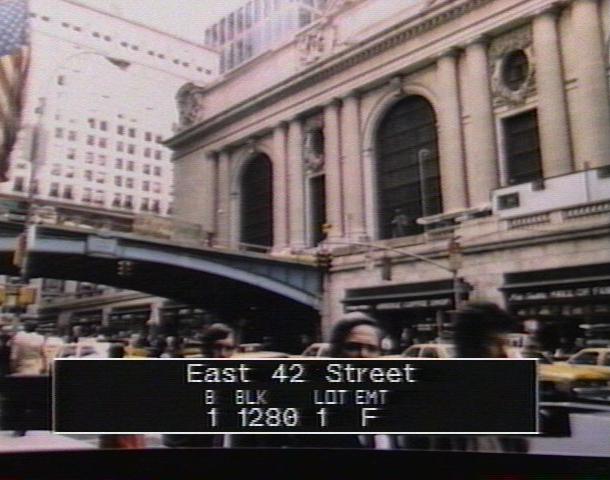
The city photographed every building for its tax records around 1940 and again in the 1980s. NYC Municipal Archives.
Written with AI from the source each entry cites, then fact-checked.
- 1871
Grand Central Depot, the earlier station on this lot, opens for the Harlem and New Haven railroads
The building that preceded today's terminal on this lot, Grand Central Depot, opened in 1871 as a shared station for the New York and Harlem Railroad and the New Haven Railroad. The Landmarks Preservation Commission's designation report adds that the New Haven line once ran downtown through a tunnel as far as 26th Street. The depot served the site until work to enlarge the station began in 1903, which led to the present terminal.
“…opened in 1871 for the New York and Harlem Railroad and for the New…”
- 1902
A wreck in the smoke-filled Park Avenue tunnel leads the state to ban steam locomotives
After a train wreck in the smoky Park Avenue tunnel in 1902, the State Legislature barred steam locomotives from the Park Avenue tracks south of the Harlem River, giving the railroads until 1908 to comply. The landmark report says this forced the lines serving the old Grand Central Depot to electrify, and that work to enlarge the station began in 1903. The present terminal, completed in 1913, grew out of that change.
- 1913
Grand Central Terminal opens at midnight to 150,000 visitors
After nearly ten years of rebuilding, the new Grand Central Terminal opened just after midnight on February 2, 1913. More than 150,000 people came through between midnight and 7 p.m. that day. Electric trains had replaced steam, and the main concourse measured 300 feet long, 125 feet wide and 125 feet high.
Source: pbs.org
- 1913
A dedication to construction workers is set above the 42nd Street door
Rather than name the financiers behind the $35 million terminal, its builders inscribe a dedication above a 42nd Street entrance crediting the anonymous laborers and workers who built it. The modest tribute has greeted travelers ever since.
Source: Ephemeral New York
- 1923
The Grand Central School of Art opens on the terminal's sixth floor
The Grand Central School of Art opened in 1923 as a teaching arm of the Grand Central Art Galleries, a cooperative that artists including John Singer Sargent, Walter Leighton Clark and Edmund Greacen had set up the year before. It took over the west side of the terminal's sixth floor, space that New York Central president Alfred Holland Smith made available. Enrollment peaked at 900 students, and the school closed in 1944. The floor now holds railroad operations and offices.
Source: Untapped New York
- 1923
John W. Campbell builds a private office in a ground-floor room of the terminal
In 1923 John W. Campbell, president of the Credit Clearing House and a New York Central board member, hired the architect Augustus N. Allen to design a private office in a 60-by-30-foot room on the terminal's ground floor. It had hand-painted wooden beams, a pipe organ, a piano and a mahogany musicians' gallery, and after hours it served as a recital room for guests. After Campbell died in 1957 the space fell into neglect, and renovations in 1999 and 2007 turned it into the cocktail bar called the Campbell Apartment.
Source: blog.mcny.org
- 1930
Terminal City peaks as a self-contained district around the depot
The rail yards Grand Central covers let hotels, office towers and apartment houses, including the Chrysler Building, the Roosevelt Hotel and the Commodore Hotel, rise directly above and beside the terminal in what developers market as Terminal City. Most of its residential buildings are later replaced by postwar office towers.
Source: Ephemeral New York
- 1937
A newsreel theater opens inside the terminal
The Grand Central Theatre, later called the Terminal Newsreel Theatre, opens inside the building offering rotating newsreels for twenty-five cents admission, giving commuters a place to catch up on news between trains.
Source: Wikipedia
- 1938
Gen. John J. Pershing is the first to use the private Track 61 under the Waldorf Astoria
Track 61 sits in the Lex Yard beneath the Waldorf Astoria and was part of that hotel's original design as a private track; The New York Times mentioned it in 1929. General John J. Pershing, a top American commander in World War I, was the first to use it, in 1938. President Franklin D. Roosevelt later brought his personal train onto the track and rode a specially designed elevator up to the street. It has seen only occasional use since his death.
“…first used in 1938 by John J. Pershing, a top U.S. general during World War I…”
Source: Wikipedia
- 1948
Dwight Eisenhower christens a new Twentieth Century Limited sleeper in the terminal
On September 15, 1948, Dwight D. Eisenhower, who would become president, christened the Hickory Creek in Grand Central. The car had been built in 1947 as a sleeper-observation car for the Twentieth Century Limited, the New York Central's Chicago train. For its time it had advanced features, including fluorescent lighting, pneumatic doors and a raised lookout lounge. The Hickory Creek returned to the terminal in 2013 for the centennial train exhibit.
Source: Forgotten New York
- 1950
Kodak begins hanging its giant Colorama photographs in the terminal
From 1950 to 1990 Kodak hung a huge color transparency inside Grand Central, each measuring 18 by 60 feet. A new Colorama went up every few weeks, and 565 were shown in all. Each one was destroyed after its display, though the original negatives and transparencies survive at the George Eastman Museum. The series ended in 1990 as the terminal prepared for a renovation that would restore its original architecture.
Source: eastman.org
- 1964
CBS moves its television network control out of the terminal
CBS ran a television production center on the terminal's third floor above the main waiting room, with Studios 41 and 42 and a master control room on the seventh floor. Edward R. Murrow's broadcasts originated there, and the network's signals for shows such as I've Got a Secret and As the World Turns were routed through the building until 1964. That year control moved to the new CBS Broadcast Center on West 57th Street, and master control followed late in 1964.
Source: provideocoalition.com
- 1967
The Landmarks Commission designates Grand Central Terminal after months of hearings
On August 2, 1967, the Landmarks Preservation Commission designated the terminal as a city landmark, after a hearing that opened on May 10, 1966 and closed on January 31, 1967. Its report calls the building a brilliant engineering solution and one of the great buildings of America. It counts about 400,000 people passing through daily, and notes that annual passengers had fallen from over 65 million in 1946 to roughly 43.4 million in 1964.
- 1967
The Main Concourse gets its first mechanical departure board
The terminal installs its first mechanical departure board at the south end of the Main Concourse, a board later replaced many times over as technology changes. The same year, a blackboard in the nearby Biltmore Room that had long posted New York Central train times is taken out of service.
Source: Wikipedia
- 1975
Jacqueline Onassis helps launch the Committee to Save Grand Central Station at the Oyster Bar
After a state court overturned the terminal's landmark status in February 1975, Jacqueline Onassis phoned Kent Barwick of the Municipal Art Society and offered to help. The society formed the Committee to Save Grand Central Station, chaired by former mayor Robert Wagner, with Philip Johnson, Brendan Gill, Doris Freedman and Fred Papert. They announced it at the Oyster Bar, where Onassis said that people who ignore their past cannot expect a future. She also wrote by hand to Mayor Abe Beame, urging him to appeal.
Source: mas.org
- 1976
Croatian nationalists plant a bomb in a terminal locker, and a bomb squad specialist is killed
In 1976 Croatian nationalists left a bomb in a coin locker at Grand Central, then hijacked a plane. The bomb went off while police were disarming it, injuring three NYPD officers and killing one bomb squad specialist. The attack came during a rough decade for the building, which was added to the National Register of Historic Places in 1975 and named a National Historic Landmark in 1976.
“…the bomb exploded while being disarmed and injured three NYPD officers and killed one bomb squad specialist…”
Source: Wikipedia
- 1978
The Supreme Court upholds Grand Central's landmark protection
In 1968 the Penn Central railroad unveiled plans by Marcel Breuer for a 55-story office tower above the terminal, and the city's Landmarks Preservation Commission rejected them. The railroad sued, and on June 26, 1978, the U.S. Supreme Court ruled 6 to 3, in an opinion by Justice William J. Brennan Jr., that the city could block the tower without paying compensation. The case set the modern test for when a regulation amounts to a taking of property.
Source: Wikipedia
- 1989
The old waiting room is boarded up after homeless New Yorkers settle there
Vanderbilt Hall was once the terminal's main waiting room, with double-sided oak benches for about 700 people. As long-distance train service shrank, homeless people began living in the room regularly during the 1980s. In 1989 it was boarded up ahead of a restoration planned for 1991, and a temporary waiting room was set up on an upper level of the terminal.
“In 1989, the room was boarded up in preparation for its restoration in 1991.”
Source: Wikipedia
- 1991
Amtrak runs its last intercity train out of Grand Central
The last Amtrak train left Grand Central on April 6, 1991, when the Empire Connection on Manhattan's West Side was finished. The new link let Empire Corridor trains coming from Albany, Toronto and Montreal run into Penn Station instead. From 1971 until then, every Empire Corridor train had ended its run at Grand Central. A few Amtrak trains came back for the summers of 2017 and 2018 while Penn Station was under maintenance.
“…ran its last train from Grand Central on April 6, 1991…”
Source: Wikipedia
- 1998
A restoration cleans the concourse's celestial ceiling
A major restoration completed in 1998 included cleaning the painted celestial ceiling over the main concourse. In 2014 a foyer in the terminal was named for Jacqueline Kennedy Onassis to honor her work in the 1970s to keep the station from being demolished.
Source: Wikipedia
- 2002
Police arrest Dean Spade over use of a restroom matching their gender identity
In 2002 MTA officers at Grand Central arrested Dean Spade, a transgender person who tried to use the restroom matching their gender identity. In 2006 another transgender person, Helena Stone, was arrested in a similar case. Lawsuits forced the MTA to drop both sets of charges, and the agency began letting people choose restrooms by gender identity.
Source: Wikipedia
- 2013
A centennial parade of restored luxury rail cars draws more than 40,000 visitors in a weekend
For the terminal's centennial, Grand Central gathered restored sleeper, lounge and diner cars from railroads across the country on May 11 and 12, 2013. The MTA estimated that more than 40,000 people came, twice the expected number, and the line began near the 42nd Street entrance corridor and wound onto an unused platform and a Metro-North train. Several of the cars had worked the Twentieth Century Limited, whose red carpet was also displayed.
Source: Forgotten New York
- 2023
Grand Central Madison opens beneath the terminal for Long Island Rail Road trains
Partial Long Island Rail Road service to the new Grand Central Madison station began on January 25, 2023. The station was the product of the East Side Access project, which had been under development since 2007 and cost $11.1 billion. Its eight tracks and four platforms sit in a two-level tunnel more than 90 feet below the Metro-North tracks. The project also added a 350,000-square-foot retail and dining concourse with new entrances along 45th, 46th and 48th Streets.
“The project, officially titled East Side Access, cost $11.1 billion.”
Source: Wikipedia
Further reading
- Grand Central TerminalWikipedia
- PARADE OF TRAINS, Grand Central TerminalForgotten New York
- HOLIDAY TRAIN SHOW, Grand Central TerminalForgotten New York
- TRACK INDICATOR, Grand Central TerminalForgotten New York
- PARK AVENUE VIADUCT LAMP, Grand Central TerminalForgotten New York
- PERSHING SQUARE, Grand Central TerminalForgotten New York
- SUBWAY ENTRANCE, Grand Central TerminalForgotten New York
- Inside Harlem’s “replica” Gilded Age rail station, tucked beneath the tracks over Park AvenueEphemeral New York
Nearby
- Grand Hyatt New York109 East 42nd Street | 12 entries
- MetLife Building (Pan Am Building)200 Park Avenue | 19 entries
- One Vanderbilt51 East 42nd Street | 18 entries
- Pershing Square Building125 Park Avenue | 13 entries
- Graybar Building420 Lexington Avenue | 11 entries
- The Biltmore Hotel335 Madison Avenue | 12 entries