Former True Reformed Protestant Dutch Church
21 Bank Street | West Village | built 1857
Open on the map5 entries

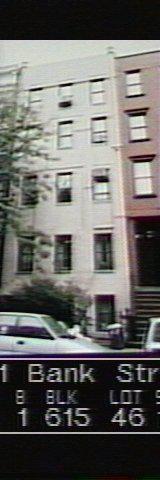
The city photographed every building for its tax records around 1940 and again in the 1980s. NYC Municipal Archives.
Written with AI from the source each entry cites, then fact-checked.
- 1857
Builders Linus Scudder and Henry L. Cathell put up a row of Italianate houses that includes 21 Bank Street
Scudder, a mason-builder long active in the Village, and Cathell bought the land in spring 1856 from the Peugnet brothers, who ran a boys' academy nearby and had used part of the site as a play area. The row of three-story brick houses with high stoops went up in 1856-57, and No. 21 was later altered beyond recognition.
- 1887
Twenty-one families, including the Fitzgeralds of 21 Bank Street, are poisoned by Fourth of July ice cream
The James Fitzgerald family at 21 Bank Street and some 20 other families ate vanilla ice cream from Ernest Intermann's Sixth Avenue parlor on July 4, 1887, and were poisoned. Some needed hospital care. The Sun called the cause a mystery, since only the vanilla was tainted, and no family blamed the confectioner.
Source: Daytonian in Manhattan
- 1893
A shrinking Dutch Reformed congregation turns a Bank Street house into a church
With only about 60 members left, the True Reformed Protestant Dutch Church sold its West Fourth and Perry Street building and bought 21 Bank Street. Architect Henry S. Ihen, a member, added a floor for the rectory, buttresses, stained glass and a stepped parapet, for $28,000. The church opened on October 29, 1893, seating 250, and more than 300 came to the first service.
Source: Daytonian in Manhattan
- 1934
The Greenwich Village Music Hall and Knickerbocker Forum operate out of the old church
After the congregation sold in 1929, the building became meeting rooms, a music hall and the Knickerbocker Forum, a venue for lectures. In November 1934 the Greenwich Village Music Hall announced a series of operas for children, opening with Humperdinck's Hansel and Gretel. A month later the Red Flannel Players invited the Columbia football team to a showing of The Greed for Gold there.
Source: Daytonian in Manhattan
- 1936
Architect Abraham Grossman converts the former church into apartments
In 1936 architect Abraham Grossman remade the building as apartments, two on each floor. His work stripped away almost all of Henry Ihen's church design, though the buttresses survived. The entrance dropped to the former English basement level and the parapet was squared off.
Source: Daytonian in Manhattan
Further reading
- The Altered True Reformed Protestant Dutch Church - 21 Bank StreetDaytonian in Manhattan
- Then & Now photos: 21 Bank StreetVillage Preservation: Greenwich Village Then & Now
Nearby
- 19 Bank Street1 entry
- 23 Bank Street1 entry
- 17 Bank Street1 entry
- 25 Bank Street2 entries
- 15 Bank Street2 entries
- 27 Bank Street2 entries