Columbus Park recreation building and comfort station
21 Mulberry Street | also 55 Mulberry Street | Chinatown | built 1934
Open on the map5 entries

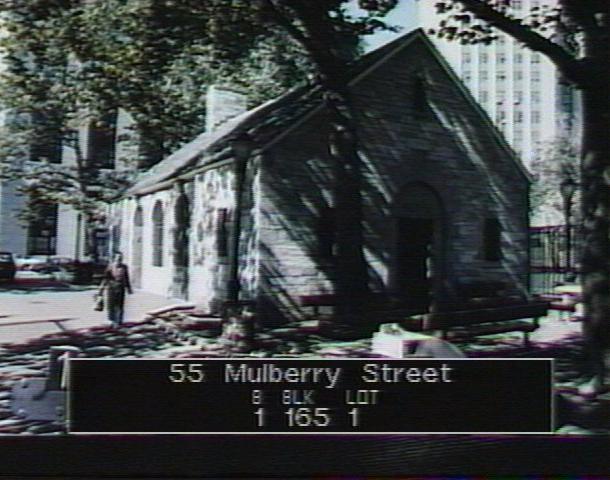
The city photographed every building for its tax records around 1940 and again in the 1980s. NYC Municipal Archives.
Written with AI from the source each entry cites, then fact-checked.
- 1897
Mulberry Bend is cleared and reopens as a park
Jacob Riis's advocacy helped bring down Mulberry Bend, the Five Points slum where his 1888 photograph of Bandits' Roost was taken. In 1897 several blocks of tenements came down, and the site became Mulberry Bend Park; the American Park and Outdoor Art Association had called those tenements the worst in the world. Police captain William Dean of the Sixth Precinct said the whole neighborhood had changed for the better.
Source: Wikipedia
- 1934
Columbus Park reopens on Columbus Day with 442 homing pigeons
Construction began in August 1934 to add trees and enlarge the playground. When the park reopened on Columbus Day, about 15,000 people came, and the Bronx Homing Pigeon Club released 442 pigeons, one for each year since 1492. Emma Stebbins's statue of Columbus stood in the park from 1934 until 1971.
Source: Wikipedia
- 1936
A recreation building with comfort stations opens in Columbus Park
A recreation building opened in the park in November 1936, with separate comfort stations for boys and girls, a room for mothers and a big play room. It was part of the 1930s rebuilding that enlarged the playground and added a wading pool, benches and drinking fountains. The Living New Deal project notes that nearly all New York City park work in 1934-43 used New Deal money and labor, and the building still serves as the park's comfort station.
Source: livingnewdeal.org
- 1936
The first Chinatown Community Play Day is held in Columbus Park
From 1936 the park hosted an annual Chinatown Community Play Day, organized by neighborhood groups and civic leaders. The day offered baseball, handball and foot races, plus a show by Chinese Boy Scout Troop 150. A baby contest handed out prizes in categories that included best dressed and strongest lungs.
Source: Wikipedia
- 1970
The Chinese American Arts Council launches the Chinatown Outdoor Summer Festival
In 1970 the Chinese American Arts Council, a unit of the Chinese-American Planning Council, started a Chinatown summer festival in the park, meant to celebrate Chinese identity and arts. By its tenth anniversary in 1980 the free event ranged from classical Chinese opera to folk dance and pop music.
Source: Wikipedia
Nearby
- Banca Italia Building28 Mulberry Street | 4 entries
- Church of the Transfiguration29 Mott Street | 4 entries
- Church of the Transfiguration25 Mott Street | 10 entries
- Louis J. Lefkowitz Building80 Centre Street | 4 entries
- Chatham Towers170 Park Row | 5 entries
- True Light Lutheran Church195 Worth Street | 5 entries