Lescaze House
211 East 48th Street | Turtle Bay | built 1865
Open on the map9 entries

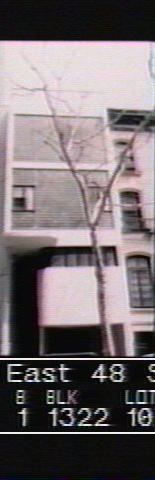
The city photographed every building for its tax records around 1940 and again in the 1980s. NYC Municipal Archives.
Written with AI from the source each entry cites, then fact-checked.
- 1933
The Building Department rejects Lescaze's plans for his glass-block house
William Lescaze filed his first application in August 1933 to turn the 1865 brownstone into a combined home and office. The city turned it down on zoning grounds and asked him to clarify twelve items, the main ones about ventilation and the hollow glass-block windows. He resubmitted in December and added a January amendment promising full mechanical ventilation and air conditioning. Approval finally came on February 11, 1934.
- 1934
A glass-block maker advertises the Lescaze House in Architectural Forum
The December 1934 issue of Architectural Forum carried a two-page advertisement built around the Lescaze House, crediting the Macbeth-Evans Company with making its glass blocks. Lescaze later recalled that a manufacturer had agreed to produce the first American glass blocks for his house at a plant in Illinois. He also remembered the fight with the building code as lasting at least three months.
- 1934
The house gets New York's first central air conditioning in a private residence
Besides its glass blocks, the Lescaze House was fitted with central air conditioning, the first such system in a private home in the city, at a time when year-round climate control for office buildings was still being debated. Compressors were installed in the basement and also on the roof over the living room. The Johnson Company of Milwaukee, maker of the thermostats, ran an Architectural Forum ad in December 1934 with two photographs of the house captioned as an office by day and a residence by night.
- 1934
Passersby gawk at the glass house, so the Lescazes open it to visitors on Mondays
After the family moved in during June 1934, so many onlookers gathered that the Associated Press said the Lescazes enjoyed roughly the privacy of a traffic cop. They answered by inviting passersby to look the house over for one hour each Monday, leaving a servant in charge while they traveled. Mary Lescaze said she did not fear stone-throwers, since the stones would simply rattle off.
“…about as much privacy as a traffic cop. The couple agreed to invite passersby to look at the house for one hour each Monday.”
Source: Wikipedia
- 1934
William Lescaze remodels an 1865 brownstone into a modernist house
Swiss-born architect William Lescaze transformed a Civil War-era Italianate brownstone into an International Style residence for his own family, moving in by June 1934. Its glass-block facade, made of 5-by-5-inch translucent blocks, was the first in New York City, and the house was also the city's first private residence with central air conditioning.
Source: Wikipedia
- 1938
Photographer Berenice Abbott documents the startling new facade
Berenice Abbott photographed the Lescaze house in 1938, capturing its startling modern facade a few years after it was completed. Its curved second-floor bay echoed the sleek lines of the Philadelphia Saving Fund Society skyscraper, which Lescaze had co-designed two years earlier.
Source: Ephemeral New York
- 1969
William Lescaze dies of a heart attack at the house he designed
Lescaze suffered a fatal heart attack at his house in 1969, aged 72. His widow Mary went on maintaining the property in largely its original condition, and the family owned it for sixteen years after his death. In 1985 the William Kaufman Organization bought it together with the adjoining house at 209 East 48th Street, which Lescaze had renovated for his son Lee's family.
Source: Wikipedia
- 1976
The city designates the modernist house a landmark
The Landmarks Preservation Commission designated the Lescaze House a New York City landmark on January 27, 1976. It later joined the National Register of Historic Places in 1980.
Source: Wikipedia
- 2001
The Landmarks Commission insists on exact replacement glass blocks
Melvyn and Robert Kaufman, the owners in 2001, were seeking a tenant for the house. The glass blocks in the windows were no longer made, but the Landmarks Preservation Commission required any replacements to match the original specifications. A spokesman for the leasing agent, SageGroupAssociates, said a studio in Pennsylvania had agreed to produce replicas of the blocks.
“…the glass blocks used in the windows were no longer being manufactured, the LPC insisted that any replacements be to the same specifications…”
Source: Wikipedia
Further reading
- Lescaze HouseWikipedia
- Is this the East Side’s most hideous brownstone?Ephemeral New York
Nearby
- Sanders-Davis House219 East 49th Street | 3 entries
- Gluck-Zimbalist House225 East 49th Street | 4 entries
- One Dag Hammarskjöld Plaza885 2nd Avenue | 7 entries
- Lexington Hotel511 Lexington Avenue | 9 entries
- The Shelton Hotel525 Lexington Avenue | 10 entries
- The Centrale138 East 50th Street | 3 entries