Gluck-Zimbalist House
225 East 49th Street | Turtle Bay | built 1900
Open on the map4 entries

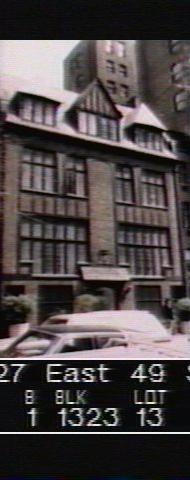
The city photographed every building for its tax records around 1940 and again in the 1980s. NYC Municipal Archives.
Written with AI from the source each entry cites, then fact-checked.
- 1926
A violin relief over the door marks Efrem Zimbalist's mansion
A relief above the entrance of 225-227 East 49th Street shows a violin and musical notes, with lettering reading "Erected in the year 1926." It marks the home of violinist Efrem Zimbalist and his wife, Metropolitan Opera soprano Alma Gluck. The building later served as a police precinct house for a time and was then divided into rentals, yet the relief was never removed.
Source: Ephemeral New York
- 1927
Grosvenor Atterbury's neo-Tudor double mansion for the Zimbalists is completed
Violinist Efrem Zimbalist and his wife, soprano Alma Gluck, bought two brownstones at 225 and 227 East 49th Street in 1926 and hired architect Grosvenor Atterbury to replace them with a double mansion. Completed in 1927, the neo-Tudor building looks like a single house from the street, with half-timbering on its brick facade. The family lived in one half and rented out the other, including to Marie Hofmann, the former wife of pianist Josef Hofmann.
Source: Daytonian in Manhattan
- 1938
Opera soprano Alma Gluck, who built the East 49th Street mansion, dies
Alma Gluck, a celebrated opera soprano, died in October 1938 after a long illness, and newspapers around the world reported her death. Six months earlier, her daughter Maria Virginia Zimbalist had married Ogden Goelet in the mansion, in a ceremony limited to family because of Gluck's illness.
Source: Daytonian in Manhattan
- 1957
The NYPD rents the mansion as a temporary precinct house
In 1957 the New York Police Department rented the former mansion, which was unoccupied at the time, as a temporary station house for the 17th Precinct while a new building was finished. By 1965 the building had been converted into apartments, and its neo-Tudor exterior survived the changes.
Source: Daytonian in Manhattan
Further reading
- The Gluck-Zimbalist House - 225-227 East 49th StreetDaytonian in Manhattan
- The violin over the door of a Turtle Bay mansionEphemeral New York
Nearby
- Sanders-Davis House219 East 49th Street | 3 entries
- Lescaze House211 East 48th Street | 9 entries
- One Dag Hammarskjöld Plaza885 2nd Avenue | 7 entries
- Sutton Place Synagogue225 East 51st Street | 3 entries
- The Centrale138 East 50th Street | 3 entries
- Rockefeller Guest House242 East 52nd Street | 12 entries