22 Grove Street
West Village | built 1930
Open on the map5 entries

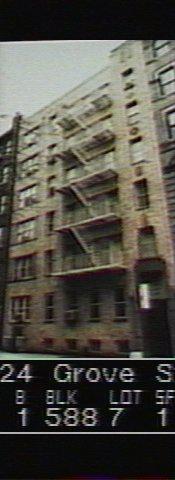
The city photographed every building for its tax records around 1940 and again in the 1980s. NYC Municipal Archives.
Written with AI from the source each entry cites, then fact-checked.
- 1925
Opera Players, Inc. tear down two Federal houses to build the 290-seat Grove Street Theatre
An earlier building on this site was the Grove Street Theatre. Opera Players, Inc. demolished two Federal-style houses at Nos. 22 and 24 in 1925 and hired architect Harrison C. Wiseman to design the playhouse. Theatre Magazine described it as the third of three intimate theaters recently built in the Village, alongside the Greenwich Village Theatre and the Cherry Lane. It lasted only about three years.
Source: Daytonian in Manhattan
- 1930
H. I. Feldman replaces the Grove Street Theatre with a six-story Art Deco apartment house
In January 1929 the New York Times reported that developer Asher Osterman had bought the theater and planned 42 studio suites in its place. Architect Hyman Isaac Feldman, then 32, designed the building; the theater itself came down in April 1930. Feldman, who went by his initials, later designed more than 2,500 apartment buildings in the region. The sandy brick facade is plain except for a terra cotta waterfall around the entrance and ornament on the sixth floor.
Source: Daytonian in Manhattan
- 1944
Travel writer George W. Seaton, who lived here, dies at 56 after working for the Office of War Information
George W. Seaton wrote guidebooks, including Let's Go to the West Indies in 1938, a 1939 guide to Scandinavia and another to New England in 1940. After war broke out in Europe he took a job with the Office of War Information. Seaton, 56, died in August 1944 while still residing in his Grove Street apartment.
Source: Daytonian in Manhattan
- 1946
Resident lawyer Emanuel Popolizio defends a veteran in a nationally reported 1946 crime spree
Emanuel Popolizio, a young attorney living in the building, took on a high-profile case in June 1946. His client, 24-year-old Henry Suckow, was one of three army veterans accused in a killing and assaults in Central Park and a second fatal shooting in Queens on June 8. Popolizio became far better known in January 1986, when Mayor Ed Koch appointed him chairman of the New York City Housing Authority, a post he held until November 1990.
Source: Daytonian in Manhattan
- 1954
A 17-year-old robber who followed a woman home turns out to be humorist S. J. Perelman's son
One cold January night in 1954, Marian Sawyer was followed into the hallway of the building by a young man with a knife, who took $21 from her. The attacker, Adam Perelman, was linked to several similar robberies and was arrested a few days later. At 17, he was the son of the famous humorist and screenwriter S. J. Perelman.
Source: Daytonian in Manhattan
Further reading
- Unexpected Art Deco - H. I. Feldman's 1930 22-24 Grove StreetDaytonian in Manhattan
- Then & Now photos: 22 Grove StreetVillage Preservation: Greenwich Village Then & Now
Nearby
- The Friends building90 Bedford Street | 5 entries
- 26 Grove Street6 entries
- 88 Bedford Street5 entries
- Chumley's86 Bedford Street | 13 entries
- 54 Barrow Street1 entry
- 18 Grove Street5 entries