246 Greene Street (Kimball Hall)
22 Waverly Place | also 246 Greene Street, 18 Waverly Place | Greenwich Village | built 1900
Open on the map6 entries

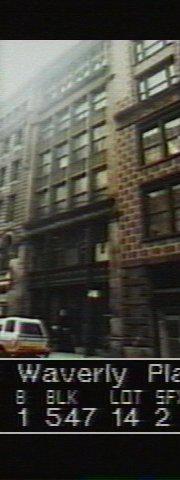
The city photographed every building for its tax records around 1940 and again in the 1980s. NYC Municipal Archives.
Written with AI from the source each entry cites, then fact-checked.
- 1890
Publisher Martin Young catches four boys stealing brass from the cellar of his house at 22 Waverly Place
Martin Young, a publisher, lived in a private house at 22 Waverly Place, one of the last still standing on the block as lofts replaced homes. Hearing a noise below, he found four boys, aged 10 to 15, taking brass from his cellar. Alfred Zucker's much larger warehouse at 246 Greene Street later engulfed the site of his house.
Source: Daytonian in Manhattan
- 1892
Alfred Zucker's eight-story warehouse for developer Simon Goldenberg opens at Greene Street and Waverly Place
Architect Alfred Zucker filed plans in February 1891 for an eight-story brick, iron and stone warehouse costing $140,000, commissioned by Simon Goldenberg. Finished in 1892, it mixes Renaissance and Romanesque Revival styles, with dark brown brick on the lower floors imitating stone blocks and arched cast-iron frames above. Zucker designed several neighboring buildings on the same block within two years.
Source: Daytonian in Manhattan
- 1892
Fur wholesalers Asch & Jaeckel fill the new building and advertise for a model to try on garments
The furriers Asch & Jaeckel took the whole building, with salesrooms on the ground floor and factory, design and office space above. Shortly after moving in, they ran a newspaper notice seeking a young woman with a 36-inch bust to serve as a live model. Partner Joseph Asch later left to put up his own building on Washington Place, the Asch Building, which housed the Triangle Waist Company at the time of the 1911 fire.
Source: Daytonian in Manhattan
- 1897
Detectives trail two noted shoplifters from the Asch & Jaeckel fur store to a cab full of stolen sealskin
Detective sergeants noticed Annie Drayton, known as Big May, and Flossie Maitland in Madison Square and followed their cab as it stopped at the Asch & Jaeckel showroom and then another fur shop. At Police Headquarters they found two sealskin jackets, worth $327, hidden under the seat, and a cape on Drayton. Both women raised $3,000 bail, then vanished before their March 1898 court date, so the bondsman forfeited it.
Source: Daytonian in Manhattan
- 1916
Trimmings dealer Harry Long's wife hires detectives, and their divorce case becomes a newspaper scandal
Harry Long's trimmings firm was based here in 1915, when his wife Florence grew suspicious of his fidelity and put private detectives on his trail. Their findings became public in January 1916 when she took him to court, and The Sun reported that a mysterious blonde had been found guilty of improper conduct with him. He was ordered to pay $200 a month toward the support of their three children.
Source: Daytonian in Manhattan
- 1946
New York University converts the former garment building into classrooms
After World War I the apparel trade moved north of 34th Street, and by the 1930s the building held a wholesale paper dealer. In 1946 New York University converted it to classrooms. As Kimball Hall, it now holds computer labs, lecture rooms and a student lounge.
Source: Daytonian in Manhattan
Further reading
- Alfred Zucker's 1892 246 Greene Street (a.k.a. 20-22 Waverly Place) Daytonian in Manhattan
- Alfred Zucker's No. 18 Waverly PlaceDaytonian in Manhattan
Nearby
- NYU Torch Club18 Waverly Place | 5 entries
- New York University Kimball Block16 Waverly Place | 6 entries
- NYU Reprographic Services14 Waverly Place | 5 entries
- 12 Waverly Place7 entries
- Brown Building29 Washington Place | 12 entries
- 15 Waverly Place7 entries