Brown Building
29 Washington Place | also 245 Greene Street, 23 Washington Place | Greenwich Village | built 1901
Open on the map12 entries

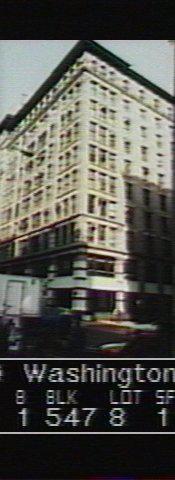
The city photographed every building for its tax records around 1940 and again in the 1980s. NYC Municipal Archives.
Written with AI from the source each entry cites, then fact-checked.
- 1843
Henry James is born in a Greek Revival rowhouse on the lot that later holds the Asch Building
The author Henry James was born in 1843 in a rowhouse at 27 Washington Place. The furrier Joseph J. Asch bought its matching neighbor at number 29 in 1890, then the James house in 1897, and acquired number 25 in 1898; number 23 joined the assembly through the builder Ole Olsen. The four lots became the site of his ten-story loft building, so the birthplace lot lies within the footprint of today's Brown Building.
- 1900
Asch dismisses architect John Woolley after digging reveals a foundation problem
Work on the Asch Building began in early June 1900. Excavation showed that the footings of the neighboring NYU building reached onto Joseph Asch's lot, and by late June he had dismissed the architect John Woolley. The job passed to Robert Maynicke's firm; Maynicke was an architect and engineer who specialized in loft and office buildings; his head draftsman Julius Franke seems to have run the job. Construction was completed in January 1901.
“Excavations revealed unexpected structural problems-- the footings of the adjacent NYU Building projected onto the Asch Building lot.”
- 1901
The Asch Building opens
Completed as the Asch Building, a ten-story loft building whose open floors suited garment manufacturers.
Source: Wikipedia
- 1909
Triangle lays off 150 workers suspected of union sympathies, setting off a lockout and strike
In September 1909 about 100 Triangle workers met with officials of ILGWU Local 25 and the United Hebrew Trades to discuss conditions at the factory. Owners Max Blanck and Isaac Harris learned of it and laid off 150 workers who had attended or were suspected of union leanings. When the firm advertised for replacements the next day, Local 25 declared a lockout and a strike. Two months later a general strike of 20,000 to 30,000 shirtwaist workers followed across the city.
“…laid off 150 workers who had either attended the meeting or were suspected of union sympathies…”
- 1911
The Triangle Shirtwaist Factory fire
Fire broke out on the eighth floor. The Triangle Waist Company occupied the top three floors, and with exits locked or blocked, 146 garment workers died, most of them young immigrant women. The disaster led to new state fire safety and labor laws.
Source: Wikipedia
- 1912
The building gets new fire safety measures after the Triangle fire
In the year after the Triangle Shirtwaist fire, the building's owners add an additional fire escape, remove the iron shutters that had trapped workers, install rooftop water tanks, and add a sprinkler system throughout the structure.
Source: Daytonian in Manhattan
- 1919
NYU takes over the building's former factory floors
Having rented the eighth floor since 1915, New York University takes over the ninth floor in 1918 and the tenth the following year, completing its hold on the three floors that had housed the Triangle Waist Company at the time of the 1911 fire. By the 1920s, the university occupies the entire building.
Source: Daytonian in Manhattan
- 1929
Realtor Frederick Brown buys the building and gives it to NYU the same day
On February 28, 1929, the realtor Frederick Brown bought the building, then called the Greenwich Building, and signed it over to New York University that same day. The gift spared the university $92,000 a year in rent. At the suggestion of Percy Straus, who ran the university's centennial fund, it was renamed the Frederick Brown Building, and a ceremony on April 22 unveiled a bronze dedication tablet in the lobby.
- 1961
Survivors and Eleanor Roosevelt attend the dedication of a Triangle fire plaque at the building's corner
To mark the fiftieth anniversary of the fire, the International Ladies' Garment Workers' Union installed a plaque to the victims on the corner pier at Washington Place and Greene Street in 1961. Elderly survivors came, including Pauline Newman, the union's first woman organizer, and Rose Schneiderman, who led the funeral procession after the fire. Eleanor Roosevelt, Frances Perkins, union president David Dubinsky and the fire commissioner also attended. The fire department and the union have held a memorial ceremony in front of the building every year since.
- 1962
NYU louvers over some windows of its laboratory building as a precaution against explosions
By the 1960s the building was a classroom and laboratory block for New York University. During extensive interior alterations in 1962, some of the windows were covered with louvers as a safeguard in case of an explosion. The building was renovated again in the early 1970s as a life-sciences center with a grant from the Charles Hayden Foundation, and it still houses the chemistry and biology departments.
“…extensive interior alterations in 1962 when some of the windows were blocked with louvers as a precaution against explosion…”
- 1991
The National Park Service names the Triangle factory building a National Historic Landmark
The National Park Service made the building, now the Brown Building, a National Historic Landmark in 1991, listing it as "Triangle Shirtwaist Factory Building (Asch Building)." By then NYU had used it continuously as an academic building for decades. The federal designation came twelve years before New York City made it a city landmark.
- 2003
The city designates the Brown Building a landmark on the fire's anniversary
On the 92nd anniversary of the Triangle Shirtwaist fire, the Landmarks Preservation Commission designates the former Asch Building a New York City landmark. The building, renamed for donor Frederick Brown in 1929, now anchors NYU's Silver Center for Arts and Science.
Source: Wikipedia
Further reading
- Brown Building (Manhattan)Wikipedia
Nearby
- Silver Center32 Waverly Place | 3 entries
- 246 Greene Street (Kimball Hall)22 Waverly Place | 6 entries
- Silver Center, former home of the Grey Art Gallery82 Washington Square East | 8 entries
- NYU Torch Club18 Waverly Place | 5 entries
- New York University Kimball Block16 Waverly Place | 6 entries
- Paulette Goddard Hall79 Washington Square East | 4 entries