St. Mary's Episcopal Church
220 Classon Avenue | Clinton Hill | built 1928
Open on the map6 entries

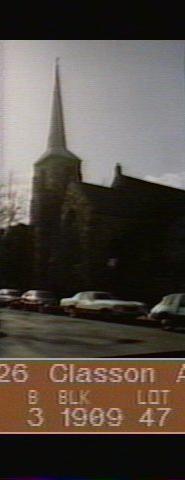
The city photographed every building for its tax records around 1940 and again in the 1980s. NYC Municipal Archives.
Written with AI from the source each entry cites, then fact-checked.
- 1835
Five parishioners of St. John's organize St. Mary's, the first Episcopal parish in East Brooklyn
Five parishioners of St. John's Episcopal Church, then on Washington Street, organized St. Mary's in 1835, and the new congregation met first in a former district school house on Flushing Avenue. Its members came mostly from the modest neighborhood that had grown up near the Navy Yard. In 1837 it built a small frame church on Classon Avenue north of Myrtle Avenue, a different lot from today's church, and because most members were poor, it was one of the first Episcopal churches to use free pews instead of charging pew rent.
- 1858
Richard Auchmuty, junior partner of James Renwick, is credited with designing the new St. Mary's
In 1858 the vestry bought land a block away on Classon Avenue and hired the firm of Renwick & Auchmuty. A contemporary source credited the design to the junior partner, Richard T. Auchmuty, though senior partner James Renwick may have contributed ideas. Auchmuty served in the Civil War, ending as a colonel at the War Department, and never returned to architecture; his main philanthropic effort was the New York Trade Schools, founded in 1881.
“…a contemporary source attributes the design to Richard Auchmuty. ... Auchmuty's main effort was the establishment of the New York Trade Schools, founded in 1881…”
- 1858
The church is built of Belleville brownstone with a flying-buttress gate leading to its porch
The Gothic Revival church is built of Belleville brownstone, with a six-bayed nave lit by paired lancet windows between buttresses. Its main entrance sits at the southwest corner, set far back from the street, so Auchmuty added a pointed-arch gateway shaped like a stepped flying buttress to lead worshippers there. The gateway projects from the tower's south side, and the church sits behind its original cast-iron fence.
- 1859
The new St. Mary's opens, and a church paper calls it Brooklyn's most beautiful
The present church opened for services in June 1859. That year the Churchman, a leading Episcopal periodical of the century, wrote that in its taste this was the most beautiful church in Brooklyn, even though the parish lacked the means of some wealthier ones.
“The present St. Mary's church opened for services in June, 1859 ... the Churchman ... wrote in 1859 that "to our taste, this is the most beautiful church in Brooklyn…”
- 1862
St. Mary's is consecrated once its building debt is cleared, in a difficult neighborhood
The church was consecrated on May 24, 1862, once the building debt had been cleared. The neighborhood proved difficult at first: the Brooklyn Daily Eagle reported in 1936 that lawless conditions in a nearby section meant the church property was sometimes molested, before the area became thickly populated.
“…consecrated on May 24, 1862, after the building debt was paid off ... the church property was sometimes molested…”
- 1981
The Landmarks Preservation Commission designates St. Mary's, called Brooklyn's least known Gothic Revival church
After an October 9, 1979 hearing where three witnesses spoke for designation and none against, the commission designated the church on October 27, 1981. Its report called St. Mary's perhaps the least well-known of Brooklyn's surviving mid-19th-century Gothic Revival churches, and noted that the small present-day congregation was working to preserve the building. The 1892 Johnson Memorial Parish House was not part of the designation.
Further reading
Nearby
- 88th Precinct Station House298 Classon Avenue | 7 entries
- Pratt Institute Memorial Hall205 Ryerson Street | 3 entries
- Pratt Institute Main Building207 Ryerson Street | 7 entries
- Pratt Institute Library261 Hall Street | 4 entries
- Emmanuel Baptist Church279 Lafayette Avenue | 5 entries
- Caroline Ladd Pratt House229 Clinton Avenue | 6 entries