88th Precinct Station House
298 Classon Avenue | Clinton Hill | built 1890
Open on the map7 entries

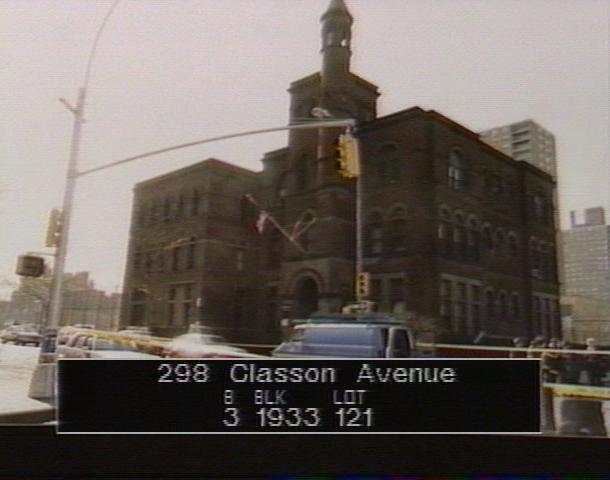
The city photographed every building for its tax records around 1940 and again in the 1980s. NYC Municipal Archives.
Written with AI from the source each entry cites, then fact-checked.
- 1889
Brooklyn buys a DeKalb Avenue corner lot for a new Fourth Precinct station house
The state authorized bonds in May 1888 to build a station house for Brooklyn's Fourth Precinct. In March 1889 the city bought a vacant 100-by-97-foot site, made up of four 25-foot lots, from Charles H. Otis for $24,250. That October the Department of City Works filed plans for a precinct house and a patrol stable with a cells extension, expected to cost $39,000.
“Brooklyn acquired the 100 x 97' site from Charles H. Otis in March 1889. Consisting of four 25-foot-wide lots, the vacant property cost $24,250.”
- 1890
The Fourth Precinct station house is completed and the police take possession
Contractor John J. Cashman finished the station house in November 1890, and police formally took possession on the 27th. While it was still going up, the Brooklyn Eagle had boasted in March 1890 that no city in the Union had anything to equal it, calling the buildings a model home for the police and an impregnable prison for lawbreakers.
- 1890
City engineer George Ingram designs the Fourth Precinct without being named on the plans
George Ingram, a civil engineer with the Brooklyn Department of City Works, developed a standard station house plan for the police and treated each as a small complex with separate stable, cell block and lodging rooms. He left the department in late 1889 or early 1890, as this precinct and the nearly identical 13th began construction. He is not named on the permits or blueprints, but the Brooklyn Eagle reported that he drew the plans for the Fourth.
“Ingram resigned from the department in late 1889 or early 1890 ... Though he was not identified on the building permits or blueprints…”
- 1890
The station house opens with 64 officers, and its precinct number changes four times
When the building opened it housed 64 officers: a captain, four sergeants and 44 patrolmen. The number rose to 80 by 1917. Its precinct was renumbered after consolidation in 1898, becoming the 56th, then the 156th by 1908 and the 96th in 1918. It has been the 88th Precinct since about 1930.
- 1926
A police lieutenant designs a three-story extension that matches the 1890 building
The original patrol stable was altered in 1915-17. In 1923 the police department filed plans for a three-story brick extension to take its place, holding detective quarters, a garage, a prison and a dormitory, and work finished in 1926 at an estimated cost of $75,000. The architect, Lieutenant Thomas E. O'Brien of the police force, matched the arches, hoods, brick and stone so the addition looks contemporary with the main building.
- 1953
A slum-clearance plan around Pratt Institute spares the station house
In July 1953 the city approved a slum clearance plan for 14 blocks around Pratt Institute, completed in 1965 with two superblocks of high-rise apartments. Several streets were closed and many 19th-century row houses were torn down. A small group of historic buildings along DeKalb Avenue was deliberately spared, including the 88th Precinct station house, which now stands between Classon Playground and Public School 270.
- 2014
The 88th Precinct station house becomes a city landmark over one objection
The Landmarks Preservation Commission designated the former 4th Precinct station house on January 14, 2014, after a December 2013 hearing. Representatives of the Historic Districts Council and the Victorian Society in America spoke in favor, and Council member Letitia James sent a letter of support. A representative of Brooklyn Community Board 1 spoke in opposition.
“One person, a representative of Brooklyn Community Board No. 1, spoke in opposition to designation.”
Nearby
- St. Mary's Episcopal Church220 Classon Avenue | 6 entries
- Pratt Institute Main Building207 Ryerson Street | 7 entries
- Pratt Institute Memorial Hall205 Ryerson Street | 3 entries
- Pratt Institute Library261 Hall Street | 4 entries
- Emmanuel Baptist Church279 Lafayette Avenue | 5 entries
- Apostolic Faith Mission (former Orthodox Friends Meeting House)265 Lafayette Avenue | 4 entries