Erasmus Hall High School
2240 Bedford Avenue | also 911 Flatbush Avenue, 2212 Bedford Avenue | East Flatbush | built 1904
Open on the map13 entries

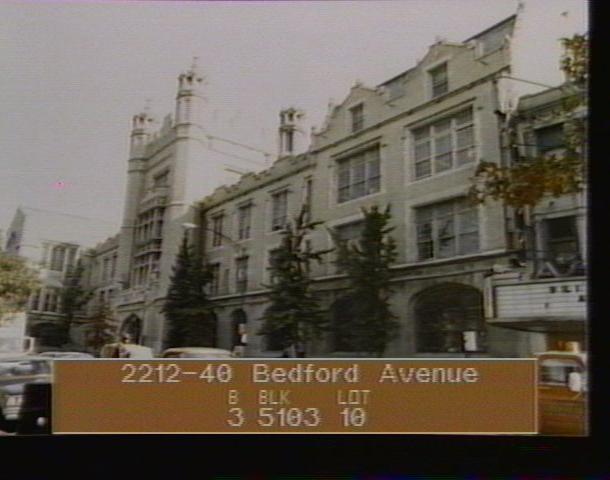
The city photographed every building for its tax records around 1940 and again in the 1980s. NYC Municipal Archives.
Written with AI from the source each entry cites, then fact-checked.
- 1786
Erasmus Hall Academy is founded in Flatbush as the first Regents-chartered secondary school
John H. Livingston and Senator John Vanderbilt founded the private academy in 1786, and it became the first secondary school to receive a charter from the state's Board of Regents. The Flatbush Dutch Reformed Church gave the land, and donors included Aaron Burr and Alexander Hamilton as well as Peter Lefferts and Robert Livingston. The wooden schoolhouse opened in 1787 with 26 students and still stands in the courtyard.
- 1896
Trustees give the declining academy to the public school system
After enrollment dropped sharply, the trustees offered the academy's grounds to the Brooklyn Board of Education in 1896. The condition was that the board build and maintain a high school of the same grade on the land. The school had 150 boys and girls then; it had admitted girls from 1801 and absorbed Flatbush's village school in 1803.
“Upon a severe decline in its enrollment in 1896, the Academy was donated to the public school system…”
- 1906
The first building of C. B. J. Snyder's Collegiate Gothic campus opens to students
The cornerstone was laid in January 1905, and the opening slipped to September 1906 because the school board wanted changes to laboratories and classrooms. The new section along Flatbush Avenue added seats for 600 students. Snyder planned a quadrangle of buildings around the old wooden academy so it could stay in use while the new school went up.
“The cornerstone for the new building was laid in January, 1905... The building was opened to students in September, 1906.”
- 1911
A Church Avenue addition makes room for 1,451 more students in an overcrowded school
By 1910 Erasmus Hall had 3,114 pupils, housed in the main building and four annexes. In 1909 the Board of Education signed off on Snyder's plans for the next section: three buildings holding 31 classrooms along with laboratories, a study hall, and rooms for music, drawing, physics, lectures and shop work. When the Church Avenue addition opened in September 1911, it added space for 1,451 more students.
“When this Church Avenue addition opened in September 1911, there was room for 1,451 more students in the main school.”
Source: Wikipedia
- 1915
Moses Horwitz, later Moe Howard of the Three Stooges, quits after two months
Moses Harry Horwitz enrolled at Erasmus Hall but dropped out after two months, in 1915. He later became Moe Howard of the Three Stooges comedy team.
“Moe Howard (Moses Harry Horwitz) (dropped out after two months, 1915), member of the Three Stooges comedy team…”
Source: Wikipedia
- 1925
The Bedford Avenue building opens with a tower, gymnasia and a large swimming pool
The Board of Education approved the Bedford Avenue addition in April 1924. C. B. J. Snyder had left his post, so William Gompert supervised construction of a building that follows his elevation drawing. Its central tower has an arched passage into the courtyard, lined up with the tower on Flatbush Avenue, and it opened on February 2, 1925 with new classrooms, gymnasia and a swimming pool.
“The building contained many new classrooms, gymnasia and a large swimming pool along the courtyard and was opened on February 2, 1925.”
- 1931
A statue of Erasmus, a gift from an alumnus, is dedicated in the courtyard
Alumnus Richard Young donated a statue of the scholar Desiderius Erasmus, a cast of Hendrick de Keyser's 1622 original in Rotterdam. It was dedicated in 1931, and its base carries an inscription calling Erasmus the greatest man of his century. The statue stands in the school's courtyard.
“A statue of Erasmus (cast from the 1622 original in Rotterdam by Hendrick de Keiser) was given by an alumnus, Richard Young... Dedicated in 1931…”
- 1940
The final building opens and the old wooden academy is moved and restored
The five-story building on the south side of the lot, supervised by chief architect Eric Kebbon, opened in September 1940 and could hold 1,566 more pupils. Inside were classrooms, a girls' gym, a large library, and rooms for art and homemaking. To make room, the original frame schoolhouse was moved and its wings torn down; the WPA started work on it, the war halted it, and restoration finished afterward.
- 1960
Chess champion Bobby Fischer drops out of Erasmus Hall
Bobby Fischer, later world chess champion, left Erasmus Hall in 1960 without graduating, according to the school's alumni list. The list also notes that photographer David Attie, another alumnus, later made portraits of him.
“Bobby Fischer (dropped out in 1960), chess champion…”
Source: Wikipedia
- 1966
The old academy building is designated the Erasmus Hall Museum landmark
The Landmarks Preservation Commission designated the 1786 wooden building in the courtyard as the Erasmus Hall Museum on March 15, 1966. The museum held the original school bell and the first dictionary the academy bought, a 1778 edition of Samuel Johnson's work. The commission counted the school among the oldest secondary schools in the country.
“The Museum contains among other memorabilia the original school bell and the first dictionary bought for the Academy, a 1778 edition of Samuel Johnson's famous work.”
- 1987
Brooklyn College archaeologists excavate at Erasmus Hall for the school's bicentennial
For the school's bicentennial in 1987, Brooklyn College ran limited excavations at Erasmus Hall. The archaeologists found that intact 18th- and 19th-century deposits tied to the school's development are still in the ground.
“The archaeologists discovered that intact deposits from the 18th and 19th centuries associated with the development of the school are still in place.”
Source: Wikipedia
- 1994
After poor scores, Erasmus Hall is divided into five small high schools
In 1994 the city split the large high school internally into smaller schools, each focusing on a different academic area, after years of poor academic results. The schools keep separate administrations and faculties but use the shared lunchroom, gymnasium, library and auditorium at different times. The exterior was left unchanged.
“In 1994, after years of poor academic scores, the huge Erasmus Hall High School was divided internally into five smaller high schools…”
Source: Wikipedia
- 2003
The campus is designated a landmark, citing alumni such as Streisand, Sills and Fischer
On June 24, 2003 the Landmarks Preservation Commission designated the whole Erasmus Hall High School campus, covering all four building phases of 1905-06, 1909-11, 1924-25 and 1939-40. Its findings name Sid Luckman, Bernard Malamud, Neil Diamond, Bobby Fischer, Beverly Sills and Barbra Streisand among the notable alumni.
“…notable alumni from this school include Barbra Streisand, Beverly Sills, Bobby Fischer, Neil Diamond, Bernard Malamud, and Sid Luckman…”
Further reading
- Erasmus Hall High SchoolWikipedia
Nearby
- Erasmus Hall High School2212 Bedford Avenue | 1 entry
- Flatbush Town Hall35 Snyder Avenue | 6 entries
- Flatbush Reformed Church890 Flatbush Avenue | 4 entries
- Flatbush Dutch Reformed Church890 Flatbush Avenue | 4 entries
- Flatbush Dutch Reformed Church Parsonage2103 Kenmore Terrace | 5 entries
- Flatbush Station post office2273 Church Avenue | 3 entries