Harriet and Thomas Truesdell House
227 Duffield Street | Downtown Brooklyn | built 1915
Open on the map7 entries

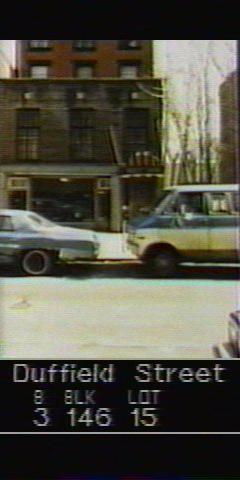
The city photographed every building for its tax records around 1940 and again in the 1980s. NYC Municipal Archives.
Written with AI from the source each entry cites, then fact-checked.
- 1848
A modest brick Greek Revival row house goes up on the old Duffield estate
Caleb H. and Amelia Baldwin acquired the lot at 227 Duffield Street, once part of John Duffield's farm, on September 25, 1848, and sold it in February 1849 to Robert Bonnell, a local mason. The three-story brick house may have been built between 1848 and 1851, while those two owners held it, in a simplified Greek Revival style in a row of brick and wood houses. It was first numbered 141 Duffield Street and had open porches at front and rear.
“The house may have been built 1848-51 during the years that the Baldwins and Bonnell owned it…”
- 1851
Abolitionists Harriet and Thomas Truesdell buy the row house
The Truesdells, who had moved from Providence, Rhode Island, to New York in 1838 and to Brooklyn a year later, bought the house in 1851 and lived there until 1863. Thomas had helped found the Rhode Island State and New England Anti-Slavery Societies, and Harriet co-founded the Providence Ladies' Anti-Slavery Society. Friends of William Lloyd Garrison, they kept supporting his American Anti-Slavery Society from Duffield Street after the 1850 Fugitive Slave Law made such work dangerous.
- 1862
Harriet Truesdell dies at the house aged 76, and Thomas leaves the next year
Harriet Truesdell died at 227 Duffield Street in 1862, aged 76. The 1855 state census had listed the household as Thomas and Harriet, their daughters Abby and Julia, a granddaughter, and a 19-year-old Black servant named Elizabeth Harris. In 1863 Thomas relocated to New Jersey, where he remarried and later died at 85, while the family kept the house until 1921.
- 1933
A luncheonette and store move in, with a two-story addition on the front
After the Truesdell family sold the house in 1921, Louis Abeloff bought it that year and held it until 1948, renting furnished rooms. In 1933 a change of use recorded a luncheonette and a store, and a two-story brick addition was built onto the front. Downtown Brooklyn was growing more commercial, and many row houses were adapted the same way for small shops and restaurants.
“In 1933 a change in use noted a luncheonette and a store at 227 Duffield Street.”
- 1996
Joy Chatel starts researching the house's history and campaigning to save it
Albert and Joy Chatel became owners in 1993; Albert had earlier lived there with his first wife, Vera Jacob. Albert died in 1996, and Joy Chatel, whom many called Mama Joy, then researched the house's history and became a community activist. She argued for preserving it because of its abolitionist ties and its alleged Underground Railroad connection.
- 2007
The city settles a lawsuit and spares the house from eminent domain
In 2004 the city announced it wanted an underground garage on the site of the house, built in 1848. A lawsuit by South Brooklyn Legal Services for owner Joy Chatel ended in a settlement announced in late November 2007, under which the city agreed to redo its plans for the area. Supporters, including politicians and historians, had argued for the house's link to the Underground Railroad and Chatel planned to offer tours on request.
Source: brownstoner.com
- 2021
The Landmarks Commission designates the Truesdell House after a fight over its future
The Landmarks Preservation Commission voted unanimously on February 2, 2021 to landmark the three-story house, citing its long association with abolitionists Harriet and Thomas Truesdell, who lived there from 1851 to 1863. An LPC researcher found no evidence for the local lore of an Underground Railroad stop. The vote halted the owner's 2019 demolition filing, which had planned a 10-story apartment tower and a Black history museum.
Source: brooklynpaper.com
Nearby
- One Willoughby Square1 Willoughby Square | 4 entries
- Offerman Building503 Fulton Street | 9 entries
- AVA DoBro100 Willoughby Street | 1 entry
- City Point Tower III (Brooklyn Point)138 Willoughby Street | 2 entries
- A. I. Namm & Son Department Store1 Hoyt Street | 9 entries
- 388 Bridge Street384 Bridge Street | 2 entries