Antonio Di Giovanni Bakery Building
228 Elizabeth Street | Nolita | built 1910
Open on the map5 entries

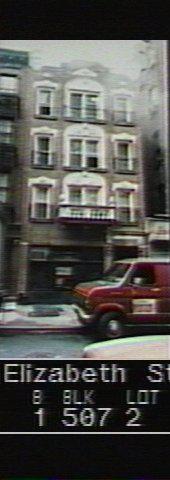
The city photographed every building for its tax records around 1940 and again in the 1980s. NYC Municipal Archives.
Written with AI from the source each entry cites, then fact-checked.
- 1827
A Federal-style house stands here, later with a grocery on the ground floor
As early as 1827 Timothy Kennedy lived in a Federal-style house at what was then 208 Elizabeth Street, later renumbered 228. Within about a decade the ground floor was a grocery run by Michael McDermott, while a carter, Patrick Farrell, lived upstairs with his family. Carters, tailors, a smith and a painter lived in the house over the next decades.
Source: Daytonian in Manhattan
- 1872
The house is raised to four floors and crowded with seventeen mostly Irish families
Around 1872 the front building was raised to four floors, and the grocery was run by John McCabe. Seventeen families were listed at the address, mostly Irish, including four shoemakers, three tailors, a plumber and several laborers. In 1880 Charles W. Voltz bought the building and the shop was turned into a butcher shop run by Verando Luigi, and soon after into a bakery run by Antonio di Giovanni.
Source: Daytonian in Manhattan
- 1900
Antonio di Giovanni leases the whole building, which holds 81 people by the census
On August 1, 1900, baker Antonio di Giovanni leased the entire building, possibly because he knew it was for sale. The next month the law firm Bullowa & Bullowa bought it. The 1900 census recorded 81 people living at the address, 75 of them Italian immigrants.
Source: Daytonian in Manhattan
- 1903
Kurtzer & Rentz give the old tenement a French-inspired facade with balconies
In August 1903 the owners hired the architects Kurtzer & Rentz to remodel the building. The new front had a balustraded balcony with two pineapple finials above the storefront, arched cast-metal window surrounds with palmettes and cherub faces, iron Juliette balconies, and a stepped parapet ending in a sunburst. Architect A. Vendrasco was hired in December 1909 to put a new oven in the bakery.
Source: Daytonian in Manhattan
- 1994
New York magazine profiles Kremer Pigments, a tiny shop of natural artists' pigments in the old bakery space
In the 1990s and early 2000s the former bakery space housed Kremer Pigments, run by German chemist Dr. Georg Kremer. In October 1994 New York magazine called his pigments his obsession and described the cubbyhole shop as brimming with color. He made artists' pigments from natural materials.
Source: Daytonian in Manhattan
Further reading
- The Antonio Di Giovanni Bakery Building - 228 Elizabeth StreetDaytonian in Manhattan
Nearby
- Antonio Di Giovanni Bakery Building228 Elizabeth Street | 6 entries
- Rosanna Dunn House21 Prince Street | 4 entries
- Rosanna Dunn House21 Prince Street | 3 entries
- 247 Elizabeth Street3 entries
- 211 Elizabeth211 Elizabeth Street | 3 entries
- Sunshine Hotel245 Bowery | 10 entries