230 West 10th Street
West Village | built 1905
Open on the map5 entries

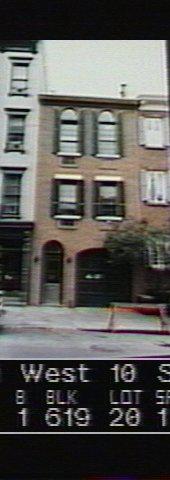
The city photographed every building for its tax records around 1940 and again in the 1980s. NYC Municipal Archives.
Written with AI from the source each entry cites, then fact-checked.
- 1834
John Kohler buys the lot at 124 Amos Street, now 230 West 10th Street, beside Blauvelt's house
In 1834 John C. Blauvelt sold his new house at 126 Amos Street, with the empty lot beside it at number 124, to John Kohler. Daytonian in Manhattan says Kohler then put up a similar brick-faced house on that lot, sharing a rear-yard stable with Blauvelt's, reached by a narrow horse walk. The Landmarks Preservation Commission describes the present No. 230 as a rebuilt stable instead. Amos Street became West 10th Street in 1857, and the lot's number became 230.
Source: Daytonian in Manhattan
- 1855
A burglar with a copied key is caught in builder Abraham Demarest's hallway at 124 Amos Street
By 1852 builder Abraham Demarest, a partner in the firm Onderdonk & Demarest, lived in a house on this lot, then 124 Amos Street. On February 4, 1855, Henry Burns let himself in with a copy of the front-door key and grabbed Demarest's overcoat from the hall tree. A servant, Isaac Parmalee, overpowered him and dragged him to a policeman. Burns tossed the key away on the way to the station, but the officer found it and it fit the lock perfectly.
Source: Daytonian in Manhattan
- 1855
Ninth Ward Republicans meet in Abraham Demarest's parlor
Abraham Demarest was active in ward politics. In October 1853 the Reform Party of the Ninth Ward had nominated him for Assessor, and within two years he had moved to the Republicans. On Monday evening, September 10, 1855, a large meeting of Ninth Ward Republicans took place at his house on this lot, then 124 Amos Street. The New York Times reported great enthusiasm and complete harmony.
Source: Daytonian in Manhattan
- 1987
A machine shop becomes Bob Self's folk-art and home-decor store
A machine works occupied the ground floor by 1922, and in 1932 mechanics were still at work here. By 1987 the shop had become a home-decor store run by Bob Self, a television-commercial producer who also made folk art. The New York Times columnist Elaine Louie quoted him on October 1, 1987, hoping his carved tramp art would be valued as folk art a century on.
Source: Daytonian in Manhattan
- 1996
Music producer Jean Ligel converts the old building at 230 West 10th into a house and private gallery
In 1996 Jean Ligel, a French-born music producer, newspaper publisher and art collector, bought the building for $950,000. Architect Jeffrey Flanigan converted it to a single-family home and private gallery, covering the front with a composition material that imitates brick. The ground floor became a garage and the rear stable was joined to the house.
Source: Daytonian in Manhattan
Further reading
- A Remarkable Re-do - No. 230 West 10th StreetDaytonian in Manhattan
- Then & Now photos: 230 West 10th StreetVillage Preservation: Greenwich Village Then & Now
Nearby
- Blauvelt House232 West 10th Street | 5 entries
- L'Artusi building228 West 10th Street | 4 entries
- Richard Dongan House234 West 10th Street | 4 entries
- 224 West 10th Street4 entries
- McNulty's Tea & Coffee building107 Christopher Street | 3 entries
- 111 Christopher Street2 entries