Blauvelt House
232 West 10th Street | West Village | built 1832
Open on the map5 entries

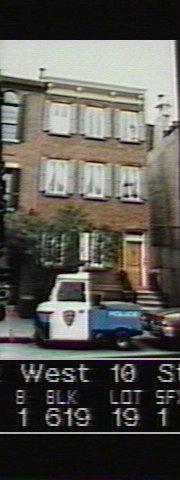
The city photographed every building for its tax records around 1940 and again in the 1980s. NYC Municipal Archives.
Written with AI from the source each entry cites, then fact-checked.
- 1833
Cartman John C. Blauvelt builds a Federal brick house at 232 West 10th Street
In 1833 John C. Blauvelt, a cartman who also applied to be a city wood inspector, built this modest brick house, two and a half stories above an English basement. A year later he sold it, with the empty lot next door, to John Kohler. A third story and an Italianate bracketed cornice were added around the end of the Civil War.
Source: Daytonian in Manhattan
- 1898
William G. Warren, who lived here in 1889, dies after diving into a drained pool at the Lafayette Place Baths
William G. Warren lived at 232 West 10th Street in 1889, when he was indicted for manslaughter after a fatal fight on Bleecker Street; the judge discharged him as having acted in self-defense. On February 27, 1898, at age 30, he dived headfirst into the plunge at the Lafayette Place Baths, not knowing the water had been drained to about a foot. He suffered a compound skull fracture and died in the hospital three hours later.
Source: Daytonian in Manhattan
- 1912
A basement tenant's terrier mauls Mary Peddie and a seamen's priest tosses it aside
On April 1, 1912, landlady Mary Peddie went into her tenant's basement to feed two dogs and was attacked by Tom, an Irish terrier. A boy ran for help to Father Philip J. Magrath, who headed St. Peter's Union for Catholic Seamen and was nicknamed the Fighting Priest along the waterfront. He grabbed the dog by its hind legs and threw it into the next room while a policeman closed the door. The Sun predicted Peddie would be disfigured for life.
Source: Daytonian in Manhattan
- 1913
The Home of the Sons and Daughters of Israel opens an aged people's home in the house
By 1913 the house was occupied by the Home of the Sons and Daughters of Israel, an organization founded four years earlier to maintain a home for aged Jewish men and women, capped at 70 residents. It stayed for decades, and by 1931 it used part of the former stable next door and housed far more people. The home moved to newer quarters uptown by the middle of the century, and in 1951 the house was converted to two apartments.
Source: Daytonian in Manhattan
- 1931
Residents of the Home of the Sons and Daughters of Israel take their annual outing with their own orchestra
On July 28, 1931, about 150 residents of the home on West 10th Street spent the day at Edgemere, Long Island. The New York Times described an orchestra among the residents, led by 85-year-old violinist Hyman Brucker. Members included an 80-year-old drummer, a ukulele player aged 85, and two men aged 92, one a violinist and the other a singer.
Source: Daytonian in Manhattan
Further reading
- The 1833 Blauvelt House -- No. 232 W. 10th St.Daytonian in Manhattan
- Then & Now photos: 232 West 10th StreetVillage Preservation: Greenwich Village Then & Now
Nearby
- 230 West 10th Street5 entries
- Richard Dongan House234 West 10th Street | 4 entries
- L'Artusi building228 West 10th Street | 4 entries
- 224 West 10th Street4 entries
- McNulty's Tea & Coffee building107 Christopher Street | 3 entries
- 111 Christopher Street2 entries