Former New York Herald Tribune Building
230 West 41st Street | also 219 West 40th Street | Times Square | built 1923
Open on the map8 entries

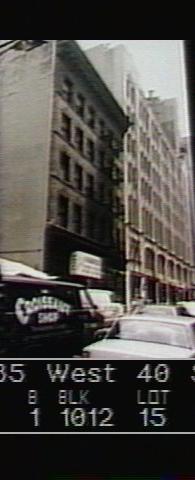
The city photographed every building for its tax records around 1940 and again in the 1980s. NYC Municipal Archives.
Written with AI from the source each entry cites, then fact-checked.
- 1924
The Tribune buys the Herald for $5 million and merges the two papers in its new West 40th Street plant
The Reid family's Tribune borrowed money in the 1920s to put up a plant on 40th Street between Seventh and Eighth Avenues, then spent $5 million in 1924 to buy the rival New York Herald from Frank Munsey. The Herald's name, the young reporter Stanley Walker (soon city editor) and most of its readers moved into the new building. The Herald had 175,000 readers and the Tribune 140,000 before the merger, and the combined Herald Tribune passed 275,000.
Source: americanheritage.com
- 1924
The Herald Tribune runs bulletins about a floating Prohibition nightclub that exists only in a reporter's imagination
The Herald Tribune story newspapermen recalled most often was one from 1924 that proved false. For five days the paper headlined reports by Sanford Jarrell about the comings and goings, bookings and clientele of a mysterious floating nightclub that had Prohibition-era New York buzzing. The club existed only in his imagination, and the paper finally admitted it had been hoaxed.
Source: americanheritage.com
- 1960
The Herald Tribune goes to press early and calls the presidential race for Kennedy by a landslide
In 1960, the Herald Tribune rushed to press and declared a Kennedy victory of Rooseveltian proportions. The returns turned out to be extremely close, as the Times reported accurately, and the mistake embarrassed publisher John Hay Whitney, who had bought the paper two years earlier. He came back from London, and editor Robert M. White, whose departure the election coverage made certain, went back to Mexico, Missouri.
Source: americanheritage.com
- 1961
Editor John Denson turns the Bay of Pigs coverage into a string of question-mark headlines
John Denson, hired away from Newsweek, had been editor for a month when the Bay of Pigs crisis broke in March 1961. His headlines for the story became questions, asking whether Castro's dictatorship was near its end, how the Soviets would oppose the United States over Cuba, whether the anti-Castro raiders were in trouble and who would take the blame. Staff grew fond of obscure, cryptogram-like headlines, and readers found that the stories beneath often failed to deliver.
Source: americanheritage.com
- 1964
The Herald Tribune shuts down for a week to honor its pledge to the struck New York Times
In September 1964 the Herald Tribune stopped publishing again, after a 114-day shutdown in 1962 and 1963, to honor a gentleman's agreement with the struck Times. Publisher John Hay Whitney held to the pledge to his fellow publishers for a week before reopening, too late to save the paper, because merger talks were already well under way. American Heritage names the paper's long conflict with the printers' union and the other newspaper unions as the main cause of its suspension.
Source: americanheritage.com
- 1966
Rewrite man Inky Blackman files the last story from the fifth floor as the Herald Tribune goes dark
At ten on Saturday evening, April 23, 1966, rewrite man M. C. (Inky) Blackman finished a news story, said good night and left the fifth floor of 230 West 41st Street. It was the last story of the New York Herald Tribune, which had run 43,483 daily issues over 125 years, and fittingly it was an obituary. The paper never resumed and was pronounced dead on August 15, 114 days later; publisher John Hay Whitney had lost an estimated $20 million on it in eight years.
Source: americanheritage.com
- 2004
The City University's Research Foundation buys the old Herald Tribune building for $60 million
CUNY's Research Foundation purchased the 20-story building, put up in 1923, in July 2004 for $60 million, as reported by the New York Times. The purchase was made in anticipation of opening a graduate journalism school there in 2006, in what had been the home of the New York Herald Tribune.
Source: commercialobserver.com
- 2006
The CUNY journalism school opens and hosts a reunion of about 100 former Herald Tribune journalists
The CUNY Graduate School of Journalism admitted its first class, 57 students, in the fall of 2006, in the former Herald Tribune headquarters. That year it also hosted a reunion of about 100 former Herald Tribune journalists, marking 40 years since the paper closed in 1966. The building holds a 130-seat newsroom and a broadcast studio; the students' TV news magazine is named 219West after the address.
“In 2006, the school hosted a reunion of about 100 former New York Herald Tribune journalists to commemorate the 40th anniversary…”
Source: Wikipedia
Further reading
Nearby
- Nederlander Theatre208 West 41st Street | 15 entries
- The New York Times Building620 8th Avenue | 15 entries
- Times Square–42nd Street subway station234 West 42nd Street | 7 entries
- Candler Building221 West 41st Street | 8 entries
- New Amsterdam Theatre214 West 42nd Street | 14 entries
- 5 Times Square210 West 42nd Street | 8 entries